Quartz stone production capacity is often presented as a simple figure: slabs per hour, square metres per day, or annual output. For anyone planning a new quartz slab factory, however, those numbers only become useful when you understand how they are calculated.
A production line may have a high theoretical pressing rate but still produce much less finished material if mixing, curing, polishing, handling, maintenance, or product changeovers create bottlenecks. Slab dimensions, operating shifts, product design, automation, and finished-product yield also influence the real output of the factory.
This guide explains how quartz slab production capacity is measured, what limits output, and how to select a line size that matches actual business requirements.
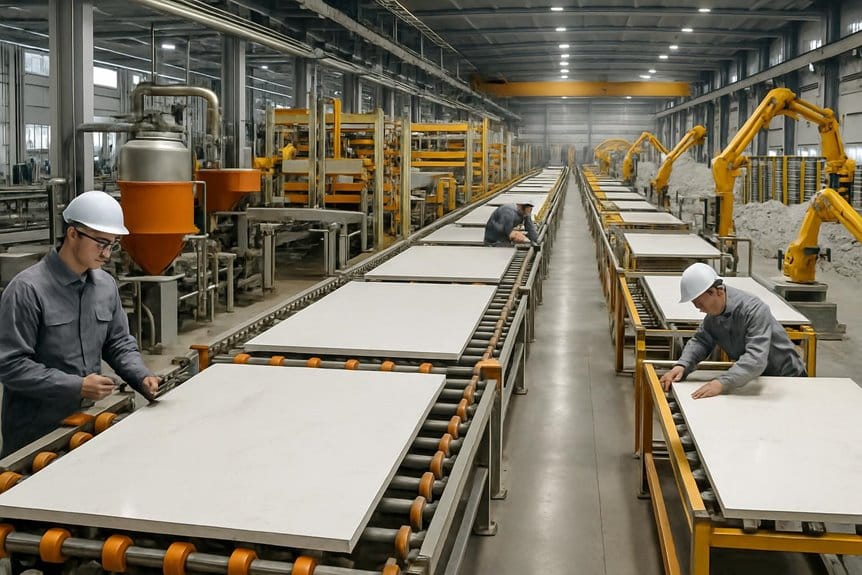
Different suppliers and manufacturers describe production capacity in different ways. Before comparing production lines, make sure the figures refer to the same measurement.
| Capacity Measure | What It Tells You |
|---|---|
| Slabs per hour | Short-term production rate |
| Slabs per day | Potential daily slab output |
| m² per day | Daily surface-area output |
| m² per year | Annual production potential |
| Saleable m² per year | Finished output after downtime and quality losses |
Slabs per hour is useful for evaluating individual production stages, but square metres are generally more useful for comparing factories producing different slab sizes.
Annual production capacity is important for business planning, but it depends heavily on assumptions about operating hours, working days, maintenance, utilization, and yield.
This is why a quoted annual figure should never be considered in isolation.
A useful distinction is:
For investment planning, saleable capacity is normally the most commercially meaningful figure.
Quartz slab production capacity is first calculated from press cycle time, slabs per hour, operating hours, and standard slab dimensions.
This hourly output is then converted into square metres per day to reflect usable production volume across shifts.
The final figure must be adjusted from theoretical output to saleable output by accounting for curing losses, calibration waste, defects, trimming, and downtime.
A practical capacity estimate starts by converting line speed into usable surface area: daily capacity = slabs per hour × slab area × operating hours. This formula gives management a controlled baseline for quartz slab production line capacity and supports direct planning of quartz slab output per day.
Square metres per day is usually more useful than slabs per day because slab formats differ. A line producing 80 standard slabs may deliver far less surface area than a line producing 80 jumbo slabs. Consequently, quartz slab factory capacity should be expressed in m²/day when comparing equipment, shifts, resin demand, storage, and downstream cutting load.
For calculation, each slab’s length and width are multiplied to obtain slab area, then multiplied by hourly slab count and scheduled operating hours.
Convert the nameplate figure into a planning figure by applying two correction factors: saleable output = theoretical capacity × utilization rate × finished-product yield.
Utilization is the percentage of scheduled production time during which the line is actually producing, excluding planned stops, changeovers, cleaning, curing delays, maintenance, and unplanned interruptions.
Finished-product yield is the percentage of slabs that pass saleable quality requirements after calibration, polishing, inspection, and packing.
For example, a line rated at 1,000 m²/day, running at 85% utilization with 92% yield, delivers 782 m²/day of saleable output.
This conversion makes quartz stone production capacity controllable rather than nominal.
It also gives management a realistic basis for quartz stone production line capacity planning, engineered quartz production capacity targets, staffing, resin supply, packaging, and shipment commitments.
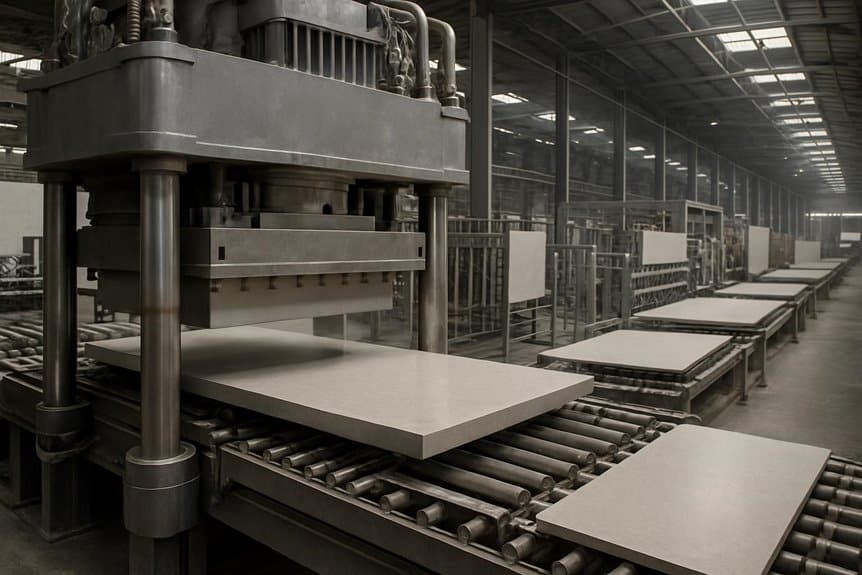
Why does press cycle time often receive too much attention in quartz stone capacity planning? Because the press is the core forming machine and its cycle is easy to measure.
However, quartz stone plant capacity is not determined by one machine. It is determined by the slowest controlled stage in the full production chain.
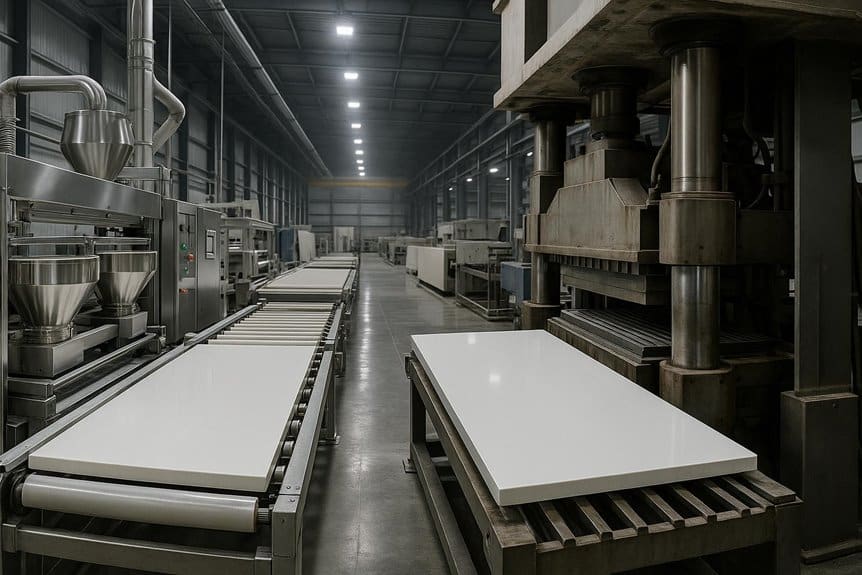
A practical line must be read as a sequence: Batching → Mixing → Distribution → Pressing → Curing → Calibration → Polishing → Cutting/Handling.
Each stage must release slabs at a compatible rate. If the press can form 15 slabs per hour, but curing or polishing can process only 12 slabs per hour, the usable line capacity is closer to 12 slabs per hour.
To understand how these stages work together from raw material preparation through pressing, curing, polishing, and final inspection, see our quartz slab manufacturing process guide.
Capacity control consequently requires balancing the complete line, not optimizing the press alone.
Each production stage has its own capacity constraints.
| Production Stage | Typical Capacity Constraint |
|---|---|
| Raw material batching | Feeding and weighing cycle |
| Mixing | Mixer volume, mixing time and number of mixers |
| Material distribution | Distribution cycle and design complexity |
| Pressing | Press cycle and slab transfer |
| Curing | Oven capacity and curing duration |
| Cooling | Transfer speed and intermediate buffer space |
| Calibration | Processing speed and material removal |
| Polishing | Line speed, polishing heads and finish requirements |
| Handling | Manual or automatic slab movement |
The objective is not necessarily to maximize every individual machine.
It is to balance the production stages.
If the press, curing oven and polishing line all have very different throughput levels, increasing the speed of one component may have little effect on total factory output.
A well-configured production line therefore considers the capacity relationship between machines before equipment is selected.
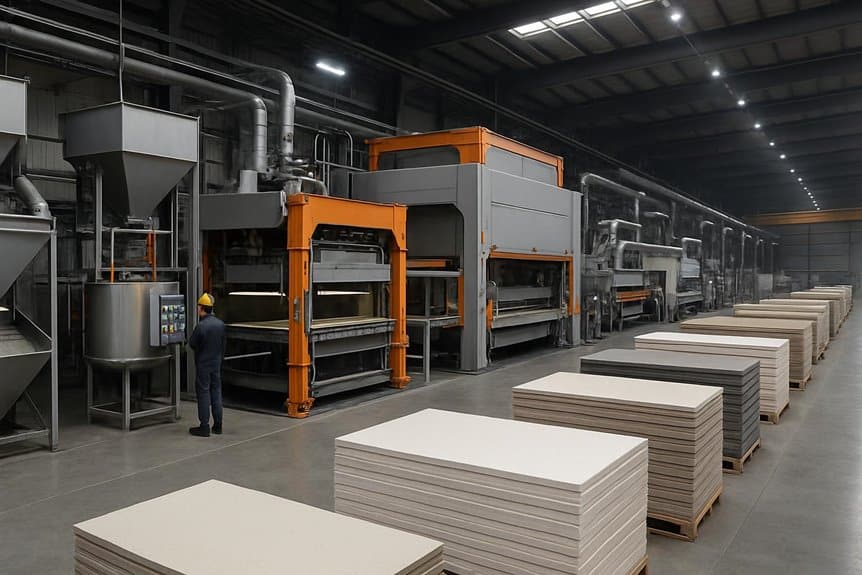
Even when two factories use similar equipment, their practical quartz stone production capacity may be very different.
Several operating variables explain why.
Standard slabs and jumbo slabs have different material volumes, handling requirements and finishing loads.
Thicker slabs require more material and may change processing requirements at several stages.
A supplier therefore needs to know the intended slab dimensions before giving a meaningful capacity figure.
Production speed is also affected by what the factory makes.
Simple products with stable formulas may be easier to run continuously.
More complex marble-look patterns, multiple colors or products requiring additional material distribution steps can increase preparation and changeover time.
A factory producing a small number of high-volume designs may therefore achieve different utilization from a factory producing many small batches.
The same machinery can produce dramatically different annual output depending on whether the plant operates:
When evaluating an annual capacity figure, always ask how many production hours per day and working days per year are assumed.
Switching colors or formulations can require cleaning mixers, conveyors and distribution equipment.
More frequent changes mean more non-producing time.
Factories producing many customized designs need to consider this when estimating realistic output.
Preventive maintenance reduces unexpected breakdowns, but it still requires scheduled production stops.
A realistic capacity model should include maintenance instead of assuming the line operates continuously throughout the year.
For quartz stone production planning, capacity should be separated into three levels: theoretical capacity, practical production capacity, and saleable production capacity.
Theoretical capacity is the maximum calculated output under ideal operating conditions, usually close to nameplate machine speed. It assumes continuous feeding, stable curing, no operator delay, no material variation, and no stoppage.
Practical production capacity is lower. It reflects normal factory conditions: mold changeovers, color changes, cleaning cycles, calibration adjustment, equipment inspection, resin handling, shift handover, and scheduled maintenance. This figure is more useful for daily production control.
Saleable production capacity is lower again because cracked, warped, contaminated, off-color, or dimensionally incorrect slabs must be removed.
Investors and factory planners should base forecasts near saleable output, not theoretical speed, to avoid overstating revenue, storage needs, and cost efficiency.

After separating nameplate, practical, and saleable capacity, the next planning question is how much output the factory actually needs to install. The decision should begin with sales demand, not machine size.
A planner should estimate expected annual slab sales, required finished-product inventory, yield after defects and trimming, realistic utilization, available production days, and future growth assumptions.
From these inputs, the required line capacity can be worked backward. If the market can initially absorb 200,000 m² per year, a substantially larger line should only be selected when supported by confirmed growth channels, export access, or phased sales expansion.
Size the line from proven demand, not optimistic capacity claims or oversized equipment assumptions.
This approach keeps capacity tied to commercial reality. It also gives management a controlled basis for equipment selection, staffing, storage planning, and raw-material supply commitments without locking the factory into unnecessary output.
Compare both sides before fixing the installed capacity, because under-capacity and over-capacity create different but equally costly operating problems.
If capacity is too low, the plant cannot meet confirmed orders, delivery times stretch, overtime becomes routine, and sales growth is capped. Management may then face an early expansion cycle, often before cash flow has stabilized.
If capacity is too high, presses, curing systems, and finishing assets sit idle. Capital is tied up without output, fixed costs spread over too few slabs, and larger buildings, utilities, and working capital may be required.
The decision should thus target controlled headroom: enough spare capability to absorb demand growth, maintenance downtime, and product mix variation, but not so much that unused capacity weakens unit cost discipline.
This balance protects margin and delivery reliability.
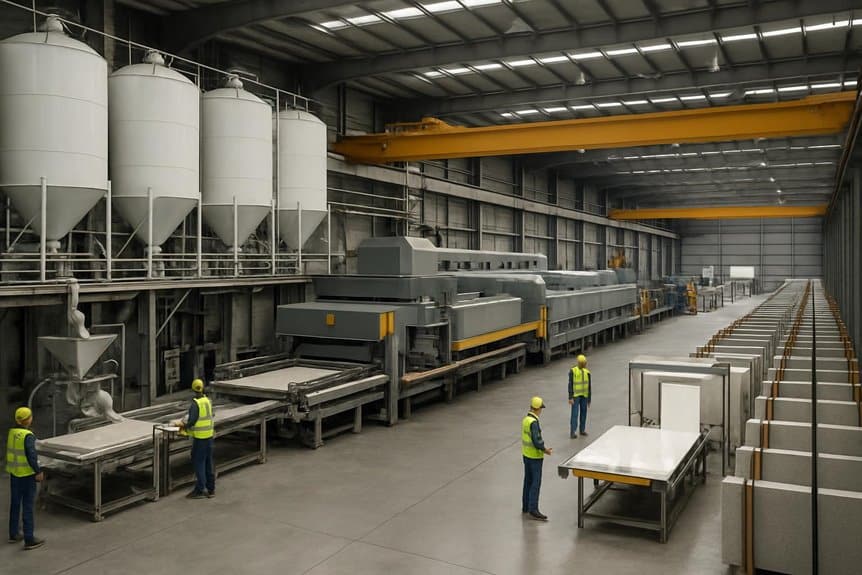
Although the press often defines nominal quartz stone production capacity, actual factory output depends on every upstream and downstream process staying balanced.
Capacity planning should verify raw material storage, mixer number or size, curing capacity, cooling buffers, polishing throughput, wastewater treatment, finished slab storage, handling capacity, inspection stations, packaging, and dispatch flow.
A plant may have enough pressing capacity yet miss daily targets because slabs queue after curing, polishing becomes the bottleneck, forklifts cannot move material fast enough, or finished goods occupy blocked aisles.
Each section requires a rated throughput, buffer volume, staffing plan, and downtime allowance matched to the line rhythm.
Practical capacity control, consequently, starts with a whole-factory flow model, not an equipment list.
There are two common approaches.
This can make sense when:
The advantage is that the factory does not need major expansion shortly after startup.
The disadvantage is the larger initial capital requirement and the risk of unused capacity if sales develop more slowly than expected.
Another approach is to build around current demand while designing the factory so capacity can be increased later.
Expansion may involve:
The key is to plan the expansion route before the first production line is installed.
If the original layout, utilities and control systems are designed without future growth in mind, expanding later may require expensive factory modifications.
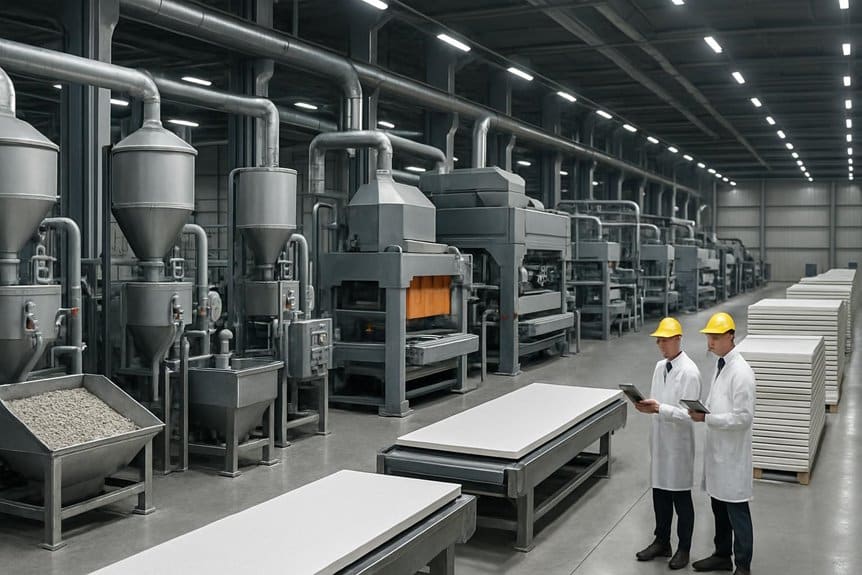
“1,500 m²/day” may sound precise, but it tells you very little unless you understand the calculation behind it.
When comparing suppliers, ask the same capacity questions for every proposal:
This allows different production line proposals to be compared on the same basis.
Without these assumptions, two apparently similar capacity figures may represent very different factories.
Automation also influences practical output, although more automation does not automatically mean the right solution for every project.
Manual handling between production stages can create delays even when the machines themselves have sufficient capacity.
A more integrated automatic production line may reduce waiting time between batching, mixing, pressing, curing and finishing, particularly at higher production volumes.
At lower volumes, however, a semi-automatic configuration may still achieve the required output while reducing initial investment.
The objective is therefore to select the automation level needed to reliably achieve the capacity target.
For a more detailed comparison, see Automatic vs Semi-Automatic Quartz Stone Production Lines.
Capacity is one of the first technical decisions that should be confirmed when planning a quartz slab plant.
It directly influences:
If you are comparing different capacity options, our quartz stone production line cost guide explains how line configuration, automation, slab size, installation, and auxiliary systems affect the overall project budget.
Changing the required capacity after the production line and factory layout have already been finalized can require major redesign.
This is why capacity planning should take place before the buyer approves the final equipment proposal.
SINONE's own feasibility and project materials use different daily and annual production targets for different proposed configurations, reinforcing that quartz stone production capacity should be calculated around the individual project rather than treated as one universal figure.
A reliable capacity plan should balance the entire production system rather than maximize one machine.
Sinone can evaluate a quartz slab production project based on target slab dimensions, thickness range, product designs, expected annual demand, working shifts, automation requirements, factory conditions and future expansion plans.
From there, the batching, mixing, distribution, pressing, curing, calibration, polishing and material-handling systems can be configured around the required production target.
If you are planning a new quartz slab factory or expanding an existing line, send us your target slab specifications, expected annual sales volume, working hours and factory information. Our team can help evaluate a suitable quartz stone production capacity and production line configuration.
Required permits typically include business registration, land-use approval, construction permits, environmental impact clearance, air-emission and wastewater permits, fire-safety approval, occupational health compliance, chemical storage authorization, machinery inspection, and product quality certifications before commissioning operations.
Like switching dust for clear air, zero-silica technology changes raw material selection, mixing behavior, curing parameters, tooling wear, ventilation needs, compliance documentation, and product testing; planners must validate recipes, suppliers, throughput, and worker controls.
Best suppliers provide controlled quartz purity, consistent gradation, low impurities, resin compatibility, and audit transparency. Preferred options include established high-purity quartz producers, reliable regional aggregate processors, certified resin suppliers, and pigment vendors with stable batch traceability.
Markets demand proof, not promises: quartz slab exporters typically need ISO 9001, CE/UKCA, NSF/ANSI 51, GREENGUARD, SGS/Intertek test reports, REACH/RoHS compliance, silica safety documentation, fire ratings, and destination-specific labeling, customs, and traceability records.
A quartz stone factory typically needs 10,000–50,000 m², depending on capacity, storage, curing, polishing, utilities, and expansion. Planners should allocate controlled zones for raw materials, production flow, finished slabs, wastewater treatment, and logistics.
Quartz stone production capacity looks simple on a press specification, yet becomes complex across batching, curing, calibration, polishing, inspection, and packing. A fast cycle can stand beside a slow bottleneck; a large design capacity can contrast with unstable daily output. Practical sizing consequently measures the whole process, not a single machine. By matching proven demand with realistic expansion paths, manufacturers can build a balanced quartz slab production line that protects delivery reliability, cost control, and long-term competitiveness.