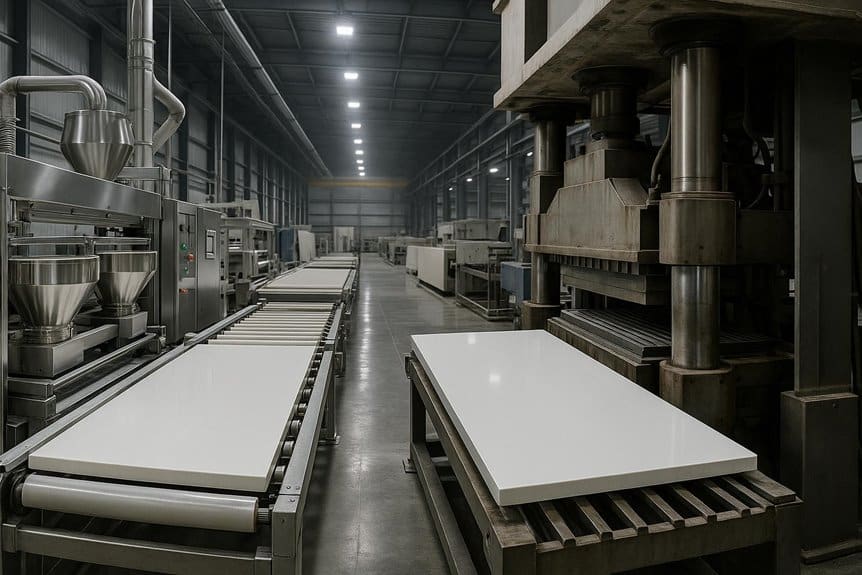
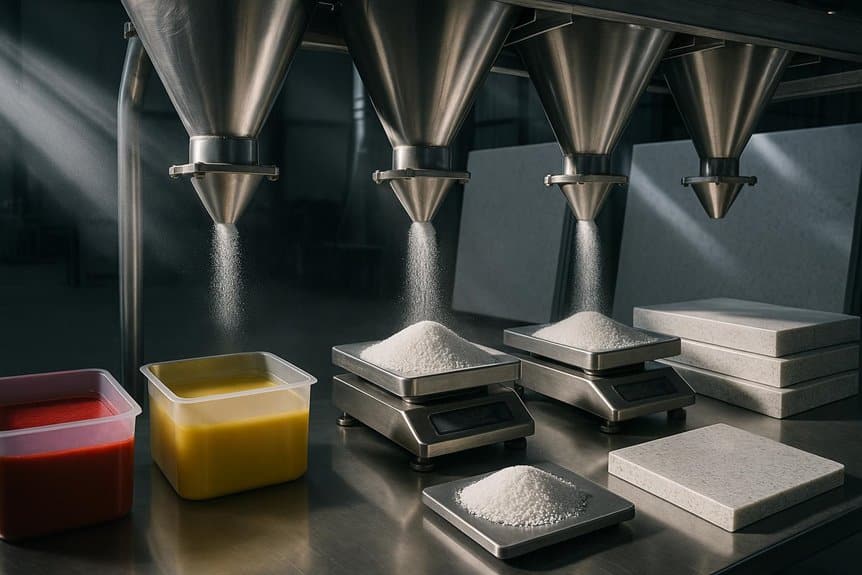
A quartz stone batching system controls the storage, conveying, weighing, dosing, and recipe execution of quartz sand, quartz powder, resin, pigments, and additives before these materials enter the mixing stage. As the upstream material-control stage of a quartz stone production line, the batching system supplies accurately measured raw materials to the mixing and forming processes.
Accurate batching is essential because even small deviations in raw material proportions can affect mixture consistency, pigment distribution, resin bonding, curing behavior, and ultimately slab density, color consistency, and surface quality.
Compared with manual handling, automatic batching improves recipe repeatability, reduces weighing variation, and makes production data easier to trace and control. This article explains how batching accuracy influences downstream processing and why a stable raw material dosing system is critical to consistent quartz slab production.

A quartz stone batching system is an automated upstream material-preparation system that stores, conveys, weighs, and doses the raw materials required for each quartz slab recipe before they enter the mixing stage.
The system can manage quartz sand or aggregate, quartz powder, resin, pigments, curing agents, coupling agents, and other selected additives according to controlled recipe parameters. Within the broader quartz slab manufacturing process, its role sits between raw material storage and mixing:
Raw material storage → weighing and dosing → batching → mixing
This stage is critical for manufacturers that need consistent production, because accurate raw material dosing helps control formulation accuracy, material consumption, and batch-to-batch repeatability.
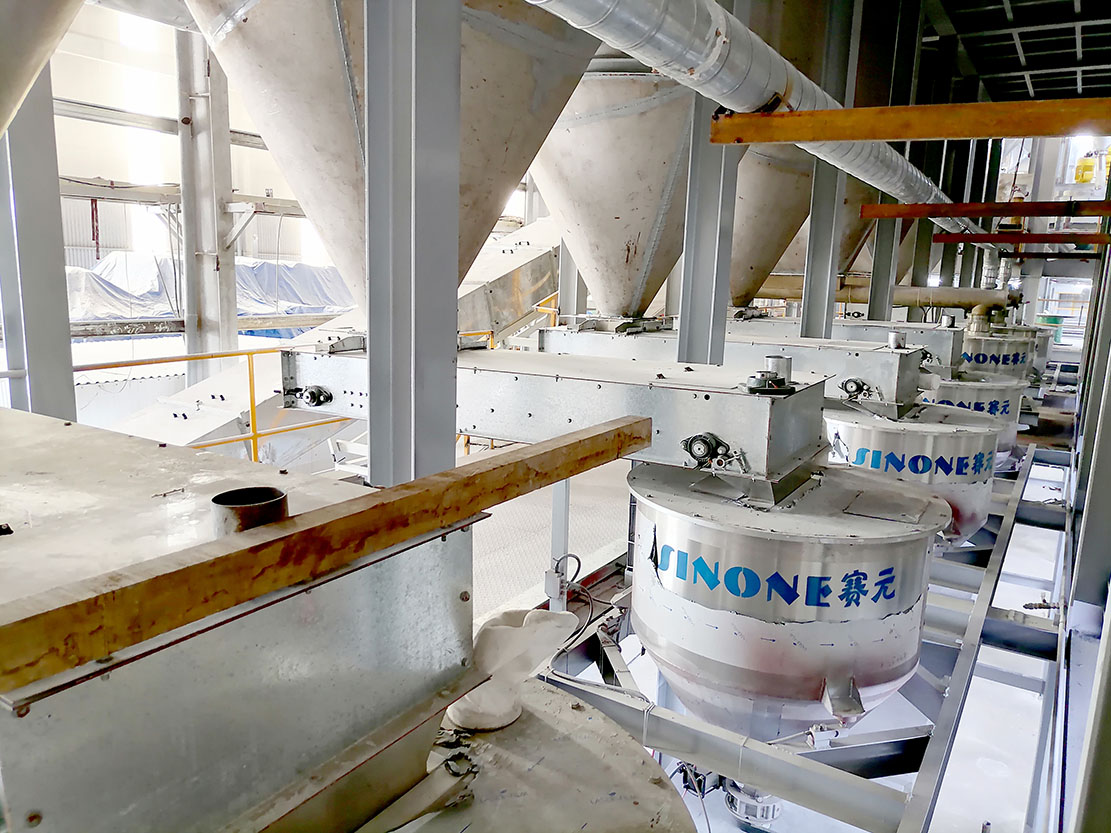
Sinone’s raw-material system integrates storage, conveying, weighing, and automatic recipe control into one coordinated unit. By reducing manual handling and improving dosing consistency, it provides a more stable material foundation for the downstream mixing and slab-forming stages.
A quartz stone batching system operates through controlled raw material storage, automatic conveying, and calibrated weighing and dosing.
Recipe control software calculates material ratios and verifies batch accuracy against preset production parameters.
Once dosing is complete, the measured materials are transferred to the mixing stage for uniform processing.
Raw material storage is the first control point in a quartz stone batching system. Quartz aggregates, powders, resins, pigments, and additives are stored separately in designated silos, tanks, or sealed containers according to material type and particle grade.
This separation helps prevent cross-contamination and ensures that the correct material is supplied to the weighing and dosing system. For quartz aggregates in particular, different particle-size grades should remain clearly separated so that the programmed recipe can be reproduced consistently from batch to batch.
| Material Group | Typical Storage Unit | Main Control Purpose |
|---|---|---|
| Quartz aggregates | Silo or container | Keep different particle grades separate |
| Quartz powder and pigments | Sealed container | Reduce contamination and moisture exposure |
| Resin and liquid additives | Tank or dedicated container | Maintain material identity and controlled feeding |
A well-organized storage system also improves traceability. Each storage position can be linked to a defined raw material in the control system, allowing operators to confirm the correct source before weighing and dosing begins.
Stable raw material storage does not determine slab quality by itself, but it provides the foundation for accurate batching. Poor material separation or incorrect feeding can introduce recipe variation that later appears as differences in color, texture, density, or processing consistency.
Once material identities are fixed in storage, automatic conveying moves quartz sand, powder, pigments, and related inputs from silos, tanks, or containers to the weighing system through controlled mechanical or pneumatic routes.
In an automatic quartz batching system, conveyors, screw feeders, bucket elevators, or pneumatic pipelines reduce manual transfer variance and isolate each material stream. Routing logic can assign dedicated paths, interlocked valves, and sequence controls to prevent cross-contamination before the quartz stone automatic weighing system receives material.
Conveying capacity, line speed, dust control, and discharge stability determine whether downstream measurement starts from a consistent feed condition. Sensors may confirm bin level, material flow, gate position, and equipment status, giving operators traceable control over movement.
Reliable conveying consequently supports accuracy by delivering identified materials predictably, without deciding final batch quantities.
Weighing and dosing quantify each material according to the selected production recipe, converting stored and conveyed inputs into controlled batch proportions. In a quartz slab raw material dosing system, quartz aggregates, powders, resin, pigments, and additives are measured before mixing, reducing variation at the source.
Load cells, metering devices, and controlled discharge mechanisms support repeatable mass control across batches. The process directly influences quartz batching accuracy because even small deviations can shift viscosity, color distribution, filler density, and compaction behavior.
Accurate dosing helps maintain predictable slab strength, surface consistency, and dimensional stability after forming and curing. For operators, the value lies in measurable control: target weight, actual weight, tolerance range, and deviation records.
This stage converts material flow into verified batch data, enabling stable downstream processing.
Recipe control translates the selected slab formulation into executable batching parameters through the PLC/control system, which determines the required quantity for each component. In a quartz slab batching system, this function converts target ratios into controlled setpoints, reducing operator discretion and improving repeatability across production runs.
For quartz production batching equipment, recipe control defines the numerical basis of accuracy before downstream processes begin. Each formulation becomes a controlled dataset rather than an operator-dependent instruction, allowing management to standardize output, compare batch performance, and maintain tighter quality control.
Transfers begin only after the batch satisfies the programmed recipe parameters, at which point the measured quartz, resin, pigment, and additive components are discharged toward the mixing system through controlled conveying or feeding equipment.
In a quartz stone batching plant, this stage protects the verified mass balance achieved during weighing and dosing. The sequence follows a defined path: storage → conveying → weighing → dosing → recipe verification → mixing.
Transfer timing, discharge order, and feed rate influence material distribution before agitation begins. Controlled delivery reduces segregation, resin concentration variation, and pigment streaking risk.
For process managers, the key control point is preventing unverified or incomplete batches from entering the mixer. Accurate transfer guarantees the mixer receives a consistent input load, supporting repeatable slab density, color stability, and curing performance downstream.
Batching accuracy determines whether each quartz slab batch begins with the correct and repeatable raw material proportions. Variations in aggregate grading, resin dosage, pigment quantity, or additive dosing can affect how the mix behaves during forming and how the finished slab performs after curing.
For this reason, controlled batching is a key process variable for maintaining consistent density, color, curing behavior, surface quality, and overall production repeatability. Accurate dosing also reduces the need for downstream correction, where defects are typically more expensive to identify and resolve.
Quartz slabs depend on a controlled balance of coarse, medium, and fine particles. Each aggregate fraction should be dosed within defined tolerances so the mixture can compact consistently and produce a stable slab structure.
In practice, accurate aggregate dosing helps convert raw material variation into a controlled production parameter rather than leaving it to manual adjustment later in the process.
Resin dosage is one of the most sensitive variables in quartz slab production because it influences workability, bonding, forming behavior, curing, and material cost.
If resin is under-dosed, the aggregate may not be coated or bonded uniformly, which can reduce cohesion during mixing, distribution, vibration, and pressing. This may contribute to inconsistent compaction and weaker internal bonding after curing.
If resin is over-dosed, the mixture may become too fluid or sticky, which can affect material distribution, forming stability, curing behavior, and raw material efficiency.
Accurate batching helps keep the resin dosage within the required process window, improving batch repeatability and reducing the need for operator correction.
Pigments are usually dosed in relatively small quantities, which means even minor weighing errors can create visible color differences between batches.
This is especially important for:
Controlled pigment dosing helps reduce shade variation, improve repeatability between production runs, and strengthen traceability by recording actual pigment weights against recipe targets.
For manufacturers producing consistent colors at scale, pigment accuracy turns color control from a visual adjustment into a measurable production parameter.
Additives such as curing agents, coupling agents, resin modifiers, and other auxiliary chemicals may represent only a small proportion of the formula, but their effect on processing can be significant.
Over-dosing may shorten working time or alter curing behavior, while under-dosing may contribute to incomplete curing, weaker bonding, or inconsistent downstream performance.
Accurate additive dosing therefore supports more predictable mixing, pressing, curing, calibration, and finishing conditions. It also helps reduce slab-to-slab variation and limits defects that may only become visible after later production stages.
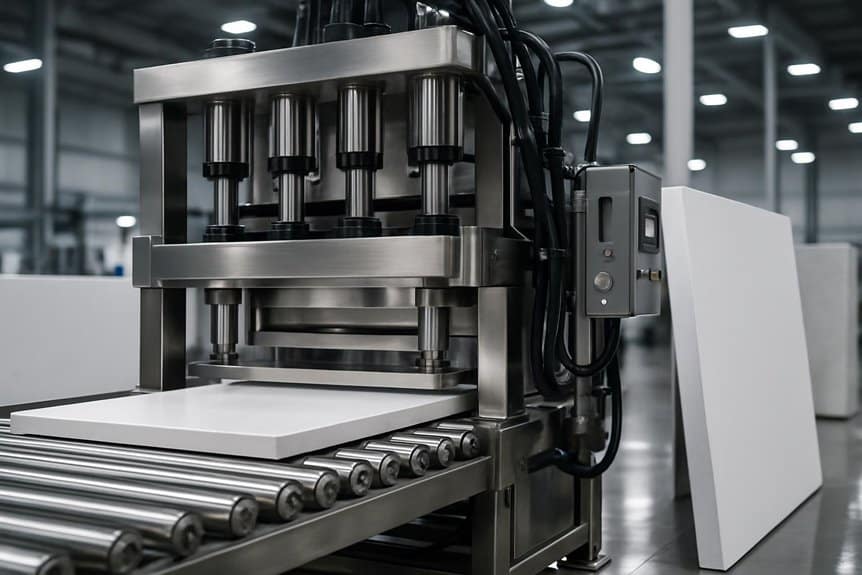
Accurate batching does not only improve recipe consistency at the material-preparation stage. It also creates a more stable mixture for the quartz stone press machine, where vacuum, vibration, and compression compact the material into slab form before curing.
Evaluating batching errors requires linking each deviation to its potential impact on downstream slab formation, rather than treating every error as an automatic defect. Each tolerance breach becomes a risk variable that may amplify or be corrected during mixing, distribution, pressing, curing, and finishing.
For controlled production, these indicators should be logged against batch records and final inspection data, allowing operators to identify recurring correlations before defects become systematic across shifts.
When comparing manual and automatic quartz stone batching, the main distinction is not simply equipment cost but the level of control required over weighing accuracy, recipe repeatability, labor input, and production traceability.
Manual or semi-manual batching relies more heavily on operator judgment during weighing, material transfer, and recipe adjustment. This can increase variability, slow throughput, and raise exposure to human error, especially when multiple slab designs or formulations are produced.
By contrast, an automatic batching system uses controlled weighing, recipe-based dosing, and digital records to improve consistency from one batch to the next. It can reduce manual handling, support faster recipe changes, and make production data easier to review as part of an automatic quartz stone production line.
However, automation is not universally required. The suitable level depends on output volume, product complexity, tolerance targets, and the factory’s need for repeatable quality control. Manufacturers should therefore choose the batching method according to their actual production requirements rather than assuming that the highest level of automation is always necessary.

Once the required level of automation has been determined, the next step is to compare batching systems against the actual production requirements of the factory. The most important factors are weighing accuracy, storage capacity, material compatibility, conveying stability, recipe control, dust management, and coordination with the mixing system.
Weighing accuracy should match the sensitivity of the slab formulation. Small deviations in quartz aggregate, powder, resin, pigments, or additives can affect batch consistency and downstream processing.
For one automatic batching configuration, Sinone specifies a weighing accuracy of approximately ±0.5%.
Storage capacity should be sized according to:
The goal is to avoid both unnecessary oversizing and frequent material shortages that interrupt production. For factories requiring larger or more stable raw material storage, the raw material storage tank should be sized to match the batching system and expected production demand.
The batching system should be able to handle the full range of materials used in the factory, including:
Different materials may require different storage, conveying, and dosing methods.
The conveying system should transfer materials consistently while minimizing segregation, leakage, contamination, and material loss.
This is particularly important when different aggregate sizes or colors are used, because uncontrolled transfer can change the actual composition of the batch before it reaches the mixer.
For factories producing multiple colors or slab designs, recipe control becomes increasingly important.
A suitable system should support functions such as:
This helps reduce operator-dependent variation between production batches.
Quartz powder and fine aggregate handling can generate significant dust, so the batching area should include effective enclosure and dust-collection measures at transfer and discharge points.
Dust control helps improve the working environment, reduce material loss, and prevent contamination between different raw materials.
The batching system should not be evaluated as an isolated piece of equipment. Its output must match the capacity and operating cycle of the mixer.
If batching is too slow, the mixer may wait for material. If material is delivered too quickly or in the wrong sequence, mixing consistency can be affected.
For this reason, batching capacity, discharge timing, and material sequence should be designed together with the mixing tank rather than specified independently. The batching system should feed the mixer at the required rate and in the correct sequence to support stable, repeatable mixing
Choosing the right batching system starts with the actual production recipe and target slab output, not simply with silo size or theoretical throughput. The system should be sized according to the number and type of raw materials, required weighing accuracy, resin and additive dosing points, production capacity, automation level, available floor space, dust-control requirements, and the feeding needs of the mixer.
| Decision Variable | Why It Matters |
|---|---|
| Recipe count and raw material types | Determines the number of bins, weighing stations, and dosing logic required |
| Weighing accuracy and automation level | Influences batch consistency, color repeatability, labor demand, and rework risk |
| Mixer interface and production capacity | Ensures the batching system can supply material at the required rate without creating a bottleneck |
| Factory space and dust-control requirements | Affects equipment layout, conveying design, and environmental-control configuration |
| Future expansion | Allows additional recipes or higher output without replacing the entire batching system |
The most suitable system should meet current production requirements while leaving a practical margin for future expansion. Oversizing the system can increase equipment cost and factory footprint, while undersizing it may restrict output or make future upgrades more difficult.
Planning or upgrading a quartz stone production line? Send Sinone your raw material types, recipe requirements, target output, and automation needs. Our engineers can recommend a batching system configuration matched to your production goals.
A quartz stone batching system automatically measures and doses the raw materials required for each production batch, such as quartz sand, quartz powder, resin, pigments and additives. Its main purpose is to keep the material proportions consistent before the batch enters the mixing stage.
Accurate weighing helps maintain the same raw material proportions from batch to batch. Variations in aggregate, resin, pigment or additives can contribute to differences in color, material consistency, curing behavior and finished slab quality.
A typical system can be configured to handle different grades of quartz aggregate, quartz powder, resin, pigments, curing agents, coupling agents and other additives. The exact configuration depends on the factory’s recipe and production requirements.
The required accuracy depends on the material being dosed and the slab formulation. Some materials, particularly pigments and additives, may require tighter control than bulk quartz aggregate. SINONE documentation references an automatic weighing and batching configuration with accuracy of approximately ±0.5%, but the appropriate specification should be determined for each production line.
Yes. An automated batching system can be configured with programmable recipes for different slab colors, patterns and formulations. Operators can select the required recipe through the control system, helping improve repeatability and reduce manual adjustment between production batches.