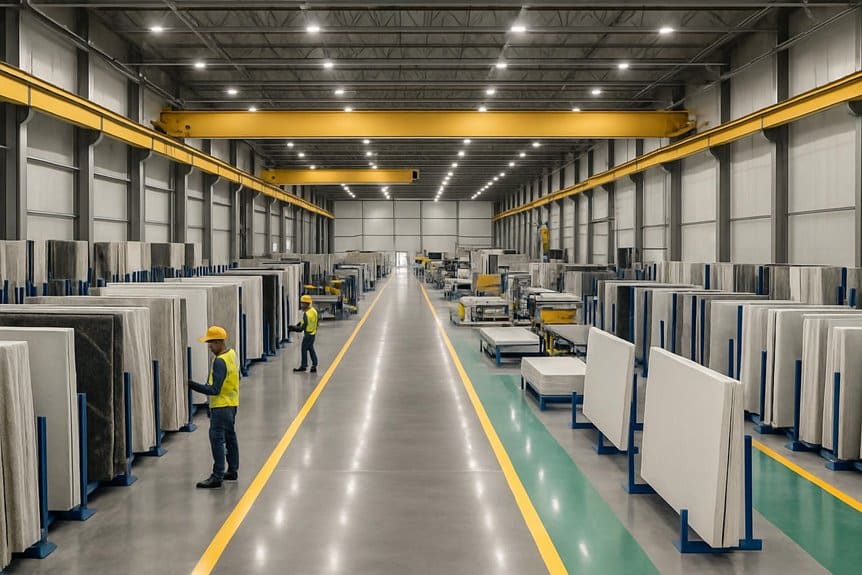
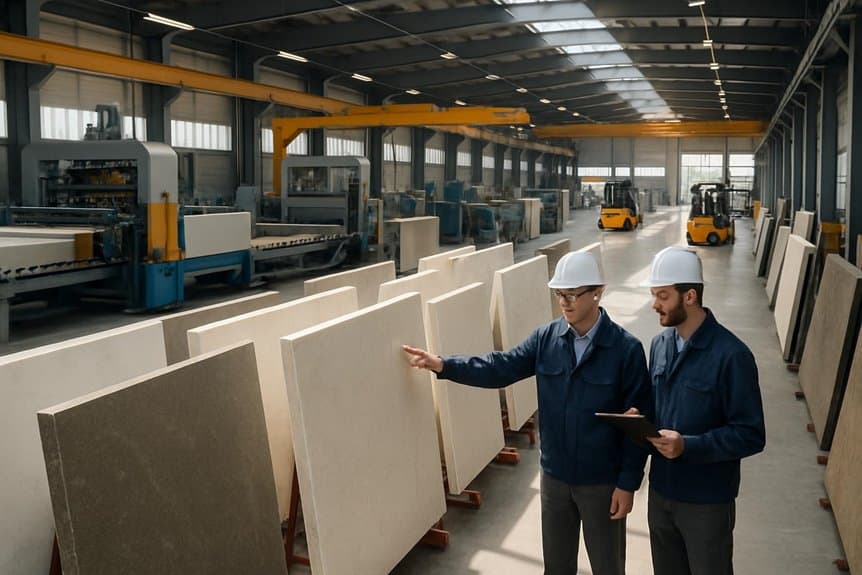
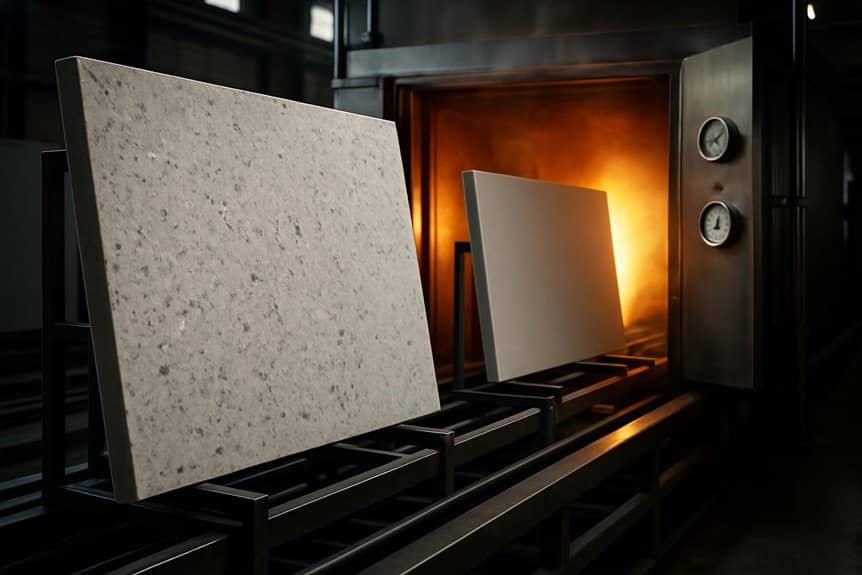
Choosing between automatic and semi-automatic quartz stone production lines depends on balancing efficiency, flexibility, and investment. Automatic lines excel in high-volume and consistent output, requiring significant upfront investment but offering reduced bottlenecks. Semi-automatic lines offer more flexibility and lower initial costs, ideal for controlled investment and moderate production needs. Consider specific manufacturing goals and long-term plans when making a decision. Further exploration will clarify the ideal approach for your production needs.
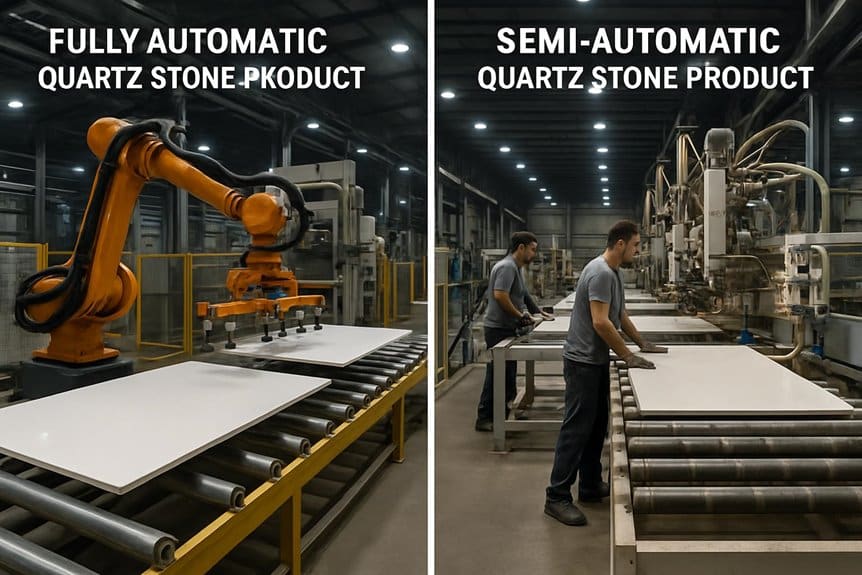
The choice between automatic and semi-automatic quartz stone production lines often revolves around the balance of efficiency and flexibility.
Neither option is universally superior; instead, each serves distinct manufacturing needs. A semi-automatic quartz stone production line is appealing when initial investment control is vital, local labor is abundant, or when moderate production volumes and product flexibility are priorities. It allows gradual automation with more manual intervention.
Conversely, an automatic quartz stone production line is advantageous for high-volume, consistent output with reduced labor dependency. It excels where material handling bottlenecks exist and centralized control is desired.
Ultimately, the decision hinges on the specific production goals, making it essential for manufacturers to align their choice with strategic priorities.
Understanding automation in quartz stone production requires clarity about what "automatic" truly entails.
The distinction between an automatic quartz slab production line and a semi-automatic quartz slab production line hinges on the degree of operator intervention across various stages.
A practical automation map highlights key differences: automated storage and feeding replace operator-assisted loading; recipe-controlled batching supersedes partial automation; integrated control in mixing and pressing phases reduces manual oversight.
Automated material distribution and conveying enhance efficiency, contrasting with manual assistance in semi-automatic setups.
Continuous automated feeding in polishing and centralized production monitoring further differentiate levels.
Buyers should prioritize a clearly defined automation level across each stage, rather than merely opting for an "automatic line," to guarantee precise control and optimized efficiency.
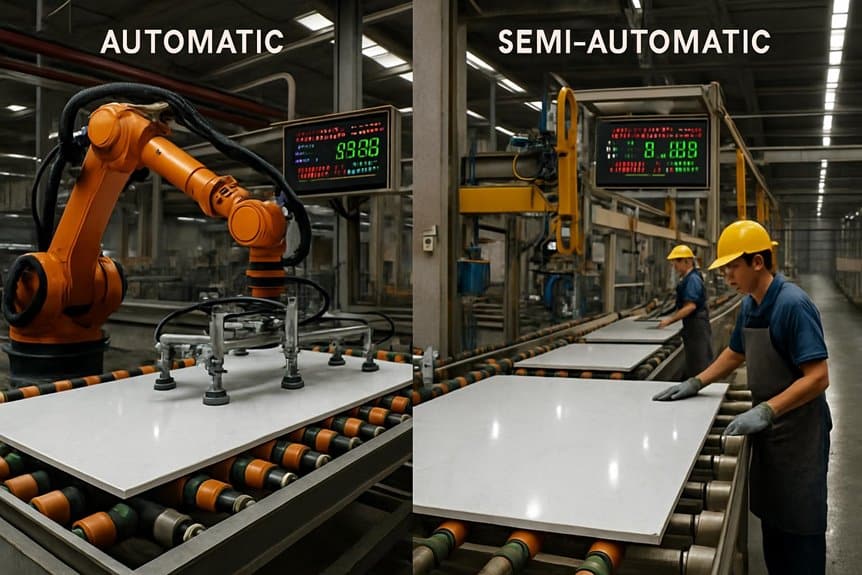
In quartz stone production, automation greatly enhances efficiency and precision, particularly in raw material batching and mixing, slab forming, pressing, and transfer.
These automated processes reduce human error, guarantee consistency, and expedite production times.
Additionally, automation in finishing and slab handling improves product quality and minimizes waste.
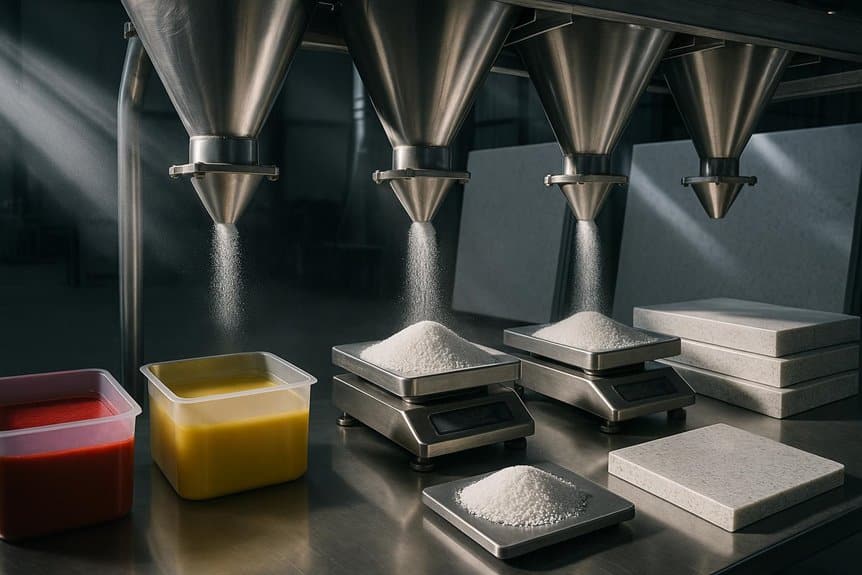
Automation revolutionizes raw material batching and mixing by enhancing precision and efficiency. In an automatic quartz stone production line, automation minimizes manual intervention, employing advanced weighing and recipe control systems. This guarantees batch repeatability and consistency, vital for maintaining quality across high production volumes.
Quartz stone production line automation allows factories to run multiple batches per shift with exact formulations, reducing errors and waste. The automated systems provide seamless control over the batching process, offering manufacturers the reliability and uniformity they need to maintain competitive advantage.
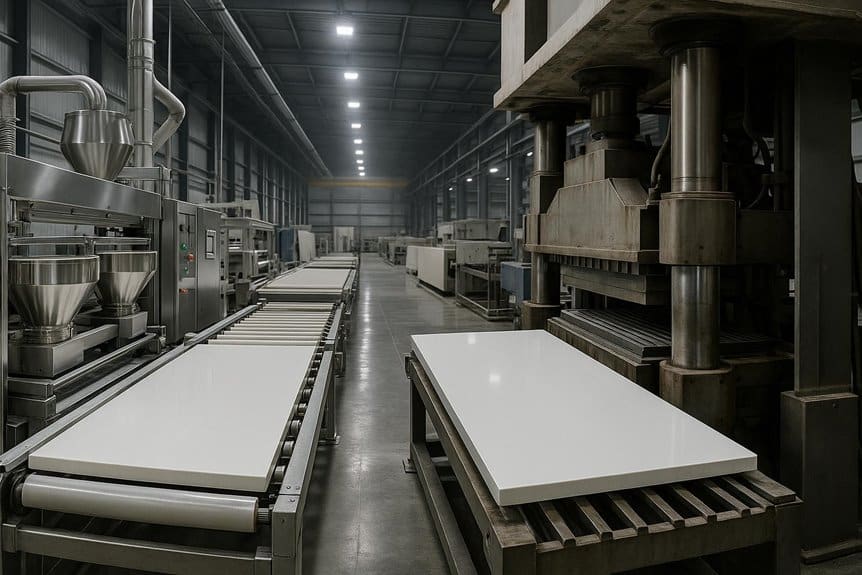
Automation delivers some of its biggest benefits during slab forming, pressing, and transfer because these stages involve repeated material movement and close coordination between machines.
In an automatic quartz slab production line, material feeding, distribution, mold transfer, press loading and unloading, and transfer to the curing system can be connected into one continuous workflow. This reduces manual handling, shortens waiting time between stages, and helps maintain more consistent production rhythm.
A semi-automatic quartz stone production line may still use an automated press cycle, but operators are more involved in moving materials or slabs between stages. This can provide flexibility, but it also increases dependence on labor and can create bottlenecks when production volume rises.
| Process Stage | Automatic Line |
|---|---|
| Material Feeding | Automated feeding and transfer |
| Material Distribution | Automated distribution |
| Mold/Slab Transfer | Integrated automatic transfer |
| Press Loading & Unloading | Automated handling |
| Transfer to Curing | Automated conveyor or transfer system |
The main advantage is not simply that each machine is automatic. It is that the stages are connected, allowing material to move from forming to pressing and curing with fewer interruptions. For higher-output factories, this integration can improve throughput, reduce handling variability, and make the overall line easier to control.
After pressing and curing, the production line moves into calibration, polishing, cutting, and slab handling. This is where the difference between semi-automatic and fully automatic configurations becomes especially visible.
In a semi-automatic quartz stone production line, machines may handle calibration and polishing automatically, while operators are still responsible for moving, turning, loading, or unloading slabs between stages. In a more integrated automatic line, these transfers are handled by conveyors, turning systems, and automated slab-handling equipment.
Automation can reduce operator involvement in several key tasks:
The key distinction is not whether the polishing machine itself is automatic, but how well the finishing equipment is connected. A line may use automatic polishing machines but still operate semi-automatically if slabs must be moved manually between each stage.
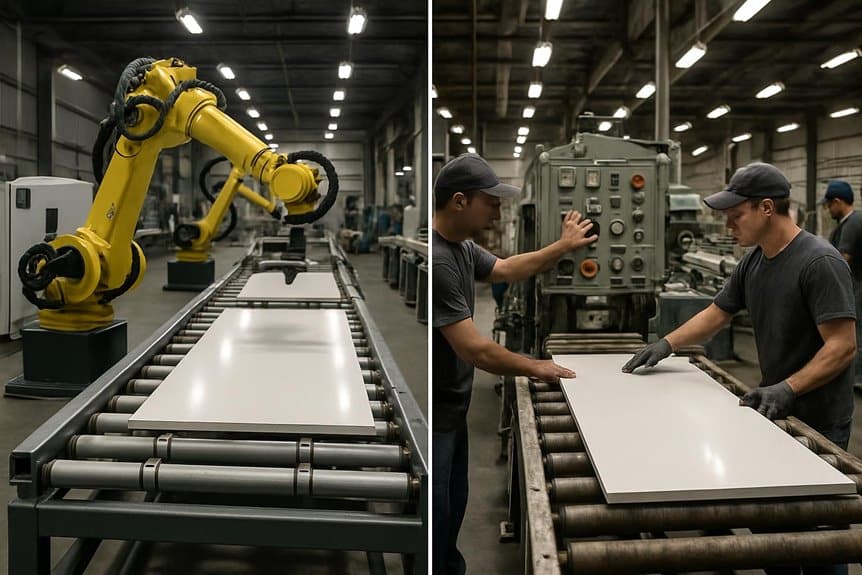
When evaluating quartz stone production lines, businesses must consider several critical factors that directly impact their operations.
A fully automatic quartz stone production line demands a higher capital investment but enhances quartz slab manufacturing with greater consistency and reduced bottlenecks. This option is favorable for operations with high sales demand and targets a market that prioritizes quality.
In contrast, semi-automatic lines offer lower entry costs and are more flexible with product changes, ideal for businesses with a limited budget or diverse product range. However, they require more manual labor and can face throughput restrictions.
Companies must assess their project budget, labor availability, and long-term production plans to determine which line aligns with their strategic goals and operational capabilities.
Evaluating quartz stone production lines requires a broader perspective beyond just the financial implications. While labor reduction is a significant factor, it is not the sole determinant of a production line's effectiveness. Buyers should consider additional aspects that influence operational efficiency and control.
For those seeking extensive control over their production processes, these factors are essential in evaluating the true value of automation beyond labor savings.
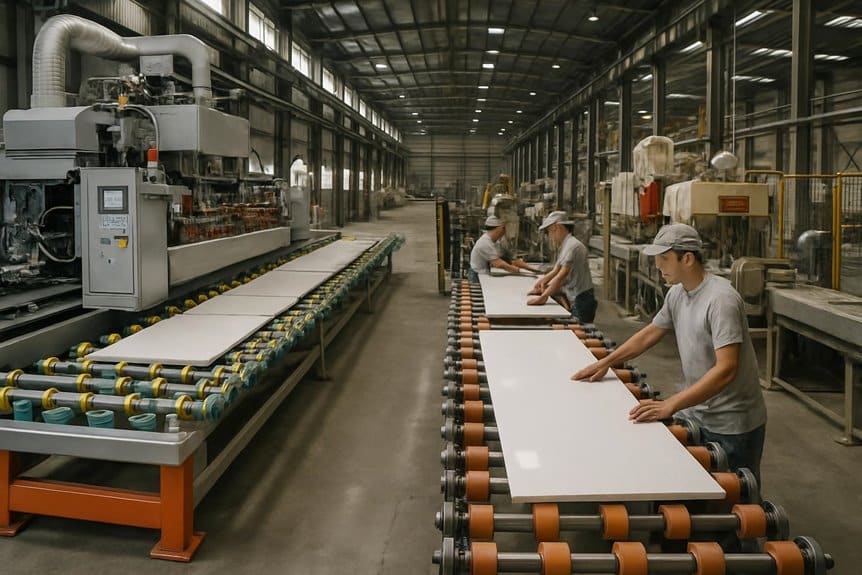
For businesses entering the quartz slab market, a semi-automatic production line can present a judicious choice. This option is particularly rational when market demand does not yet justify full capacity, enabling businesses to maintain flexibility in production volumes.
With relatively low labor costs and skilled operators available, semi-automatic lines allow for precise control over production processes without the need for extensive initial capital.
These lines are also ideal when the owner anticipates expanding automation later. It is essential to note that semi-automatic does not equate to low quality; the excellence of slabs relies on raw materials, formula control, and operator capability.
Ultimately, the level of automation primarily affects system operation and connectivity, not the inherent quality of the product.
In scenarios where high-volume production is essential, a fully automatic quartz stone production line becomes a strategic advantage.
Automation delivers consistency and efficiency, particularly in situations where:
In scenarios demanding consistency and efficiency, automation enhances high-volume production, reduces labor constraints, and ensures uniformity across shifts.
Advanced systems like those from KEDA and VEEGOO integrate raw-material batching through to polishing with intelligent controls, offering centralized production management.
This approach aligns with long-term expansion goals, making it a compelling investment for manufacturers aiming to optimize operations and meet high demand efficiently.
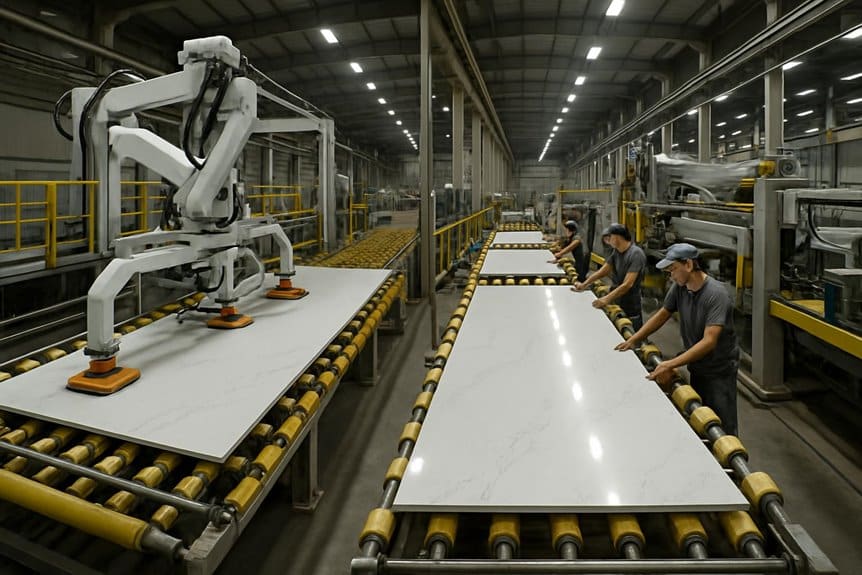
While a fully automatic quartz stone production line offers significant benefits, a hybrid approach may prove to be a more strategic investment for some manufacturers.
This method allows for targeted automation of processes such as weighing, batching, mixing, and polishing, which are high-frequency and labor-intensive. By focusing automation on areas that maximize operational efficiency, manufacturers can maintain flexibility in less critical stages, creating a balanced workflow.
Furthermore, a hybrid system provides an upgrade path as demand increases, allowing for incremental investment. However, manufacturers must assess if their existing semi-automatic lines can be economically upgraded, considering equipment design and layout.
This strategic blend of automation and manual intervention guarantees both efficiency and adaptability in production operations.
Choosing the right production line can greatly impact a manufacturer's efficiency and profitability. To make an informed decision, consider these vital questions:
A thoughtful evaluation of these factors can guide manufacturers to choose the most suitable production line for their specific needs.
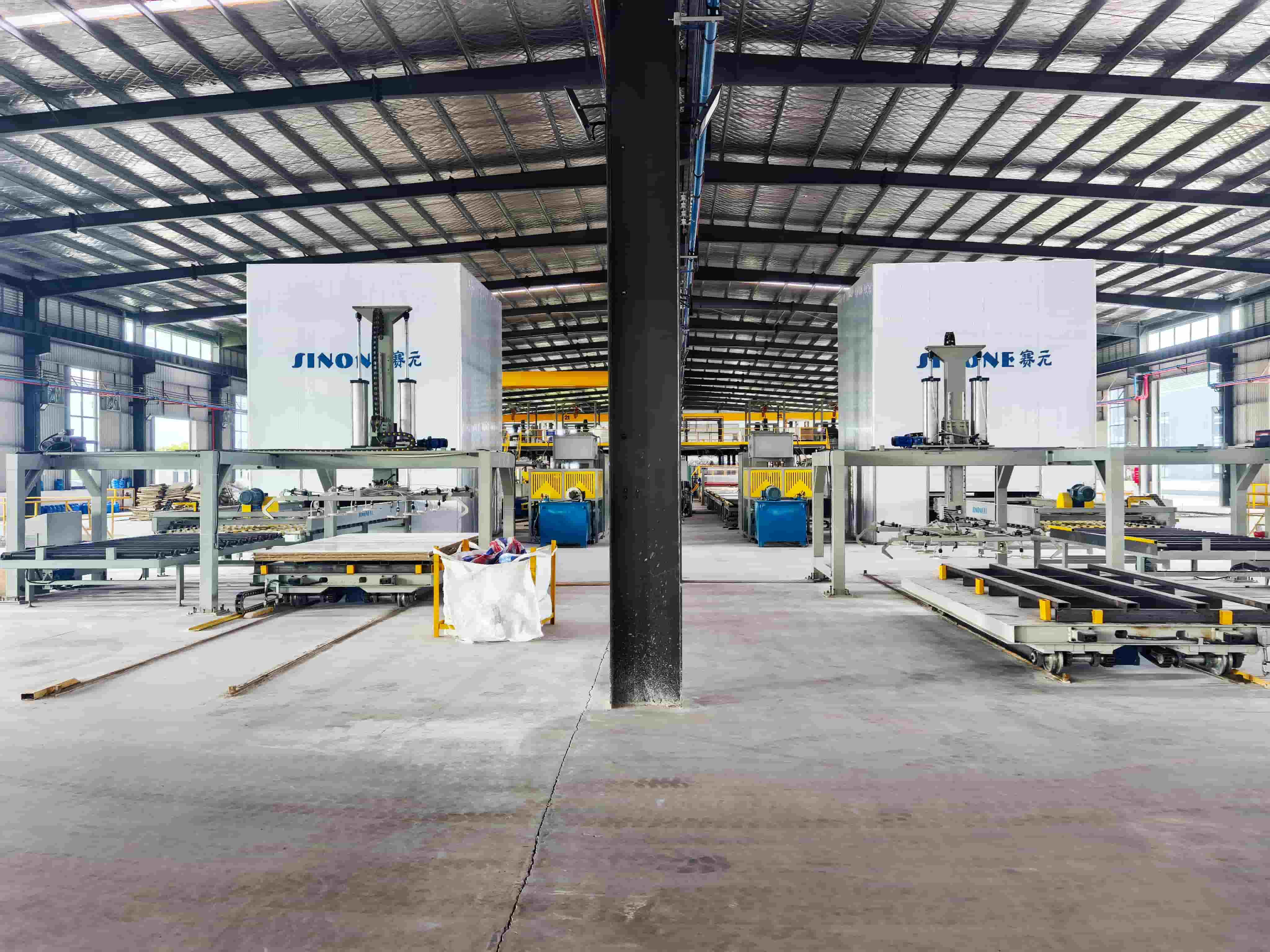
SINONE configures each production line around the buyer’s capacity target, slab size, labor conditions, automation requirements, and investment plan.
A semi-automatic line is often suitable for projects with moderate output requirements, lower initial investment targets, or markets where labor is readily available. Core stages such as batching, mixing, pressing, curing, and polishing can still be automated, while some material and slab handling remains operator-assisted.
A fully automatic line connects more stages through automated feeding, transfer, handling, and centralized control. This is better suited to factories targeting higher output, lower labor dependence, and more consistent continuous production.
The right choice is not simply “more automation is better.” The goal is to automate the stages that create the most value for the specific factory.
Contact SINONE with your target capacity, slab specifications, factory size, and automation requirements to compare suitable line configurations.
In choosing between automatic and semi-automatic quartz stone production lines, businesses must weigh efficiency against cost, innovation against tradition, and automation against human touch. The decision hinges on specific needs, operational goals, and future scalability. While automation promises precision and speed, semi-automation allows flexibility and control. A hybrid approach might offer the best balance. Ultimately, the right choice aligns with the company's vision, resources, and long-term growth strategy, ensuring both productivity and profitability.