Breton quartz technology is an integrated engineered-stone production platform using vacuum vibro-compression, coordinated batching, curing, finishing, and process support. Chinese quartz press systems are more varied, ranging from basic presses to complete automated lines with vacuum, vibration, mixing, curing, and digital controls. The real difference lies in integration, consistency, specifications, supplier support, and process discipline—not nationality alone. Buyers should compare slab size, capacity, vacuum stability, vibration design, automation, service, and sample results, with key details explained below.
Breton quartz technology refers to BretonStone, Breton’s engineered-stone production platform for manufacturing quartz slabs using vibro-compression under vacuum.
The core forming principle combines vacuum, vibration, and compression. Vacuum helps remove trapped air, vibration compacts and redistributes the mineral aggregate, and compression consolidates the mixture with resin or another binder into a dense slab before curing.
For equipment buyers, however, BretonStone should not be viewed simply as a quartz press specification. It is a broader production system that can include raw-material preparation, moulding and forming, curing, finishing equipment, automation software, plant layout, installation, start-up support, process know-how, and operator training.
Breton publishes plant configurations for slab sizes ranging from approximately 140 × 300 cm to 210 × 360 cm, with stated daily capacities of about 1,200 to 4,600 m² depending on the line configuration.
In this sense, BretonStone is best understood as an integrated engineered-stone manufacturing platform rather than a standalone quartz press machine.
There is no single standardized “Chinese quartz press technology.” Equipment design varies between manufacturers in press structure, vibration configuration, vacuum control, automation level, and overall line integration.
However, many modern Chinese quartz production systems follow the same core engineered-stone forming principles used across the industry. Raw materials are automatically batched and mixed, distributed into the slab-forming area, then compacted through a combination of vacuum, vibration, and controlled pressing before curing, calibration, and polishing.
The real difference is therefore not whether a system uses vacuum vibration, but how effectively those functions are engineered and controlled. Buyers should look at how the vacuum is generated and maintained, how vibration is distributed across the slab, how pressing force is transmitted, how stable the machine structure remains during operation, and how consistently the press communicates with upstream and downstream equipment.
Automation is another important variable. More advanced Chinese production lines can integrate PLC control, recipe management, material conveying, production monitoring, curing coordination, and finishing equipment into a connected system rather than operating each machine independently.
Manufacturers also differ significantly in their proprietary engineering. KEDA, for example, promotes artificial-stone systems combining vibration technology with automated production and digital management, while Sinone has developed its own quartz pressing and production-line solutions. These companies illustrate why “Chinese technology” should be treated as a broad equipment category rather than a single manufacturing method.
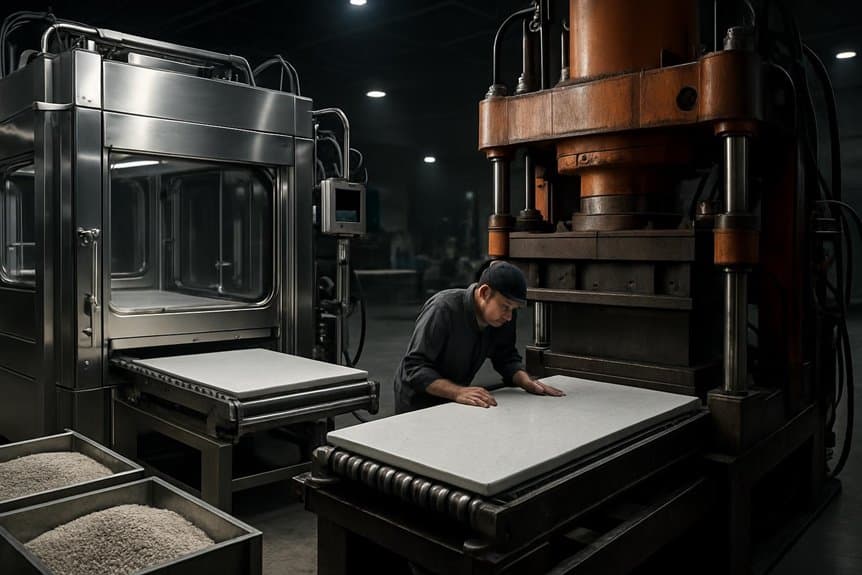
BretonStone and modern Chinese quartz press systems can use the same basic forming principle: vacuum, vibration, and compression are combined to compact the quartz-resin mixture before curing. The main differences lie in how the equipment is engineered, controlled, integrated, and supported.
| Comparison Area | Breton Technology | Chinese Quartz Press Systems |
|---|---|---|
| Core forming principle | Vibro-compression under vacuum | Commonly vacuum, vibration, and compression |
| Technology scope | Integrated production platform | From standalone presses to complete production lines |
| Press design | Proprietary Breton engineering | Varies by manufacturer and machine architecture |
| Automation | Integrated machine and plant control | Ranges from semi-automatic to highly automated |
| Slab formats | Defined plant configurations | Depends on supplier and equipment specification |
| Process know-how | Strong emphasis on technology transfer and process support | Level of support varies by supplier |
| Customization | Configured within the BretonStone platform | Often flexible in slab size, capacity, and line configuration |
| Project support | Plant engineering, installation, training, and commissioning | Depends on manufacturer and project scope |
The key point is that “Chinese quartz press technology” is not one standardized system. Different manufacturers use different press structures, vibration arrangements, vacuum systems, control platforms, and levels of automation.
BretonStone, by contrast, is better understood as a complete engineered-stone manufacturing platform rather than simply a press machine. Breton combines forming technology with plant engineering, software, production know-how, installation, and training.
So the meaningful comparison is not simply European versus Chinese equipment. It is how each system performs in areas such as pressing stability, automation, slab size, capacity, integration, and technical support.
Breton technology is often treated as a shortcut for quartz quality because buyers cannot easily evaluate what happens inside the manufacturing process. Compaction quality, vacuum control, curing conditions, and internal slab structure are difficult to judge from the finished surface alone, so the use of a recognized production technology can become a visible indicator of manufacturing control.
BretonStone has decades of industrial development behind its vacuum vibro-compression process, together with technologies for large-format slabs, veining, automation, and integrated engineered-stone production. This established manufacturing platform is one reason BretonStone has become an important benchmark in the quartz industry.
However, using Breton technology does not automatically determine the quality of every finished slab. Slab performance also depends on quartz aggregate grading, resin quality and proportion, pigment and additive dosing, batching accuracy, mixing uniformity, material distribution, vacuum conditions, vibration parameters, pressing control, curing time and temperature, calibration, polishing, and final quality control.
In other words, a BretonStone plant provides a proven manufacturing platform, but the final result still depends on how well the complete production process is controlled.
The same principle applies when evaluating a Chinese quartz press system. “Chinese quartz technology” is not a single standardized production method. Different manufacturers use different press structures, vacuum systems, vibration configurations, automation levels, components, and process controls. Finished slab quality should therefore be evaluated based on the actual equipment specification, process control, and production results, rather than country of origin alone.
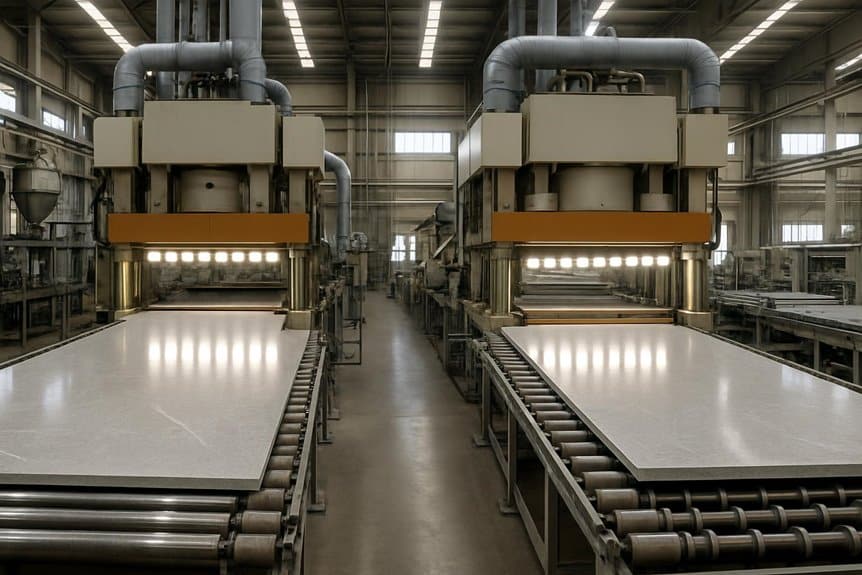
Asking whether Breton or Chinese quartz technology is better is too broad to support a useful equipment decision. Buyers should compare measurable machine capability, production performance, integration, and technical support instead.
For the pressing system, check vacuum capability and stability, vibration layout and control, pressing architecture, and cycle control. These factors reveal how effectively the machine performs vacuum vibro-compression in actual production.
For production capability, compare maximum slab size, thickness range, jumbo capability, and sustainable output. Do not judge capacity from press cycle time alone—batching, mixing, curing, handling, and polishing can all become line bottlenecks.
For automation and integration, evaluate PLC control, recipe storage, parameter monitoring, alarms, production data, and synchronization with upstream and downstream equipment.
Finally, compare installation, commissioning, operator training, process support, spare parts, maintenance, and after-sales service. These factors can be just as important as the press specification once the line enters production.
The useful comparison is not simply “Breton or China?” but whether the system can deliver the required slab formats, output, process control, flexibility, and support for the specific factory project.
The better choice depends on the factory’s investment model, production targets, technical requirements, and preferred level of system integration rather than on the equipment origin alone.
BretonStone may make sense when the investor wants a highly integrated production platform with established process know-how, plant engineering, software, installation, start-up support, and training supplied within one technology system. It can also suit projects where the BretonStone name, specific Breton technologies, or a standardized premium production platform are important to the investment strategy.
A Chinese quartz production system may make sense when the project requires greater flexibility in equipment configuration, automation level, production capacity, or capital expenditure. Chinese suppliers can offer anything from individual press systems to complete quartz slab production lines, allowing the factory configuration to be adapted around slab size, product type, available space, local labor, and investment budget.
However, “Chinese equipment” should not be treated as one technical category. Press design, automation, process control, project experience, commissioning support, and after-sales capability vary significantly between manufacturers. Buyers therefore need to evaluate the actual supplier and system rather than relying on country of origin as a quality indicator.
For either approach, the final decision should be based on required slab formats, sustainable output, automation, process flexibility, technical support, expansion plans, and total project investment. The most suitable system is the one that matches the factory’s production objectives and operating conditions.
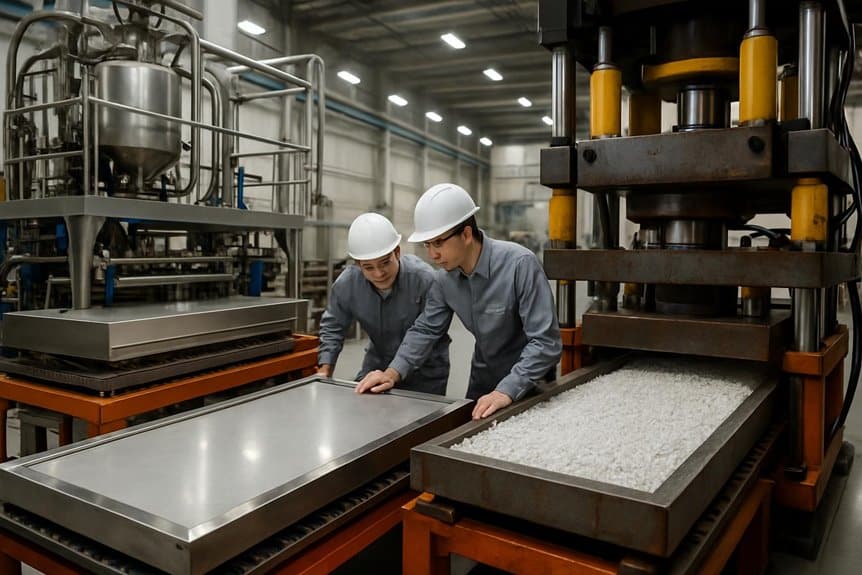
When evaluating a Chinese quartz press as an alternative to Breton technology, the comparison should be based on measurable production capability rather than brand name or country of origin. The most important question is whether the proposed system can reliably produce the slab sizes, quality levels, and output required by your factory.
Start with the core press specifications. Compare maximum slab dimensions, supported thickness range, vacuum performance, vibration configuration, pressing method, and normal cycle time. Pressing force alone is not enough to judge performance, because slab compaction depends on how vacuum, vibration, and compression work together across the full forming area.
Production capacity should also be evaluated at line level. A short press cycle does not necessarily mean higher factory output if batching, mixing, distribution, curing, or finishing becomes the bottleneck. Ask the supplier to explain how its stated daily capacity is calculated and what operating hours or shift pattern the figure assumes.
Other factors worth comparing include:
Project references are particularly useful. Ideally, the supplier should be able to demonstrate lines producing slab dimensions, product types, and capacities similar to those planned for your factory.
BretonStone is more than an individual press; it is an integrated production technology and engineering platform. A Chinese supplier should therefore also be assessed on its ability to support the complete production system rather than only supply the pressing machine. Sinone, for example, provides equipment covering raw-material handling, batching, mixing, forming, curing, and finishing, together with installation, commissioning, and production training.
The practical comparison is therefore not simply “Breton or Chinese equipment.” It is whether the proposed quartz press system can meet your slab specifications, production capacity, automation requirements, and technical-support expectations within the planned investment.
Comparing Chinese quartz press technology with Breton for your project? Contact Sinone to discuss your production requirements and suitable equipment configuration.
Some BretonStone technologies have historically been patent-protected, while BretonStone® remains a registered brand. Patent and licensing status can vary by technology and country, so buyers should verify the current legal position for the specific equipment or process being considered.
Yes. Quartz slabs produced in China can meet NSF/ANSI 51 if the specific product and manufacturing facility satisfy the required food-zone standards. Certification applies to the finished product and listed facility, not automatically to the machinery brand.
Not by itself. Slab quality also depends on raw materials, batching, mixing, pressing, curing, polishing, and overall process control. BretonStone is a proven platform, but equipment brand alone does not determine finished quality.
Many modern Chinese quartz presses also use vacuum, vibration, and compression. However, press structure, vibration control, vacuum performance, automation, and line integration can vary significantly between manufacturers.
There is no fixed lifespan. Service life depends on machine construction, operating hours, maintenance, component quality, spare-parts availability, and how well the equipment is maintained and upgraded.
Not necessarily. Total investment depends on automation, capacity, slab size, supporting equipment, installation, commissioning, training, freight, and service. Buyers should compare the complete project scope rather than only the equipment price.