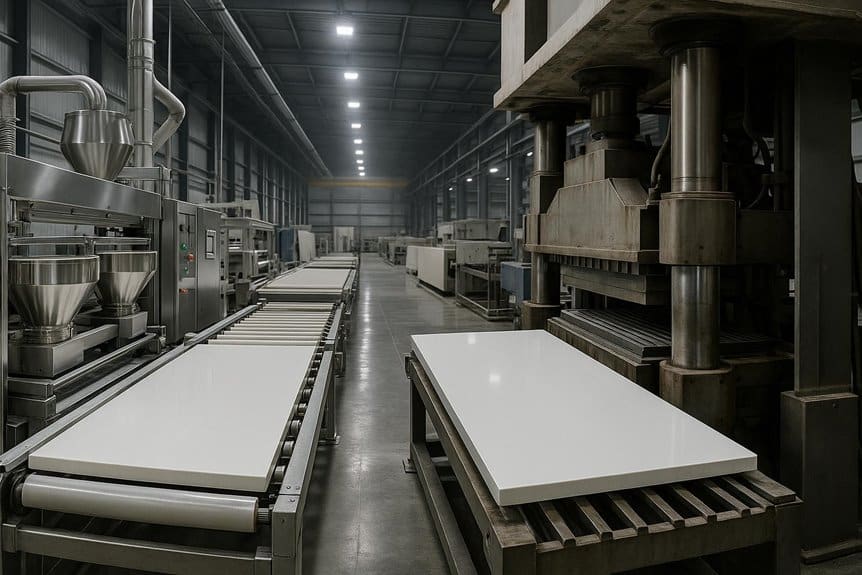
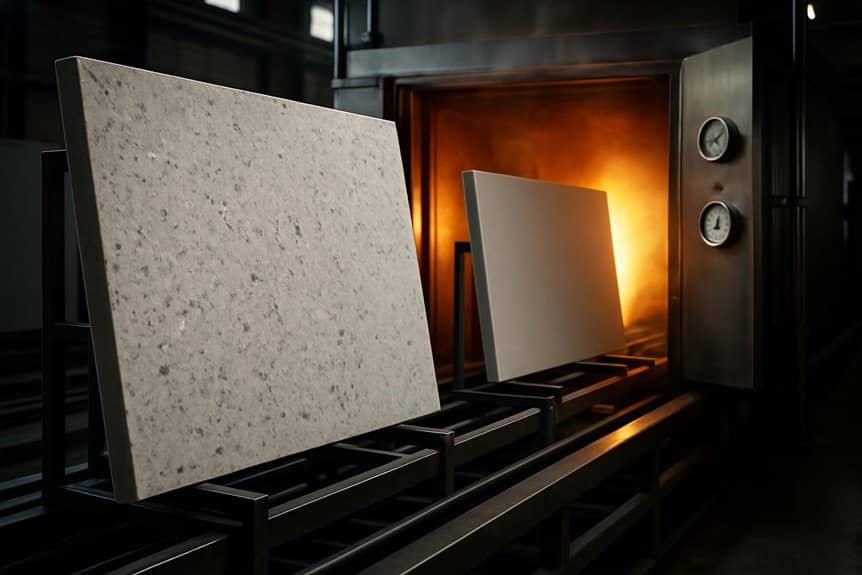
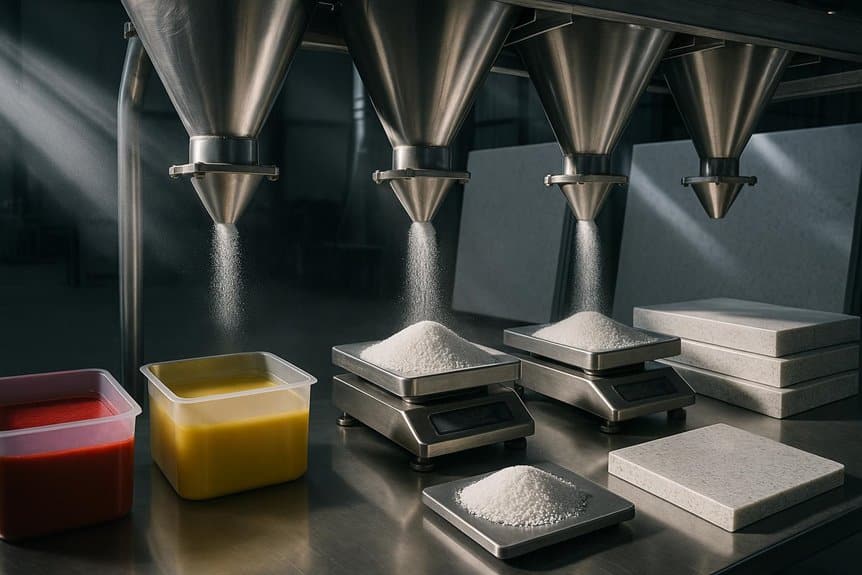
A quartz slab curing oven determines how reliably resin binds the mineral aggregate after pressing. Its temperature profile, dwell time, heat uniformity, and cooling rate influence polymerization, internal stress, hardness, and dimensional stability. Even small deviations can cause uneven curing, surface defects, or reduced mechanical performance. The critical question is not simply whether an oven reaches the target temperature, but how consistently it controls the complete curing cycle.

A quartz slab curing oven is a controlled thermal-processing system used after vacuum vibration pressing, when the compacted slab still contains an uncured resin binder. Its purpose is to apply validated thermal conditions that allow the binder reaction to progress consistently, converting the pressed aggregate-resin body into a structurally stable slab.
The quartz slab curing oven, consequently, serves as a quality-control stage rather than merely a heating chamber. It helps establish the strength, dimensional stability, and material integrity required before finishing operations.
Within the production sequence, its position is clearly defined: pressing, curing, cooling, then calibration or polishing. A quartz stone curing machine must be specified according to slab dimensions, resin formulation, target throughput, and approved curing parameters.
Controlled curing reduces variability between batches and supports predictable downstream handling, surface preparation, inspection, and production scheduling.
Quartz slabs are loaded into the oven chamber using a defined handling arrangement that maintains spacing for uniform heat exposure.
The system applies a programmed heating profile and holds the slabs at the required curing temperature for the specified duration, allowing the resin binder to polymerize consistently.
After the hold period, slabs are unloaded or moved through controlled cooling to limit thermal stress and preserve dimensional stability.
After pressing, the formed quartz slab is transferred into the curing section through the production line’s designated loading and conveying system. Depending on the line configuration, slabs may be moved by conveyors, carriers, racks, or other automatic handling equipment designed to keep the uncured slab stable during transfer.
At this stage, handling must be controlled because the slab has already been formed but has not yet completed thermal curing. The loading system should therefore position each slab securely and consistently inside the curing oven while minimizing unnecessary movement, deformation, or surface disturbance.
For continuous production, slab loading also needs to match the output of the upstream press and the capacity of the curing oven. Poor coordination between these stages can create waiting time, reduce line efficiency, or make the curing section a production bottleneck.
Once the slab is positioned in the chamber, the curing oven raises and maintains the validated process temperature according to the production recipe. The objective is not merely to make the slab hot.
A quartz slab curing machine must deliver controlled thermal input across the full slab area, including edges, center zones, and varying thickness sections. Programmable controls regulate heating output against sensor feedback, while circulation systems distribute heat through the chamber environment. This reduces temperature gradients that can cause uneven resin reaction, localized stress, dimensional variation, or inconsistent mechanical properties.
The quartz curing system is configured around validated setpoints, ramp conditions, slab dimensions, loading density, and resin requirements. Accurate sensors, stable heating components, and effective insulation support repeatable conditions.
Heating uniformity is consequently a primary process-control requirement, not simply an equipment characteristic.
Once the quartz slab reaches the required curing temperature, it must remain under stable thermal conditions long enough for the resin binder to complete the intended curing reaction. This holding period helps the pressed quartz mixture develop sufficient structural stability before cooling and downstream processing.
The required curing time varies with the resin formulation, slab thickness, curing temperature, heat distribution, and oven configuration. In a typical quartz slab production configuration, curing may take around 70–90 minutes at approximately 80–90°C, although the actual settings should always be determined according to the material formulation and production requirements.
If the hold time is too short, the slab may be insufficiently cured. Extending the cycle unnecessarily, however, can reduce production efficiency and increase energy consumption. The curing period should therefore be optimized together with temperature rather than treated as a fixed value.
After the validated curing hold, the quartz slab is unloaded from the curing oven and transferred through a controlled cooling stage before polishing or other downstream operations. This shift must be managed to prevent thermal shock, residual stress, distortion, and microcracking in the resin-bound structure.
The engineered quartz curing oven should coordinate unloading speed, slab support, transfer spacing, and cooling-air conditions with the validated thermal profile. Cooling is not merely a passive delay; it determines how uniformly the slab returns from the quartz stone curing temperature to a stable handling condition.
Sensors and programmed controls should verify temperature reduction across slab surfaces and thickness before release to finishing equipment. The sequence remains: pressed slab → heating → temperature hold → resin curing → unloading → cooling.
Consistent cooling supports dimensional stability, predictable polishing behavior, and reliable final quality.
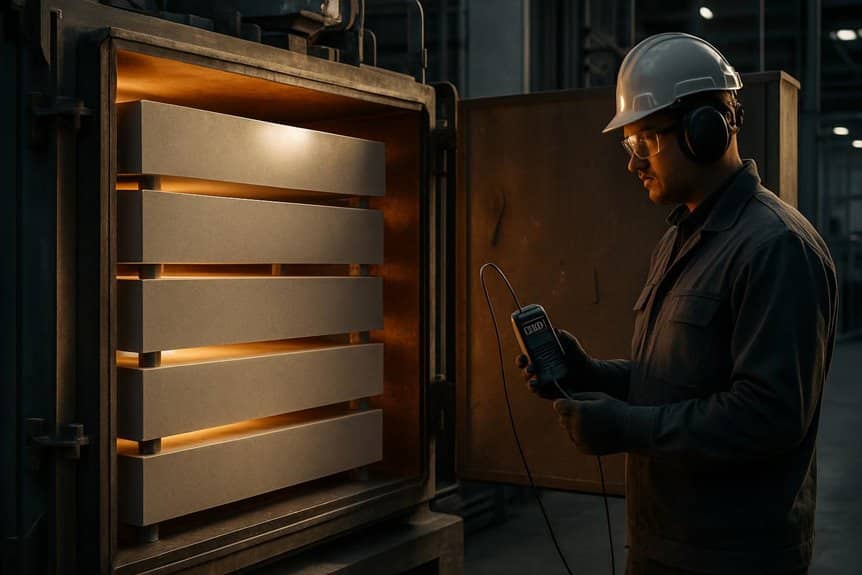
A quartz slab curing oven must do more than simply heat the slab. The curing stage depends on several parameters working together, particularly temperature, curing time, heat uniformity, and the rate at which the slab is heated and cooled. These settings should be adjusted according to the resin system, slab thickness, product specification, and production-line configuration rather than treated as fixed values for every quartz slab.
Temperature directly affects how the resin binder cures after the slab has been pressed. The oven must provide enough heat to support a stable curing reaction without exposing the slab to unnecessary thermal stress.
For a typical quartz slab production configuration, curing temperatures may be around 80–90°C. However, the correct setpoint depends on the resin formulation, additives, slab thickness, and curing system.
If the temperature is too low, the resin may not cure sufficiently within the planned cycle. Excessive temperature, on the other hand, can increase energy consumption and may affect resin behavior, color stability, or dimensional consistency. The goal is therefore not the highest possible temperature, but a stable temperature matched to the material formulation.
Once the slab reaches the required curing temperature, it must remain under stable thermal conditions long enough for the resin binder to complete the intended curing reaction. This holding period helps the compacted quartz mixture develop sufficient structural stability before cooling and downstream processing.
The required curing time varies with the resin formulation, slab thickness, curing temperature, heat distribution, and oven configuration. In a typical production setup, the curing period may be around 70–90 minutes at approximately 80–90°C.
If the hold time is too short, the slab may be insufficiently cured. Extending the cycle unnecessarily, however, reduces throughput and increases energy consumption. Curing time should therefore be optimized together with temperature rather than controlled as an isolated parameter.
Uniform temperature distribution is just as important as the selected temperature itself. Large quartz slabs need to experience consistent thermal conditions across their full surface and thickness.
Significant hot or cold zones inside the curing oven can create differences between:
Good airflow, heating-system design, insulation, sensor placement, and control accuracy all contribute to maintaining stable temperature distribution.
For equipment buyers, this means that maximum oven temperature alone is not enough to evaluate a curing system. Temperature uniformity and repeatability under actual production conditions are more meaningful indicators of oven performance.
The speed at which a slab is heated and later cooled also affects process stability. Heating too aggressively can create larger temperature differences within the slab, while uncontrolled cooling may introduce unnecessary internal stress or dimensional variation.
The heating and cooling profile should therefore match the slab thickness, resin system, and production cycle. A well-designed curing system balances sufficient thermal input with controlled temperature changes so that slabs can move efficiently into cooling, calibration, and polishing without compromising consistency.
In practice, curing performance depends on the combination of all four parameters:
temperature + hold time + uniformity + controlled heating/cooling
Optimizing only one of these while ignoring the others can still result in unstable curing. The curing oven should therefore be selected and configured as part of the overall quartz slab production process rather than as an independent heating unit.uling. Profiles should be confirmed through production trials and adjusted only under documented process control.
The curing oven does more than harden the resin binder. Its ability to maintain the required temperature, distribute heat evenly, and control the curing cycle can directly influence how consistently quartz slabs perform after pressing. When curing conditions vary across the oven or between production batches, the resulting differences may not become visible until the slabs reach calibration, polishing, or final inspection.
Temperature uniformity is especially important. The center, edges, upper surface, and lower surface of the slab should experience reasonably consistent thermal conditions throughout the curing cycle. Significant temperature differences can cause uneven resin curing and contribute to variations in slab properties.
Curing performance can influence several quality areas:
| Curing Condition | Possible Effect on Quartz Slabs |
|---|---|
| Insufficient temperature or curing time | Incomplete resin curing and reduced structural stability |
| Uneven heat distribution | Differences in curing between slab areas |
| Excessive temperature | Potential changes in resin behavior, color, or dimensional stability |
| Unstable curing cycles | Greater batch-to-batch variation |
| Poor temperature control | Inconsistent downstream calibration and polishing performance |
| Excessively long curing | Lower production efficiency and unnecessary energy consumption |
A well-designed quartz slab curing oven should therefore provide repeatable temperature control rather than simply reaching a high maximum temperature. Consistent heating, suitable hold time, reliable monitoring, and stable cycle control help create predictable conditions from one slab batch to the next.
Curing is still only one part of slab quality control. Raw material proportions, mixing, material distribution, pressing, cooling, calibration, and polishing also affect the finished product. The role of the curing oven is to ensure that the thermal stage does not introduce unnecessary variation into an otherwise controlled production process.

When evaluating a quartz slab curing oven, buyers should look beyond the maximum temperature rating. The more important question is whether the oven can maintain stable, repeatable curing conditions for the required slab size, production capacity, and resin system. Temperature control, heat uniformity, automation, insulation, and line integration all affect both slab consistency and operating efficiency.
A curing oven should provide precise and stable temperature control throughout the full curing cycle. Key points to check include the available temperature range, control accuracy, sensor layout, and how clearly operators can monitor actual oven conditions.
The control system should allow the curing temperature to be adjusted according to the slab formulation and process requirements rather than relying on one fixed setting. Multiple temperature sensors can also help operators identify variation within the chamber and maintain more consistent curing conditions from batch to batch.
Temperature uniformity is often more important than the oven's maximum temperature.
If different areas of the chamber heat unevenly, slabs in different positions may experience different curing conditions. This can lead to inconsistent resin curing, dimensional variation, or differences in downstream processing performance.
When comparing curing ovens, buyers should therefore ask how heat is distributed throughout the chamber and how the manufacturer verifies temperature consistency across different slab positions.
The heating system determines how quickly and evenly the oven reaches and maintains the required curing conditions. Its design can affect heat distribution, warm-up time, temperature stability, and energy consumption.
Rather than comparing heating power alone, buyers should consider whether the system can maintain uniform temperatures under normal production loads and respond reliably when recipes or production conditions change.
The curing oven must be sized according to the production line rather than selected as an isolated machine.
Important factors include:
If the curing system cannot process slabs at the rate they leave the pressing stage, it can become a bottleneck for the entire line. At the same time, an unnecessarily oversized oven can increase equipment investment, factory footprint, and energy consumption.
The correct capacity should therefore balance curing time with the output of the upstream press and the downstream cooling and finishing systems.
Modern curing ovens should allow operators to control and monitor the curing cycle rather than relying heavily on manual adjustment.
Useful functions can include:
For factories producing different slab types or formulations, recipe-based control can improve repeatability and reduce dependence on manual parameter setting.
Good chamber insulation helps retain heat, reduce temperature fluctuation, and lower unnecessary energy loss.
Poor insulation can increase heating demand and make it more difficult to maintain stable thermal conditions, particularly during continuous production. Buyers should therefore consider insulation quality, chamber sealing, heat-loss control, and overall energy management when comparing ovens.
Energy efficiency should not be judged only by installed heating power. The more useful question is how efficiently the oven maintains the required curing conditions during actual production.
The curing oven also needs to fit smoothly into the production-line handling system.
Depending on the line design, slabs may be transferred using carriers, racks, conveyors, or other automated handling equipment. The loading and unloading arrangement should support the required slab dimensions and production cycle without creating unnecessary waiting time or manual handling.
For a fully integrated line, the curing system should coordinate with the upstream press and downstream cooling equipment so that slab transfer remains stable and continuous throughout production.
Line balance determines the required capacity of a quartz slab curing oven; it should not be specified independently from the production system. Capacity calculation must align press cycle, slab dimensions, hourly slab output, validated curing duration, loading capacity, curing positions, shift pattern, and available cooling capacity.
If the press produces slabs faster than the oven cures them, work-in-process accumulates upstream and curing becomes the line bottleneck. Conversely, excessive chamber capacity increases capital expenditure, plant footprint, and heating demand without improving output.
The controlled approach is to calculate curing capacity from complete line balance, using actual operating rates rather than chamber size alone.

Choosing the right quartz stone curing oven requires a system-level evaluation of slab geometry, resin formulation, validated curing profile, production rate, and integration with pressing, handling, cooling, and factory utilities.
Oven selection should be based on actual process data, not cycle settings copied from another factory. Curing temperature, dwell time, airflow, loading density, and cooling must match the resin system, slab mass, and required throughput.
Practical buyer checklist: confirm maximum slab size, thickness range, formulation requirements, curing temperature and time, slabs per hour or day, shifts, automation target, available floor space, local utilities, press capacity, and downstream cooling arrangement.
The selected configuration should maintain stable flow without creating bottlenecks.
For a suitable configuration, provide SINONE with your slab dimensions, resin system, target capacity, curing requirements, and factory conditions. We can then configure the curing system to match the required production process and line capacity.
Temperature sensors should be calibrated at least annually, with quarterly verification recommended for critical curing operations. Calibration frequency should increase after repairs, process deviations, sensor replacement, or whenever quality-control data indicates temperature instability or drift.
Resin curing operations require ventilation, temperature interlocks, fire detection, PPE, chemical-resistant handling procedures, emergency shutdowns, calibrated sensors, controlled access, spill containment, and documented training. Operators should follow resin safety data sheets and local regulations.
Like a closed-loop material stream, cured quartz slabs can be crushed and reused as aggregate in controlled proportions. Resin-bound scrap requires validation for particle size, contamination, color consistency, mechanical performance, and formulation compatibility.
Required floor space depends on slab dimensions, throughput, loading method, and oven configuration. A single-chamber unit may require 30–80 m², while integrated systems need additional clearance for loading, cooling, maintenance, and material handling.
An exceptionally rigorous preventive schedule is recommended: inspect sensors, heaters, fans, and seals weekly; clean filters monthly; calibrate controls quarterly; lubricate mechanisms quarterly; verify insulation semiannually; and document trends, alarms, repairs, and component replacements continuously.
A quartz slab curing oven determines final slab performance through controlled heating, dwell time, and gradual cooling. Coincidentally, the factors that protect resin chemistry also protect production consistency: uniform temperature supports polymerization, while stable cooling limits internal stress and distortion. Selecting equipment with accurate controls, even heat distribution, and capacity aligned to line output enables reliable curing. As a result, manufacturers can improve dimensional stability, mechanical strength, appearance, and overall quartz slab quality.