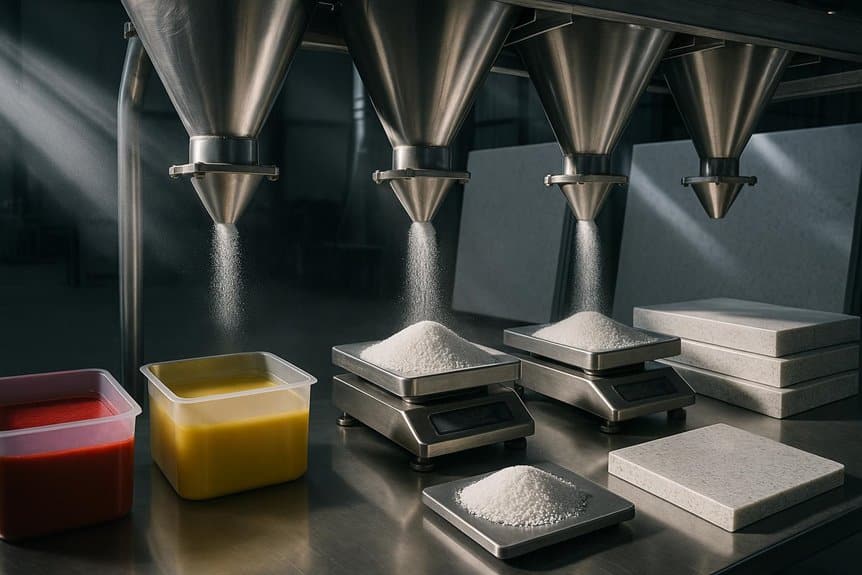
A quartz stone production line has no universal price. Cost depends on rated capacity, slab size, thickness range, automation level, press specification, curing system, polishing line, and environmental equipment. Buyers should separate standalone machinery cost from installed line cost and total factory investment. Common exclusions include foundations, utilities, logistics, installation, startup inventory, and working capital. Accurate budgeting requires a line-by-line scope review, with the following sections showing how each cost factor is controlled.
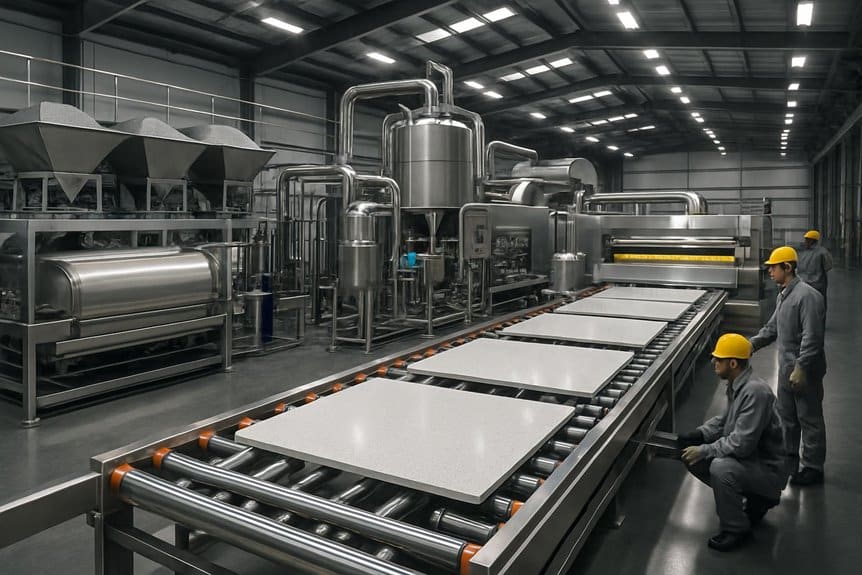
There is no single standard price for a quartz stone production line because different quotations may cover very different equipment and service scopes. A compact semi-automatic line for standard slabs cannot be compared directly with a fully automatic, high-capacity line designed for jumbo slab production.
Marketplace prices can provide a rough reference, but they are rarely enough for investment planning. A reliable quotation should be based on the required production capacity, slab dimensions and thickness, automation level, equipment configuration, product requirements, destination country, and installation conditions.
| Cost term | What it usually includes |
|---|---|
| Standalone machine price | One individual machine, such as a press, mixer, or polishing machine |
| Production-line equipment price | The connected machines included in the supplier’s quoted scope |
| Installed line cost | Equipment plus shipping, installation, commissioning, and related services |
| Total plant investment | The complete project budget, including factory preparation, utilities, environmental systems, startup materials, and working capital |
The key is to compare quotations on the same basis. A lower price does not necessarily mean a lower-cost project if essential machines, auxiliary systems, installation services, or factory preparation are excluded.
After defining the cost category, the buyer should verify the quotation scope before comparing a quartz stone production line equipment price.
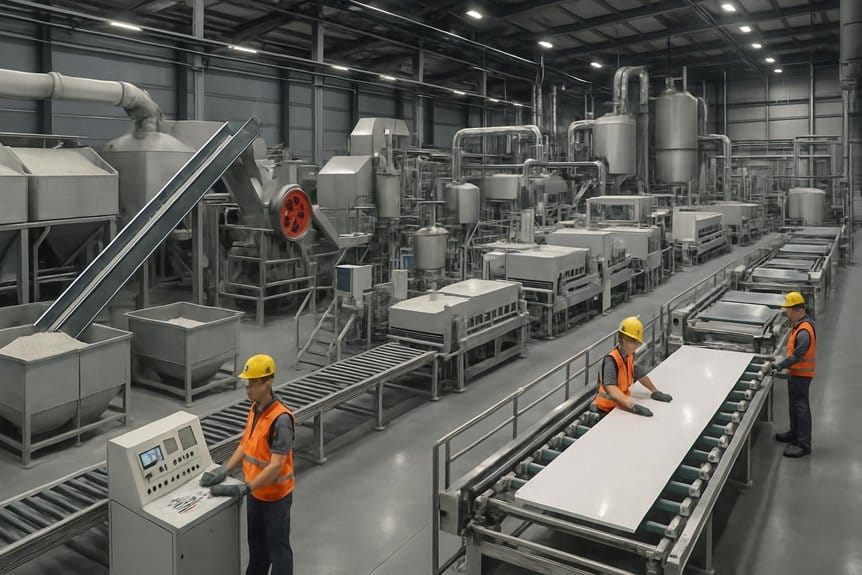
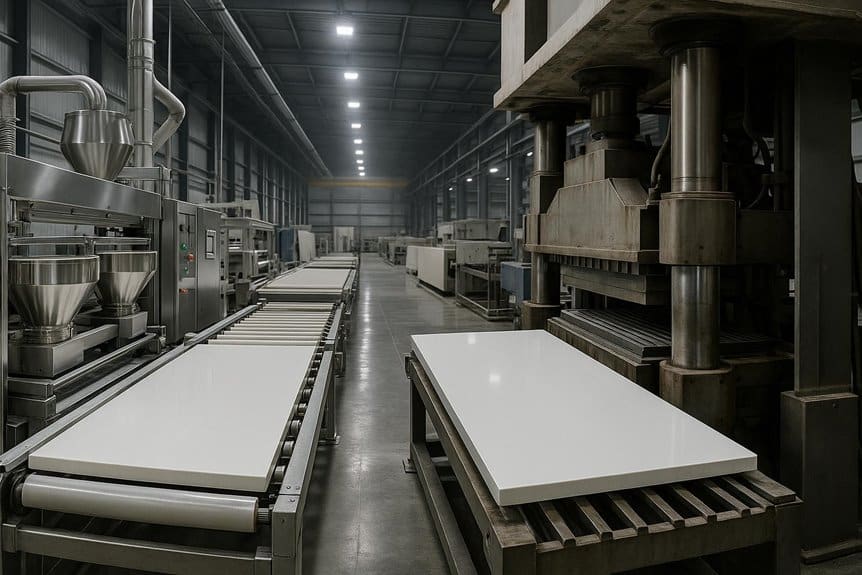
A complete proposal may cover raw material storage and feeding, automatic weighing and batching, mixing and material distribution, vacuum vibration press, curing system, cooling and slab transfer, calibrating and polishing line, cutting and trimming, inspection and protective-film application, electrical control and automation, plus dust and wastewater treatment.
For cost control, each item should be listed as included, optional, or excluded. This prevents a low headline price from understating the real quartz stone production line cost.
It also separates core production equipment from environmental systems and automation packages. A defined scope lets the buyer compare offers consistently and estimate quartz slab manufacturing plant cost with fewer procurement gaps.
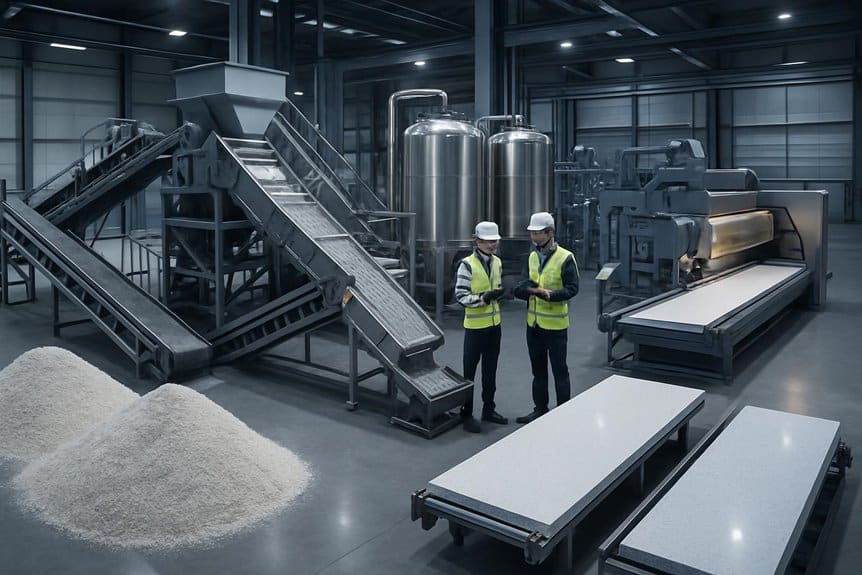
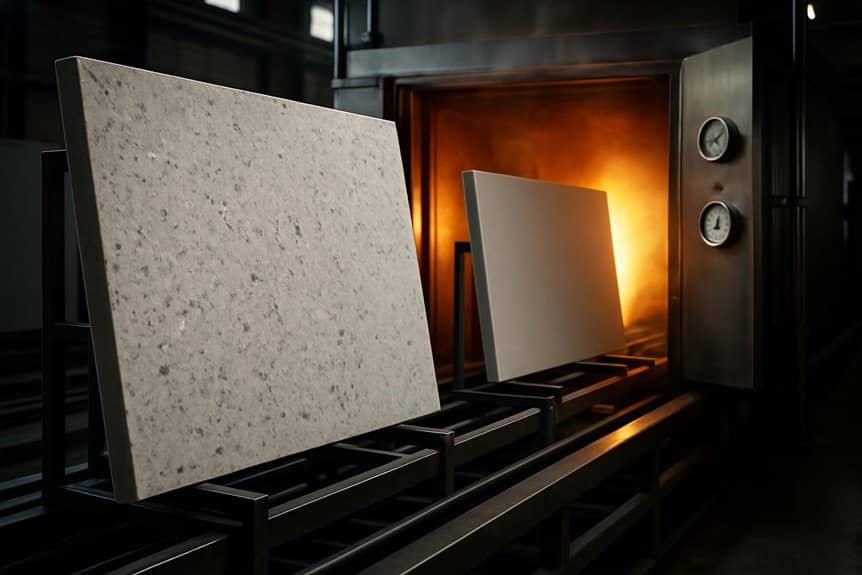
Quartz stone production line cost is primarily determined by production capacity, slab size, product range, automation level, and the specifications of core equipment such as press machines, polishing machines, and curing ovens.
Higher output targets, larger slab formats, broader texture or color capabilities, and advanced automation typically increase capital investment but can reduce labor and unit production costs.
Environmental systems, auxiliary equipment, energy efficiency, and component quality further affect total project cost, downtime risk, and long-term operating expenses.
Production capacity affects the cost of the entire quartz stone production line, not just one machine. As the target output increases, the batching, mixing, conveying, pressing, curing, polishing, and slab-handling systems must all be sized to maintain a balanced workflow. If one stage cannot keep pace, it becomes a bottleneck and reduces the practical output of the line.
A higher-capacity line may therefore require larger or additional mixers, faster conveying and distribution equipment, a press with a shorter production cycle or greater throughput, expanded curing capacity, and a higher-speed polishing line. More automated configurations may also need additional conveyors, buffer stations, sensors, and control systems to coordinate production between stages.
| Capacity factor | Typical cost impact |
|---|---|
| Batching and mixer capacity | Larger vessels or additional mixing units |
| Material conveying speed | More conveyors, feeders, and control components |
| Pressing throughput | Higher-capacity pressing, vacuum, and vibration systems |
| Curing capacity | Larger ovens, more curing positions, or additional zones |
| Polishing throughput | More polishing heads, motors, and slab-handling equipment |
| Line automation | Additional sensors, buffers, PLC controls, and transfer systems |
Buyers should select capacity according to realistic sales demand, planned operating shifts, expected utilization, and future expansion—not simply choose the largest line within the available budget. The right objective is a balanced production line that can achieve the required output consistently without unnecessary capital investment.
Beyond production capacity, slab size and product range directly determine the specification level and total cost of a quartz stone production line. A standard slab setup requires lower structural load, smaller molds, and simpler downstream matching. A jumbo slab configuration increases investment across the press, molds, curing system, conveyors, polishing equipment, cutting system, and handling equipment.
Controlled specifications prevent unnecessary capital oversizing.
A higher automation level usually increases the initial cost of a quartz stone production line because it adds automatic feeding, weighing, conveying, slab transfer, centralized control systems, and handling equipment.
These modules require sensors, drives, control logic, installation work, and commissioning time, so the engineered quartz production line cost rises compared with a semi-automatic layout.
The cost tradeoff is labor control and process stability. Automated batching and weighing reduce manual variation; conveyors and slab transfer reduce handling labor; centralized control improves parameter tracking and repeatability.
In factories where labor cost is high or output targets are strict, higher automation may reduce staffing demand and rework risk. Some users report labor savings of about 40%.
Consequently, automation level should be selected by balancing capital budget, labor rate, output volume, and quality requirements.
After automation level, the next major cost variable is the technical specification of the core equipment and components. A similar equipment list can hide a different production line configuration, which directly changes quartz stone making machine price.
Therefore, the lowest quotation often reflects lower specifications, not equal value.
Several auxiliary systems can materially change quartz stone production line cost because they determine whether the plant can run safely, continuously, and in compliance with environmental requirements.
A complete environmental system may include dust collection, wastewater recycling, sludge treatment, ventilation, and VOC control. These items add capital cost, but they reduce regulatory exposure, cleaning downtime, water consumption, and disposal expense.
Auxiliary equipment also affects the final budget. Compressed air stations, slab handling devices, electrical control cabinets, sensors, interlocks, and safety systems must match line capacity and automation level.
When suppliers exclude these systems or list them as optional, the quoted price may understate the real investment.
Buyers seeking cost control should verify scope, capacity ratings, energy demand, maintenance access, and integration responsibility before comparing production line proposals.
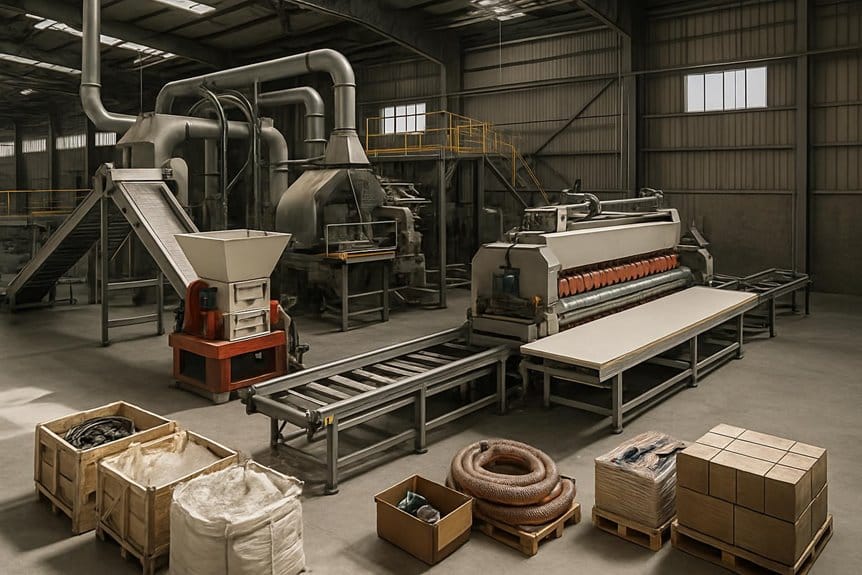
Although the equipment quotation is the core reference for a quartz stone production line cost estimate, it often excludes substantial project expenses outside the machinery scope.
For artificial quartz stone production line cost control, the equipment quotation should be audited line by line.
Common exclusions include:
Buyers should require written inclusion and exclusion lists, with cost responsibility assigned before contract signing and budget approval.
A quartz stone production line may be the largest single capital expense, but it is not the same as the total investment required to build and start a quartz slab factory.
At the budgeting stage, buyers should separate the equipment quotation from the wider project costs. This makes it easier to compare suppliers, identify excluded expenses, and build a realistic site-specific investment model.
| Budget item | Main cost drivers | Key control point |
|---|---|---|
| Production line equipment | Equipment scope, capacity, slab size, automation level, component specifications | Confirm the complete technical configuration and all included machines |
| Factory preparation | Existing building condition, floor loading, drainage, foundations, production layout | Complete the factory layout and civil-work plan before installation |
| Utilities and environmental systems | Power supply, water, compressed air, dust collection, wastewater treatment, ventilation | Check local utility capacity and environmental requirements |
| Logistics and installation | Shipping distance, container quantity, customs duties, lifting equipment, engineer travel, local labor | Define delivery terms and installation responsibilities clearly |
| Startup inventory | Quartz materials, resin, additives, pigments, packaging, consumables, spare parts | Prepare enough inventory for commissioning and trial production |
| Working capital | Labor, energy, maintenance, sales expenses, inventory turnover | Allow sufficient funds for the initial operating period |
A practical budgeting formula is:
Total project investment = production line equipment + factory preparation + utilities and environmental systems + logistics and installation + startup inventory + working capital
The final investment can vary significantly by country and project location. Factory construction, import duties, labor rates, utility infrastructure, raw material costs, and environmental compliance requirements must therefore be calculated for the actual site rather than estimated from the machine price alone.
This distinction is important because a low equipment quotation does not necessarily mean a lower total project cost. If essential utilities, environmental systems, installation services, or auxiliary equipment are excluded, the buyer may face substantial additional expenses later.
After the total factory investment has been separated into equipment, site, utility, logistics, and working-capital items, each quartz stone production line quotation should be normalized before price comparison.
The buyer should compare scope line by line, not only the final quartz stone production line price.
A semi-automatic line may appear cheaper, but if capacity, labor, or commissioning scope differs, the total is not directly comparable.
A compact comparison table improves purchasing control.
A disciplined cost-control plan starts by confirming the target slab size, thickness range, surface finish, color series, and expected monthly demand before any machinery is removed from the quotation.
Capacity should be sized to realistic sales volume, not maximum theoretical output. The quartz stone press, curing oven, and polishing or finishing systems should be protected first, because they determine density, flatness, curing stability, and final quality.
Capital expenditure can be controlled by separating essential equipment from optional upgrades, then applying automation only where it reduces labor, rejects, downtime, or handling risk.
The layout should still reserve space, utilities, and transfer routes for future expansion. Cutting necessary systems from the first order often causes local purchases, installation delays, manual bottlenecks, and unstable output.
Operating power, air, water, dust control, and staffing should be checked before approval.
Cost control only works when the quotation is based on measurable project data, not a generic request for “one quartz production line.”
To calculate a meaningful quartz stone production line cost, the supplier needs the target slab length, width, and thickness, whether standard or jumbo slabs are required, the expected output in slabs per hour or square metres per day, and the planned product styles.
Accurate quartz line pricing starts with slab size, output targets, slab format, and planned product styles.
Key quotation inputs include:
With these inputs, capacity, utilities, logistics, labor demand, and configuration can be priced with fewer assumptions.
Once you have a preliminary budget, the next step is to request a project-specific quotation rather than rely on a generic machine price. At SINONE, we configure each quartz stone production line according to your target capacity, slab dimensions, automation requirements, factory conditions, utility supply, destination, and installation scope.
We can quote standalone equipment, a complete production line, or a turnkey solution that includes equipment configuration, installation, commissioning, operator training, and technical support.
| Cost input | Information we need | Why it matters |
|---|---|---|
| Core equipment | Press, curing oven, calibrating and polishing line, cutting system | Establishes the main capital-equipment cost |
| Production target | Slab size, thickness, daily output, product range | Determines machine size and line capacity |
| Automation scope | Batching, mixing, distribution, transfer, handling and control systems | Affects equipment cost, labor demand and production consistency |
| Factory utilities | Voltage, power capacity, compressed air, water and drainage | Influences installation and operating requirements |
| Environmental systems | Dust collection, wastewater recycling, sludge treatment and ventilation | Affects compliance and total project scope |
| Shipping and installation | Export packing, destination port, freight, engineer travel and local labor | Determines landed and installed cost |
| Commissioning support | Trial production, operator training, process adjustment and acceptance testing | Reduces startup risk and supports stable production |
To prepare an accurate proposal, we will usually ask you to provide a factory drawing or available dimensions, local voltage and frequency, planned production capacity, slab specifications, destination port, installation schedule, and required acceptance criteria.
At SINONE, we specialize in quartz stone and inorganic stone production lines. We can support your project from production line planning and equipment manufacturing to installation, commissioning, training, and after-sales service. Our project materials highlight nearly 100 patents and experience from almost 300 production line projects across more than 30 countries and regions, giving us a strong technical basis for equipment configuration and project risk control.
Send us your target slab size, required output, factory information, automation preference, and destination country, and we will prepare a suitable production line configuration and detailed cost proposal.
Installation and commissioning usually take 30–60 days, depending on line configuration, factory readiness, and utilities. Sinone’s 200+ line experience, precision engineering, and end-to-end support reduce downtime, control labor costs, and accelerate stable production.
Like clockwork, quartz production equipment requires scheduled lubrication, belt inspection, press calibration, polishing head checks, oven temperature verification, dust removal, and electrical diagnostics. Proper preventive maintenance protects uptime, controls costs, and preserves automated line accuracy.
Yes. Sinone can customize lines for different slab sizes, configuring press machines, polishing, curing, CNC texture, and transfer systems. Modular engineering supports output control, cost planning, labor reduction, and stable production across residential to commercial applications.
Sinone provides post-installation operator training, but the critical detail is control: teams learn machine operation, safety, maintenance, troubleshooting, and process optimization, supporting lower downtime, labor savings, stable output, and faster production-line handover.
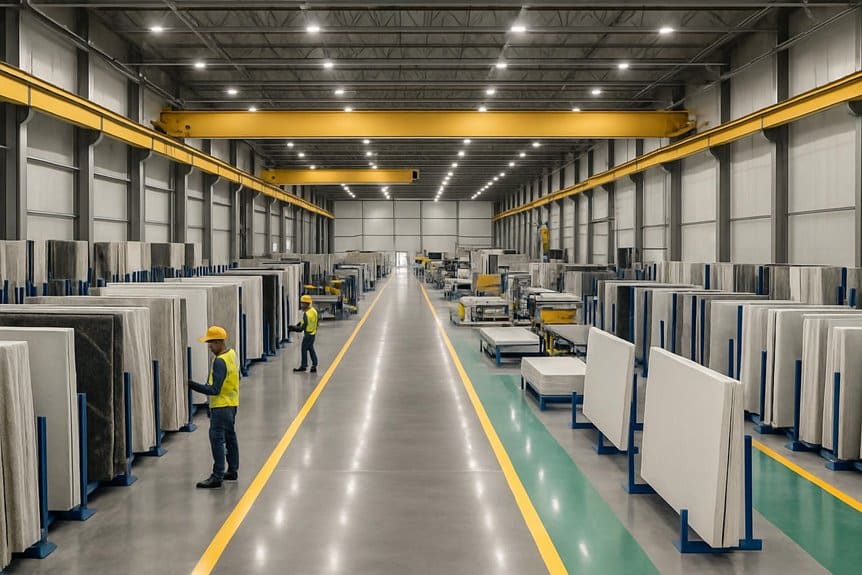
Factory space depends on configured machines, output target, material storage, curing, polishing, CNC, and logistics flow. Sinone’s 6000+ sqm manufacturing experience enables layout planning that controls footprint, labor movement, energy use, installation risk, and expansion capacity.
A quartz stone production line cost is not a single price tag but a balance sheet of capacity, automation, equipment scope, utilities, installation, labor, and lifetime efficiency. Like gears in a precision drive, each machine affects output and ROI. With 200+ delivered lines, patented technology, and integrated support, SINONE helps manufacturers compare quotations technically, control capital expenditure, and estimate total factory investment with clearer cost visibility before committing to a production plan.