Choosing the right quartz stone press machine depends on slab size, thickness range, target output, vacuum stability, vibration uniformity, and pressing force distribution. A suitable press removes trapped air, compacts the quartz-resin mix evenly, and maintains repeatable density and surface quality. Buyers should also check sealing reliability, automation, maintenance access, spare parts, and future capacity needs. Selection should focus on measurable slab quality, not tonnage alone, with further details explained in the sections below.
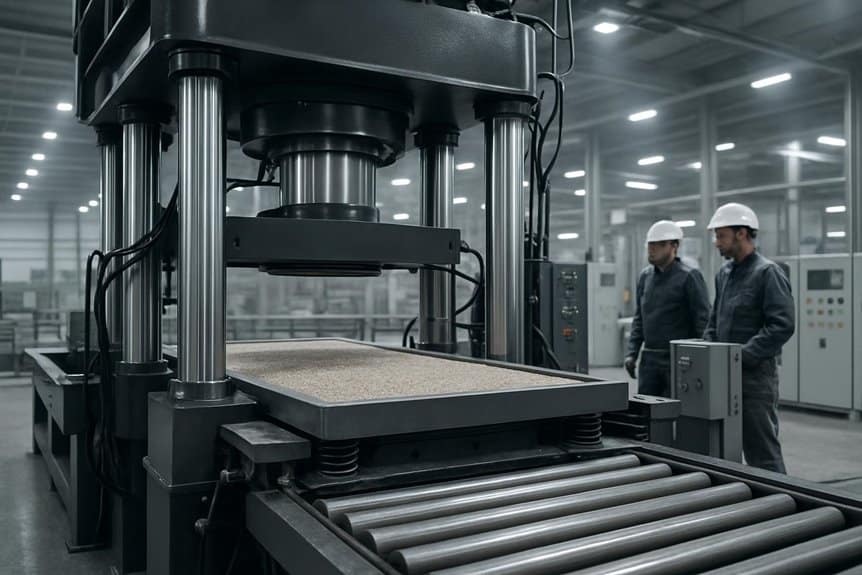
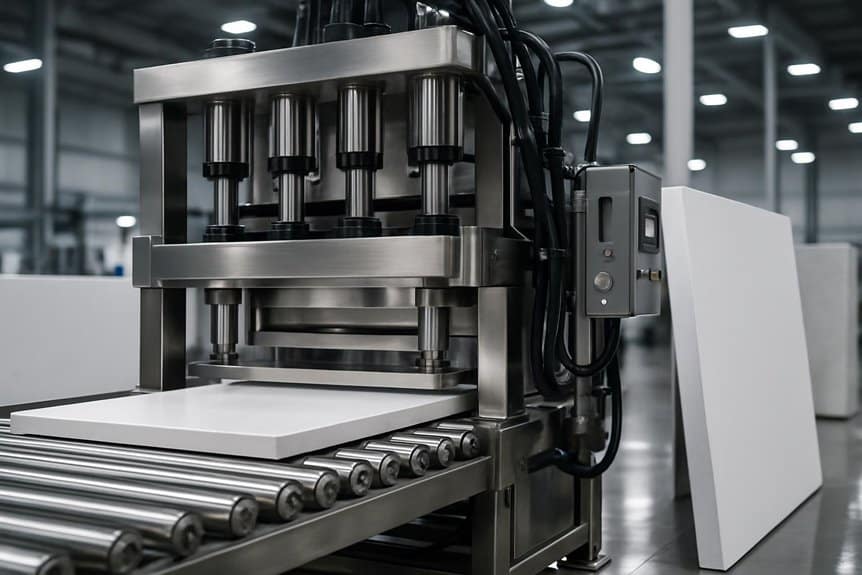
A quartz stone press machine is the core forming equipment in a quartz slab production line, positioned after material mixing and distribution and before curing. It is also called a quartz slab press machine or vacuum vibration press, depending on configuration. Its main role is to remove trapped air, compact the quartz-resin mixture, and form a controlled slab body ready for the next stage.
For producers, the machine defines consistency. Stable quartz press technology helps create repeatable density, thickness, and surface conditions before curing, reducing variation between batches.
Buyers usually compare quartz press specifications such as slab size, pressure capacity, vacuum performance, vibration control, automation level, and operating stability. The right selection gives plant managers tighter process control, predictable output, and a stronger foundation for efficient slab production.
Quartz stone pressing begins when distributed material enters the press and the pressing chamber is sealed.
Vacuum then removes trapped air while vibration rearranges and compacts the aggregate.
Finally, compression forms the slab into a dense, stable surface ready for curing and finishing.
Before pressing, the distributed quartz-resin mixture enters the press in a carefully leveled, pre-measured layer. At this stage, the material should already match the required slab size, target thickness, color distribution, and batch formula.
Any uneven spread, excess material, or low-density area can affect final slab consistency. A quartz stone pressing machine depends on this prepared feed condition to maintain predictable compaction results.
In controlled production, quartz slab pressing equipment receives the layer from the distribution system with minimal disturbance, preserving pattern accuracy and mass balance.
Moisture, resin ratio, aggregate grading, and surface flatness must be stable before vacuum vibro compression begins.
With quartz press automation, operators gain repeatable positioning, thickness control, and batch traceability, reducing manual variation before the pressing cycle advances to its next controlled stage.
Once the distributed material is positioned, the pressing chamber closes to isolate the slab layer from external air, dust, vibration, and uncontrolled pressure variation. This sealed state gives the engineered stone press machine a defined process boundary, so compaction can occur under repeatable mechanical conditions.
| Control point | Production effect |
|---|---|
| Air isolation | Limits disturbance to resin, quartz, and pigment layout |
| Dust exclusion | Protects slab surface consistency |
| Vibration shielding | Helps maintain uniform material distribution |
| Pressure stability | Supports predictable density control |
For buyers, sealing quality directly affects process authority. A chamber that locks tightly helps prevent edge variation, shifting patterns, and inconsistent thickness before pressing force is applied. It also supports accurate planning of quartz press capacity because each cycle begins from a controlled, repeatable state.
After sealing, the press applies vacuum to draw trapped air out of the mixed quartz, resin, pigment, and additive layer. This step reduces voids before densification begins.
Air pockets matter because they can become pinholes, weak spots, color inconsistencies, or internal defects after curing and polishing. A controlled vacuum stage helps the slab achieve a more uniform structure and a cleaner surface standard.
For production managers, vacuum performance is a control point, not a background function. Stable vacuum level, reliable chamber sealing, and consistent evacuation time all affect repeatability.
If air removal is incomplete, later pressure cannot fully correct the defect risk. A suitable quartz stone press should thus allow operators to monitor vacuum status, set process parameters, and maintain predictable slab quality across batches and shifts.
With trapped air removed, the quartz mix must still be rearranged into a denser internal structure. Vibration supplies controlled movement that lets quartz particles shift, rotate, and settle into tighter packing. Larger grains find stable positions while smaller particles fill gaps between them, improving uniformity across the slab bed.
Static pressure alone can force the mix downward, but it may not overcome friction, bridging, or uneven particle contact inside the aggregate. Without vibration, locked particles can preserve hidden voids and density variation.
A well-designed press uses vibration parameters that match the mix formula, mold depth, and target slab quality. Frequency, amplitude, and duration must remain adjustable, giving operators control over compaction behavior before final forming force is applied in the next stage.
Apply controlled force, and the compacted quartz mix begins to take its final slab form. At this stage, the press applies calibrated pressure across the mould surface, driving particles closer together and reducing internal gaps left after vibration.
The objective is not brute force, but repeatable force distribution. Stable pressure helps create uniform density from edge to center, limiting weak zones, thickness variation, and inconsistent surface response.
A suitable quartz stone press allows operators to manage pressure level, pressing area, and timing with accuracy. This control supports predictable slab geometry and reliable downstream handling.
If pressure is uneven, the slab may show density imbalance or dimensional deviation. When compression is stable, the mix holds its designed shape with greater consistency, giving production managers tighter control over quality before the cycle advances.
Once the programmed vacuum, vibration, and compression stages are complete, the pressing cycle ends and the formed slab moves toward curing. At this point, the press has delivered its controlled sequence, and the slab should have consistent density, reduced air content, and a stable formed shape ready for the next production stage.
The engineering relationship is straightforward:
| Mechanism | Main Function |
|---|---|
| Vacuum | Reduces trapped air |
| Vibration | Rearranges and compacts particles |
| Compression | Consolidates and forms the slab |
This sequence shows why press selection should not focus only on advertised pressing force. A quartz stone press is best evaluated as an integrated vacuum-vibration-compression system. Buyers seeking process control should examine timing accuracy, synchronization, stability, and repeatability across the full pressing cycle and equipment layout.
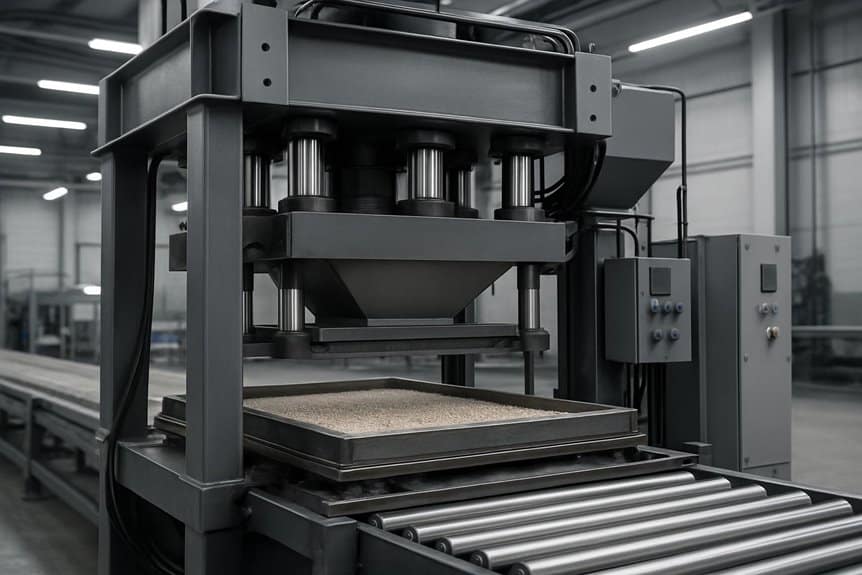
A quartz stone press machine is built around several critical systems that work together to form dense, uniform slabs.
Its main components include the structural frame and pressing structure, vacuum chamber and sealing system, vibration system, force-application system, and mold and slab support system.
Understanding these parts helps clarify how machine design affects slab quality, efficiency, and long-term reliability.
Rigidity defines the structural frame and pressing structure of a quartz stone press machine, because the system must remain stable under repeated loading during slab forming. The frame carries compression forces, maintains alignment, and limits deformation that could affect slab thickness, density, or surface uniformity.
A controlled structure supports predictable output and reduces mechanical stress over long production cycles.
For buyers, the frame should be judged by stiffness, machining accuracy, weld quality, and service accessibility.
Strong structure gives operators better control over production consistency, maintenance planning, and equipment lifespan.
When air remains trapped in the quartz mixture, the vacuum chamber and sealing system determine how effectively it is removed before and during pressing. A well-designed chamber gives the producer control over slab density, surface quality, and reject rates. Its structure should resist deformation under repeated negative pressure, while access points must close consistently without alignment drift.
| Component | Control Value |
|---|---|
| Chamber body | Maintains stable vacuum space |
| Door seals | Prevents air leakage |
| Vacuum pump system | Generates required negative pressure |
| Monitoring instruments | Confirms pressure consistency |
Reliable seals are critical because minor leakage can reduce compaction uniformity. Vacuum gauges, sensors, and alarms allow operators to verify conditions before pressing begins. For disciplined production, the preferred system is one that makes vacuum status visible, repeatable, and easy to audit.
Vibration drives compaction by helping the quartz mixture settle, flow, and release remaining voids under pressure. A well-specified vibration system gives operators tighter control over slab density, surface consistency, and repeatable production results.
Controlled force gives a quartz stone press the compression needed to densify the slab, but performance depends on how that force is generated, guided, synchronized, and distributed across the mold—not on tonnage alone. The force-application system typically combines hydraulic power, cylinders, guide structures, sensors, and control logic to maintain repeatable pressure behavior during pressing.
| Component | Control function |
|---|---|
| Hydraulic unit | Generates adjustable pressing force |
| Press cylinders | Transfer force with stable stroke |
| Guide columns | Keep movement aligned |
| Pressure sensors | Verify applied load |
For controlled production, the buyer should assess pressure regulation accuracy, cylinder synchronization, frame rigidity, and response speed under load. A well-designed system applies force evenly and predictably, reducing density variation, trapped voids, and slab instability while giving operators measurable control over each pressing cycle.
Match the mold and slab support system to the required slab dimensions to keep forming stable from loading through demolding. This assembly defines slab length, width, thickness, edge alignment, and underside support during compaction. A controlled fit reduces shifting, corner defects, uneven density, and breakage risk after pressing.
For buyers, the key measure is dimensional control. A press may have strong force application, yet poor slab support can still cause rejects.
Stable molds give operators predictable output, cleaner edges, and better process authority.
Coordinate the press through a PLC and control system that manages cycle control, vacuum monitoring, vibration settings, production recipes, fault monitoring, and operating data. This unit defines how each slab cycle starts, runs, adjusts, and stops, giving production teams repeatable command over pressing conditions.
A suitable PLC should support accurate timing, stable signal response, and clear parameter adjustment. Vacuum values, vibration frequency, pressure stages, and recipe data should be displayed in an organized interface so operators can confirm settings before production.
Recipe storage helps standardize different slab sizes, colors, and formulations while reducing manual input errors.
Fault monitoring should identify abnormal vacuum, vibration, motor, sensor, or timing conditions quickly. Operating data should support process review, maintenance planning, and controlled optimization across shifts and production batches.
Evaluate press design by looking at how it changes the finished slab, not only by its mechanical specifications. Stable pressing gives production managers tighter control over quality outcomes.
Good press design is measured by finished-slab consistency, not mechanical specifications alone.
Pressing consistency matters, but it does not work alone. Raw materials, batching, mixing, distribution, curing, and finishing also influence final quality.
Press design simply makes those variables easier to control.
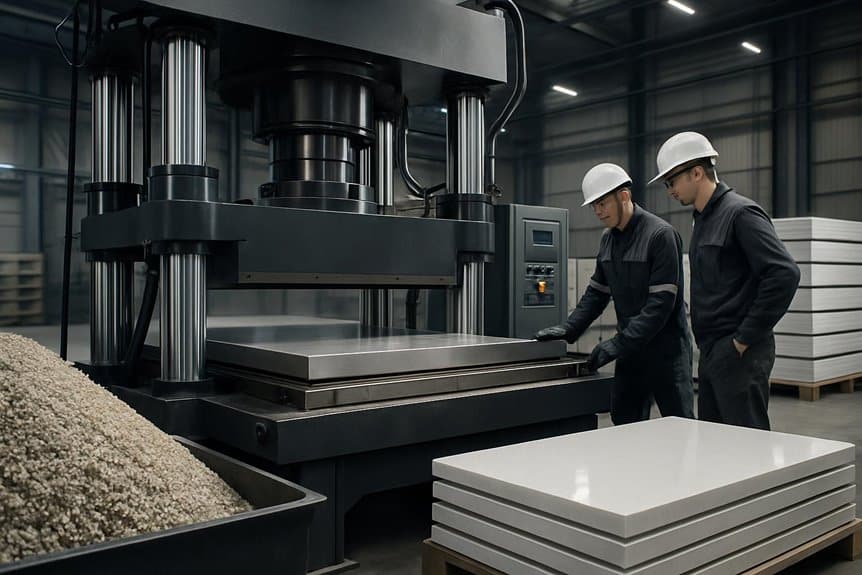
Choosing the right quartz stone press machine requires evaluating slab size and pressing area, slab thickness range, and required pressing force.
Force distribution, vacuum performance, and vibration performance directly influence compaction quality and slab consistency.
These factors should be matched to the intended product range, production scale, and quality requirements.
Slab size is one of the first technical factors to define when selecting a quartz stone press machine. The press must match the producer’s target format while preserving control over cost, space, and output planning.
An undersized press limits order capability and may force early equipment replacement. An oversized press can raise investment, footprint, and operating requirements without proportional return.
The right pressing area gives the manufacturer controlled capacity, efficient layout planning, and room to serve market changes.
Thickness range directly affects what a quartz stone press machine can produce and how easily a factory can serve different market segments. A buyer should confirm the machine’s minimum and maximum slab thickness before selection.
Thin slabs may suit wall panels, furniture surfaces, and lightweight applications, while thicker slabs are often required for countertops, commercial interiors, hospitality projects, healthcare spaces, and public-area installations.
Product range also depends on how quickly the press can adapt to different specifications. Factories serving multiple customers need controlled adjustment, repeatable settings, and stable operation across varied slab formats.
A machine limited to one narrow thickness range may restrict order acceptance and reduce production flexibility. The preferred choice is a press that supports planned product lines today while leaving room for future slab variations.
After confirming product range requirements, buyers should assess how pressing force is applied across the full forming area. Tonnage alone is not a reliable selection standard. A press with higher rated force may still produce uneven compaction if force transfer is unstable or poorly matched to slab size.
Key factors should be reviewed together:
The practical goal is controlled compaction, not maximum tonnage.
Buyers seeking stable production should examine how mechanical design, vibration, material recipe, and cycle parameters interact. Higher tonnage does not automatically create denser, flatter, or more consistent quartz slabs in actual operation.
Vacuum performance is a critical selection factor because trapped air directly affects slab density, surface quality, and long-term consistency. Buyers should examine achievable vacuum level, but should not rely on one headline number. A stronger indicator is whether the press can reach and hold the required vacuum repeatedly under real production conditions.
Vacuum stability shows how well the system resists leakage, pressure fluctuation, and cycle-to-cycle variation.
Evacuation speed also matters because slow air removal can limit throughput and process control. Sealing reliability should be checked at chamber doors, pipelines, valves, and flexible connections, since small leaks can compromise slab quality.
Effective monitoring gives operators clear vacuum data, alarms, and maintenance visibility. The right system provides measurable control over every cycle, not merely a promising specification on paper.
Air removal is only part of slab compaction; vibration performance determines how evenly the quartz mixture settles, densifies, and fills the mold. Buyers should examine whether the press gives operators stable, measurable control over vibration behavior, especially when producing larger slab formats where weak zones become more visible.
A suitable quartz stone press machine should deliver repeatable vibration uniformity across the full slab area, giving production teams tighter control over slab density, surface quality, and reject risk.
When evaluating pressing cycle and required capacity, buyers should distinguish the press’s cycle time from the factory’s real production output.
Pressing cycle means the time required for one pressing operation, including slab positioning, vibration, vacuum pressing, pressure holding, release, and unloading readiness. A shorter cycle can improve potential output, but it does not define total plant capacity alone.
Actual throughput depends on the entire slab production sequence: raw material loading, mixing, material distribution, curing, handling, finishing, and planned or unplanned downtime.
If these stages are slower than the press, the press will wait; if the press is slower, it becomes the bottleneck.
Buyers should calculate required daily slabs, slab sizes, shift hours, and acceptable downtime, then select a press capacity that matches the full line, not just nameplate cycle speed.
Automation is valuable only when it gives the quartz stone press stable, repeatable control over the factors that affect slab quality. Buyers should judge the control system by its ability to reduce uncontrolled process variation, not by the number of screens, buttons, or interfaces. A suitable system keeps critical settings visible, adjustable, protected, and traceable.
The right automation gives managers discipline, operators guidance, and maintenance teams reliable evidence when performance changes.
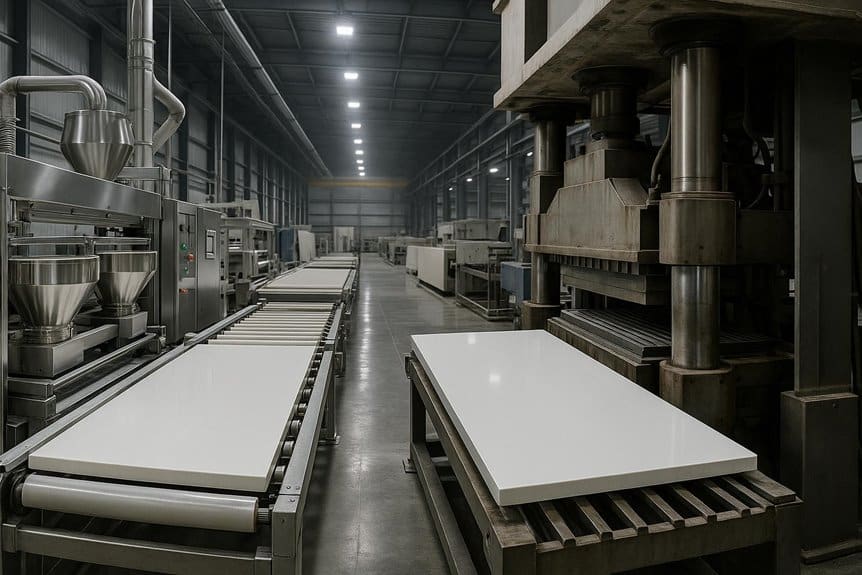
Because a quartz stone press works within a wider manufacturing flow, it should be evaluated as part of the complete production line rather than as a standalone machine. The buyer should assess how upstream material distribution feeds the press, whether batching, spreading, and leveling can match the required cycle, and whether loading and unloading methods support consistent slab handling.
Conveyor layout, transfer equipment, and positioning accuracy also affect control over timing, slab alignment, and workflow continuity.
Downstream curing capacity must be checked against press output, since an unmatched curing oven can create queues or idle time. The same logic applies to conveyors between pressing, curing, and later processing.
A suitable press should fit the line’s target capacity, space, automation level, and transfer rhythm, giving production managers predictable throughput.
Evaluating reliability starts with how easily the quartz stone press can be inspected, serviced, and restored after wear or failure. A buyer should compare suppliers by measurable service factors, not claims. The stronger choice gives plant managers predictable uptime, clear maintenance control, and fast recovery when production pressure is high.
A dependable supplier reduces downtime by making repair decisions faster, safer, and less dependent on improvisation, especially during continuous slab production.
After reliability, maintenance, and spare-parts support have been reviewed, the next step is to give the manufacturer enough project data to match the quartz stone press machine to real production needs.
The buyer should prepare slab dimensions, thickness range, intended products, target daily or annual capacity, and planned number of shifts. Automation level should also be stated clearly, including loading, pressing, conveying, and control preferences.
Factory conditions matter as much as output targets. The manufacturer should receive available space, electrical requirements, existing equipment details if the line is being upgraded, destination country, and installation requirements.
This checklist gives both sides control over scope, layout, utilities, and service planning. The selection process then becomes structured: define requirements, evaluate the technical configuration, and request an appropriate quotation.
Several common mistakes can turn a quartz stone press investment into a bottleneck for the entire production line. Buyers seeking control should evaluate performance as a system, not as isolated specifications.
A disciplined selection process prevents expensive constraints. It should prioritize measurable output quality, stable vacuum, line compatibility, upgrade space, and reliable technical service.
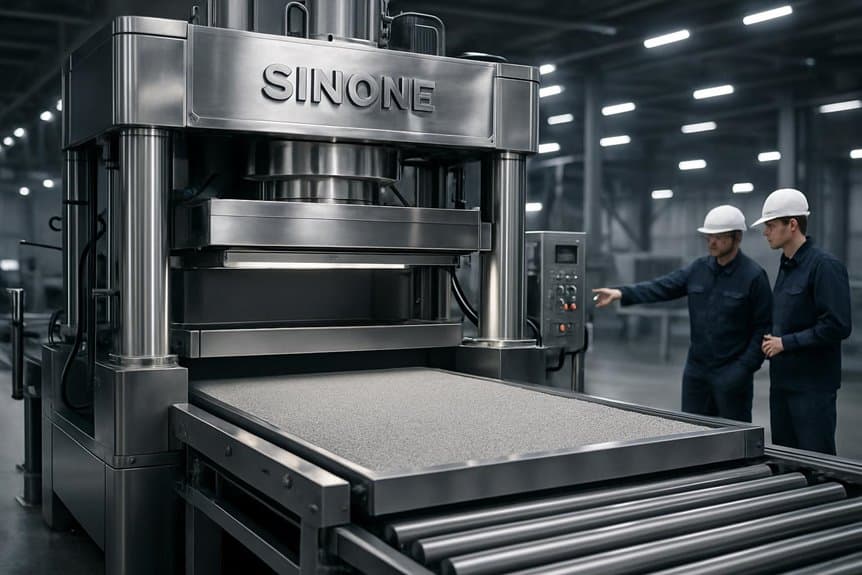
Once requirements for compaction quality, vacuum stability, vibration uniformity, production capacity, and line integration are established, a quartz press can be evaluated by how consistently it delivers those conditions in actual production.
SINONE specializes in quartz and engineered-stone production equipment, with its air-spring press technology forming a core part of its pressing system. The machine combines vacuum evacuation, high-frequency vibration, and controlled pressing to compact the quartz-resin mixture more uniformly, reduce trapped air and internal voids, and support consistent slab density and forming quality.
The press is supported by automated process control, allowing key operating parameters and pressing cycles to be managed consistently across production batches. For complete-line projects, the pressing system can also be coordinated with upstream material handling and downstream curing, calibration, polishing, and slab-transfer equipment, helping avoid capacity mismatches between individual production stages.
SINONE further provides installation, commissioning, operator training, and technical support, so press performance is addressed not only at equipment delivery but also during line start-up and ongoing production.
Installation and commissioning usually take two to four weeks, depending on site readiness, line configuration, and operator training needs. A structured schedule, prepared utilities, and coordinated technical support help management control downtime and acceptance.
Like a cockpit checklist, operators require structured training in controls, loading, emergency stops, guarding, maintenance locks, fault response, and quality checks. Supervised practice guarantees disciplined operation, reduced downtime, and controlled, repeatable safe production.
Maintenance should follow daily inspections, weekly lubrication and fastening checks, monthly calibration, and scheduled professional servicing every six to twelve months. Operators retain control by logging conditions, downtime, parts wear, and service actions consistently.
Overseas customers receive end-to-end after-sales support, including remote diagnostics, installation guidance, operator training, spare parts coordination, rapid response service, and tailored technical assistance, enabling controlled maintenance, stable production, and minimized downtime across global installations.
Yes, the press can integrate with existing production lines. Configuration depends on layout, automation level, and upstream or downstream equipment. The technical team assesses interfaces, control requirements, and workflow to guarantee controlled, stable production continuity.
Choosing the right quartz stone press machine should not come down to price, tonnage, or advertised cycle speed alone. Buyers need to evaluate how effectively the machine combines vacuum, vibration, compression, structural stability, automation, and line integration for the slab sizes, thicknesses, product types, and production capacity they plan to achieve.
A press that is properly matched to the production requirements can support more stable forming, better slab consistency, and more reliable long-term operation. The goal is not simply to buy a more powerful machine, but to select a pressing system that fits the factory’s actual process and production needs.
Planning a new quartz slab line or upgrading an existing press? Provide SINONE with your target slab size, thickness, capacity, and automation requirements to discuss a suitable press configuration.


[…] slab press machine price can vary widely because the press is not a standard-cost item. Pressing area, tonnage, mold size, vacuum-vibration design, hydraulic system, automation level, […]
[…] In this sense, BretonStone is best understood as an integrated engineered-stone manufacturing platform rather than a standalone quartz press machine. […]