Quartz slab decoration technologies allow manufacturers to create marble-look veins, printed designs, and three-dimensional surface textures using different production methods. Decorative effects may be formed within the quartz mixture before pressing or introduced through specialized surface-processing equipment after slab formation.
The manufacturing method determines more than appearance. It also influences pattern consistency, material preparation, equipment requirements, processing sequence, and production capacity.
Pre-press veining, thermal transfer printing, and CNC texture drawing are three approaches used to produce decorative engineered quartz slabs. Each creates a different result and requires specific process controls.
For manufacturers developing new slab collections or upgrading existing equipment, understanding these differences is essential before selecting a decoration system.

Decorative effects can be introduced at different stages of the quartz slab manufacturing process.
Some patterns are formed by arranging differently colored quartz mixtures before pressing. Others are applied to a prepared slab surface through printing technology or created by mechanically processing the surface into a specified texture.
The main distinction is whether the decoration changes the material's internal color arrangement, adds a visual surface pattern, or modifies the physical surface geometry.
| Decoration method | How the effect is created | Principal result |
|---|---|---|
| Pre-press veining | Separately colored materials or pigments are arranged before slab compaction | Internal color patterns and marble-like veins |
| Thermal transfer printing | Decorative patterns are transferred from suitable media under controlled processing conditions | Detailed surface imagery and repeatable printed designs |
| CNC texture drawing | CNC-controlled mechanical processing creates specified surface textures | Physical relief, directional textures, and three-dimensional effects |
These methods are not interchangeable.
A printed marble pattern can reproduce detailed visual characteristics without necessarily extending through the slab body. CNC texture drawing can create physical relief, but it does not independently reproduce the full range of colors available through printing.
Pre-press veining creates a different effect because the color arrangement is incorporated into the slab material during forming.
Manufacturers should therefore begin by defining the intended decorative appearance and physical surface characteristics rather than selecting machinery based only on its processing speed or automation level.
Pre-press veining creates decorative patterns before the quartz mixture undergoes final compaction.
The process generally begins by preparing quartz aggregates, powders, resin, pigments, and additives according to the required formulations.
Different color mixtures are prepared separately and then introduced into the forming area in controlled arrangements.
Depending on the required design and production system, manufacturers may use manual placement, controlled material distribution, or specialized veining equipment.
The resulting appearance depends on how the colored materials are positioned and how they behave during subsequent pressing and curing.
In conventional single-color quartz production, mixing aims to distribute pigments consistently throughout the batch.
Marble-look production requires a different approach.
The objective is to preserve selected color differences while creating the intended movement and distribution of veins.
Several factors influence the result:
Pattern control is particularly important when manufacturing decorative slabs at industrial scale.
A visually attractive trial slab does not automatically establish that the same pattern can be reproduced consistently across production batches.
Manufacturers must evaluate how their mixing, distribution, pressing, and curing processes interact.
Pre-press veining is suitable when the intended product requires decorative color arrangements formed within the quartz mixture.
This may include marble-look slabs with contrasting veins, flowing color transitions, or other effects created during material distribution.
The method should be selected according to the required pattern characteristics, production volume, and available forming technology.
The depth and continuity of the resulting pattern depend on the actual production method. Not every pre-press veining arrangement produces identical through-body effects.
Specialized veining equipment should therefore be evaluated according to the specific material-distribution method and intended slab design.

Thermal transfer printing provides a different approach to quartz slab decoration.
Rather than arranging colored mixtures before pressing, the process transfers a prepared decorative image onto a compatible slab surface using controlled heat, pressure, and processing time.
It is particularly useful for reproducing detailed marble-look graphics, natural-stone-inspired patterns, and customized surface designs.
The process begins with preparing the intended decorative design and suitable transfer media.
The slab is then prepared and positioned according to the requirements of the printing system.
Surface condition is important because contamination, irregularities, or unsuitable material characteristics may affect the transfer result.
Once the slab and transfer media are positioned, the equipment applies the specified processing conditions to transfer the decorative pattern.
The main operations include:
The specific transfer mechanism depends on the ink or colorant system, transfer media, and slab material.
A printed pattern should not automatically be described as penetrating the entire slab thickness or providing a particular durability level without appropriate testing.
Several parameters influence the consistency of industrial thermal transfer printing.
| Parameter | Manufacturing consideration |
|---|---|
| Transfer media | Must be compatible with the colorant system and substrate |
| Slab surface condition | Affects transfer uniformity and appearance |
| Temperature | Must remain within the validated transfer conditions |
| Pressure | Influences contact between transfer media and slab |
| Processing time | Must support the required transfer without unsuitable thermal exposure |
| Pattern registration | Determines design alignment and repeatability |
| Slab handling | Must prevent movement or damage during processing |
These variables must work together.
For example, a correctly prepared decorative image may still produce inconsistent results if the transfer media moves during processing or if temperature distribution is unsuitable.
Manufacturers should also evaluate the finished pattern against the intended product specifications.
Visual inspection may include color consistency, image clarity, registration, incomplete transfer, and other surface irregularities.
Where required, additional performance testing should verify the suitability of the decorative surface for its intended applications.

Our Thermal Transfer Printing Production Line integrates controlled heating, pressure, slab conveying, and automated processing functions.
The system is designed to reproduce decorative patterns on engineered quartz and inorganic stone slabs using suitable transfer media.
For industrial manufacturers, the equipment configuration must consider slab dimensions, material compatibility, transfer conditions, target production capacity, and downstream handling requirements.
Thermal transfer printing is particularly relevant when the manufacturing objective involves detailed visual patterns rather than physical surface relief.
CNC texture drawing creates decorative effects by mechanically processing the surface of an engineered stone slab.
Unlike thermal transfer printing, which introduces a visual pattern, CNC texture drawing modifies the physical characteristics of the surface.
CNC-controlled equipment follows programmed processing paths to create the intended texture geometry.
The resulting effects may include directional lines, brushed appearances, natural-stone-like relief, and customized geometric textures.
A texture design is first translated into the processing instructions required by the CNC system.
The slab is positioned and supported so that the equipment can follow the programmed paths consistently.
During processing, the system controls relevant movement and texture parameters, including depth, spacing, direction, and speed.
The exact mechanical interaction depends on the selected tooling and equipment configuration.
The main manufacturing considerations include:
Texture geometry: The required depth, spacing, and direction determine the appearance and physical character of the finished surface.
Slab positioning: Consistent support and alignment help maintain processing accuracy across large slab dimensions.
Tooling and machine condition: The mechanical processing system must remain suitable for the slab material and specified texture.
Program repeatability: Consistent CNC instructions support repeatable decorative effects across production batches.
Surface inspection: Finished textures must be checked for continuity, geometric consistency, and unintended surface damage.
For industrial production, maintaining consistent processing conditions becomes especially important when the same design is manufactured repeatedly.
CNC texture drawing can produce effects that conventional printing cannot create independently.
These include physical grooves, directional relief, and surfaces with controlled tactile characteristics.
The technology can also be used to develop decorative finishes that differ from conventional polished quartz slabs.
However, CNC texture drawing does not automatically produce detailed multicolor graphics.
Its primary function is mechanical surface structuring.
Our CNC Texture Drawing Production Line combines CNC-controlled processing with automated slab conveying and programmable texture patterns.
The equipment can be configured according to the required slab dimensions, texture geometry, production capacity, and integration requirements.
Manufacturers should select this technology when the intended product requires physical surface decoration rather than purely visual color patterns.

Pre-press veining, thermal transfer printing, and CNC texture drawing offer different ways to manufacture decorative quartz slabs.
Although each technology can contribute to a differentiated product range, the processing principles and equipment requirements are substantially different.
| Comparison | Pre-Press Veining | Thermal Transfer Printing | CNC Texture Drawing |
|---|---|---|---|
| Main function | Creates color arrangements within the slab mixture | Transfers decorative surface imagery | Creates physical surface textures |
| Production stage | Before final pressing | Dedicated surface decoration operation | Mechanical surface processing |
| Decorative result | Internal color patterns and veins | Printed colors, graphics, and natural-stone patterns | Grooves, relief, and directional textures |
| Main controls | Material placement, pigment distribution, pressing compatibility | Transfer media, temperature, pressure, timing, registration | Programmed paths, depth, spacing, machine movement |
| Primary equipment | Material distribution or specialized veining systems | Thermal transfer printing equipment | CNC texture processing equipment |
| Main limitation | Pattern development depends on material behavior during forming | Appearance and performance depend on the transfer system and substrate | Cannot independently reproduce detailed multicolor imagery |
| Main quality checks | Vein placement, color separation, pattern repeatability | Image clarity, transfer uniformity, registration | Texture geometry, continuity, surface condition |
Combining decorative technologies may be possible when the processes and slab materials are compatible.
For example, a manufacturer may produce internal color arrangements during slab forming and subsequently apply an additional decorative surface treatment.
A printed design and a physical texture may also be combined in a suitable production arrangement.
However, the processing order must be evaluated carefully.
Mechanical texturing can change surface geometry, potentially affecting later image transfer. Similarly, a processing operation performed after printing may influence the transferred pattern.
The correct sequence depends on the decorative system, material properties, and required finished result.
Different decorative technologies should only be combined after compatibility testing and production trials.
Decorative quality cannot be evaluated using one universal inspection method.
The relevant parameters depend on whether the decoration is formed inside the slab, transferred onto the surface, or created through mechanical processing.
For internal veining, manufacturers should evaluate color placement, pattern distribution, unintended blending, and consistency after pressing and curing.
The initial arrangement of colored materials may change during compaction.
Therefore, inspection should consider the appearance of the finished slab rather than only the pattern before pressing.
For thermal transfer printing, quality control should consider:
Printing parameters should be recorded and evaluated alongside the finished surface.
Where required by the product specification, appropriate testing should assess the performance of the transferred decorative effect.
For CNC texture drawing, the focus shifts to physical surface geometry.
Inspection may include texture depth, spacing, direction, continuity, and consistency across the slab.
Tool wear, machine alignment, and slab positioning may influence the result.
Repeated production should be evaluated against the approved texture design and dimensional requirements.
Decorative equipment cannot necessarily correct defects originating during earlier manufacturing stages.
Poor slab flatness may affect surface processing. Visible pinholes, cracks, or contamination may also compromise the intended decorative appearance.
Before downstream decoration, manufacturers should confirm that the slab has reached the required processing condition.
This includes suitable curing, dimensional stability, surface preparation, and handling readiness for the selected technology.
For pre-press veining, the relevant controls are different because the decorative process occurs before the slab is fully formed.

Choosing between different quartz slab decoration technologies should begin with the product the factory intends to manufacture, including its visual appearance, surface characteristics, and production requirements.
The first question is not which machine offers the most features. It is whether the required decorative effect is internal, visual, physical, or a combination of these characteristics.
A manufacturer developing marble-look products may require a different production approach from one planning textured architectural slabs.
The table below summarizes the main selection considerations.
| Manufacturing objective | Technology to evaluate | Important considerations |
|---|---|---|
| Marble-like veins incorporated into the slab mixture | Pre-press veining and controlled material distribution | Formulation compatibility, color placement, pressing, curing |
| Detailed surface graphics | Thermal transfer printing | Material compatibility, transfer media, pattern registration, processing conditions |
| Repeatable decorative patterns | Thermal transfer printing | Design preparation, alignment, consistent processing |
| Three-dimensional surface textures | CNC texture drawing | Texture geometry, tooling, slab condition, processing accuracy |
| Multiple decorative effects | Combination of compatible technologies | Process sequence, material compatibility, additional handling |
| Expanding an existing product range | Suitable decoration equipment upgrade | Production capacity, available factory space, equipment integration |
Manufacturers should establish the intended pattern appearance, surface characteristics, and product specifications.
For example, if a slab requires detailed visual marble veins without physical relief, thermal transfer printing may be worth evaluating.
If the intended surface requires controlled grooves or tactile texture, CNC texture drawing is more directly relevant.
When veins must form part of the slab material itself, pre-press distribution and veining methods should be considered.
These distinctions help prevent investment in equipment that cannot produce the intended decorative result.
Decoration equipment must be sized according to the factory's required output.
Relevant considerations include the time needed for processing, slab positioning, changeovers, inspection, and material handling.
Manufacturers should also determine how frequently designs will change.
A factory producing a limited range of standardized patterns may have different automation requirements from one manufacturing numerous customized designs.
Pattern repeatability, design preparation, equipment maintenance, and operating costs should be included in the evaluation.
The equipment purchase price is only one part of the investment.
Additional costs may involve conveying systems, loading and unloading equipment, utilities, control integration, installation, training, and process validation.
Consumables and maintenance requirements also vary between decorative technologies.
Manufacturers should compare these requirements against the expected product range and production volume rather than selecting equipment solely on its initial price.
Existing quartz slab manufacturers may be able to introduce new decorative equipment without replacing the entire manufacturing line.
However, the technical feasibility depends on the equipment already installed and the requirements of the intended decorative process.
The decoration method determines where the equipment should be installed.
Pre-press veining must be integrated into material preparation or distribution before final forming.
Thermal transfer printing and CNC texture drawing require suitable slab surface-processing stages.
For these systems, the appropriate location depends on slab condition, curing readiness, surface preparation, downstream operations, and equipment requirements.
Installing decoration equipment at the wrong production stage may result in unnecessary handling or incompatible processing conditions.
Before integrating new equipment, manufacturers should evaluate:
For example, installing a high-capacity decoration machine provides limited benefit if the existing conveying equipment cannot supply or remove slabs at the required rate.
The additional process should be evaluated as part of the complete production system.
Before full-scale operation, the upgraded line should undergo appropriate commissioning and process trials.
The evaluation should confirm:
At SINONE, we provide production line upgrade solutions for manufacturers seeking to modernize existing equipment or introduce new processing capabilities.
Our engineering team can evaluate machinery compatibility, factory layout, automation requirements, and process integration before recommending an equipment configuration.
Pre-press veining creates decorative color arrangements within the uncured quartz mixture before slab compaction.
Thermal transfer printing applies a decorative image through a separate surface-processing operation using suitable transfer media and controlled heat and pressure.
The two methods produce different pattern characteristics and require different equipment arrangements.
Thermal transfer printing should not automatically be considered a through-body decoration process.
The depth and characteristics of the transferred pattern depend on the colorant system, transfer media, slab material, and operating conditions.
Manufacturers requiring decoration throughout the slab body should evaluate appropriate pre-press material-distribution methods.
They may be combined when the equipment, slab material, and processing sequence are compatible.
However, mechanical texturing changes surface geometry, which can affect subsequent printing or transfer operations.
Similarly, processing a slab after printing may influence the decorative image.
The combination should be validated through production trials before industrial implementation.
Effective capacity depends on processing time, slab dimensions, equipment configuration, design changes, conveying, positioning, and inspection.
The sustainable output must also account for production interruptions and integration with adjacent machinery.
Manufacturers should evaluate the complete decoration process rather than relying only on a machine's rated operating speed.
Yes, provided the existing factory can accommodate the machinery and its operating requirements.
The evaluation should include available space, slab handling, processing sequence, electrical and automation interfaces, production capacity, and material compatibility.
Some projects may require additional conveying equipment or modifications to the existing production arrangement.
Different decorative quartz slab products require different manufacturing technologies. Selecting the appropriate equipment begins with the intended surface appearance, slab specifications, and production requirements.
At SINONE, we provide CNC texture drawing and thermal transfer printing systems for engineered quartz and inorganic stone manufacturing.
Our equipment can be configured according to slab dimensions, target patterns, production capacity, automation requirements, and factory integration conditions.
Planning to Introduce New Decorative Quartz Slab Designs?
Share your intended patterns, slab dimensions, production capacity, and existing factory layout with our engineering team.
We can help evaluate suitable surface decoration equipment and integration options for your production line.
Contact Sinone to discuss your decorative quartz slab manufacturing requirements and request an equipment proposal.



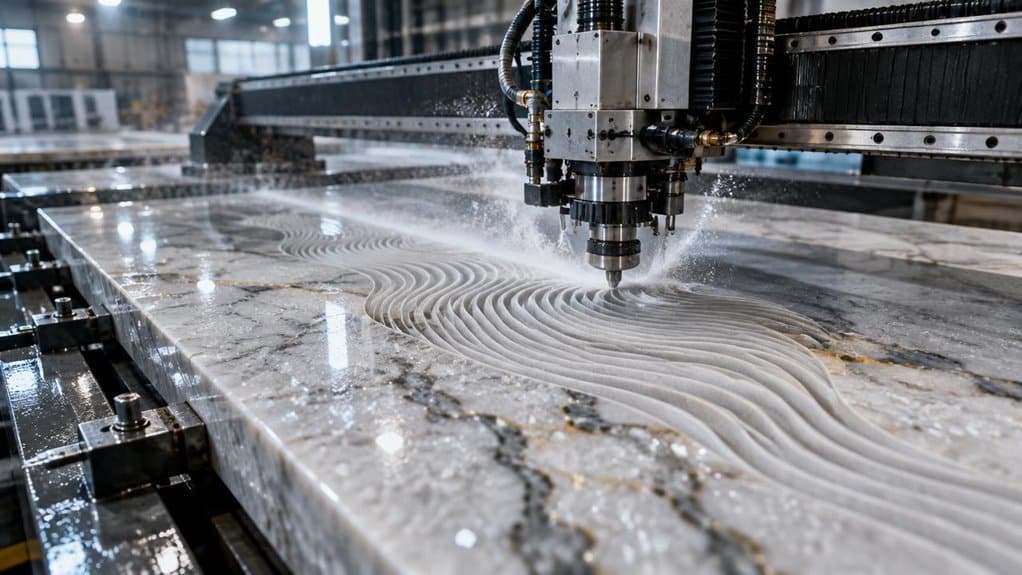


[…] drawing machine performs specialized surface processing on quartz and inorganic stone slabs to create decorative patterns with controlled three-dimensional […]