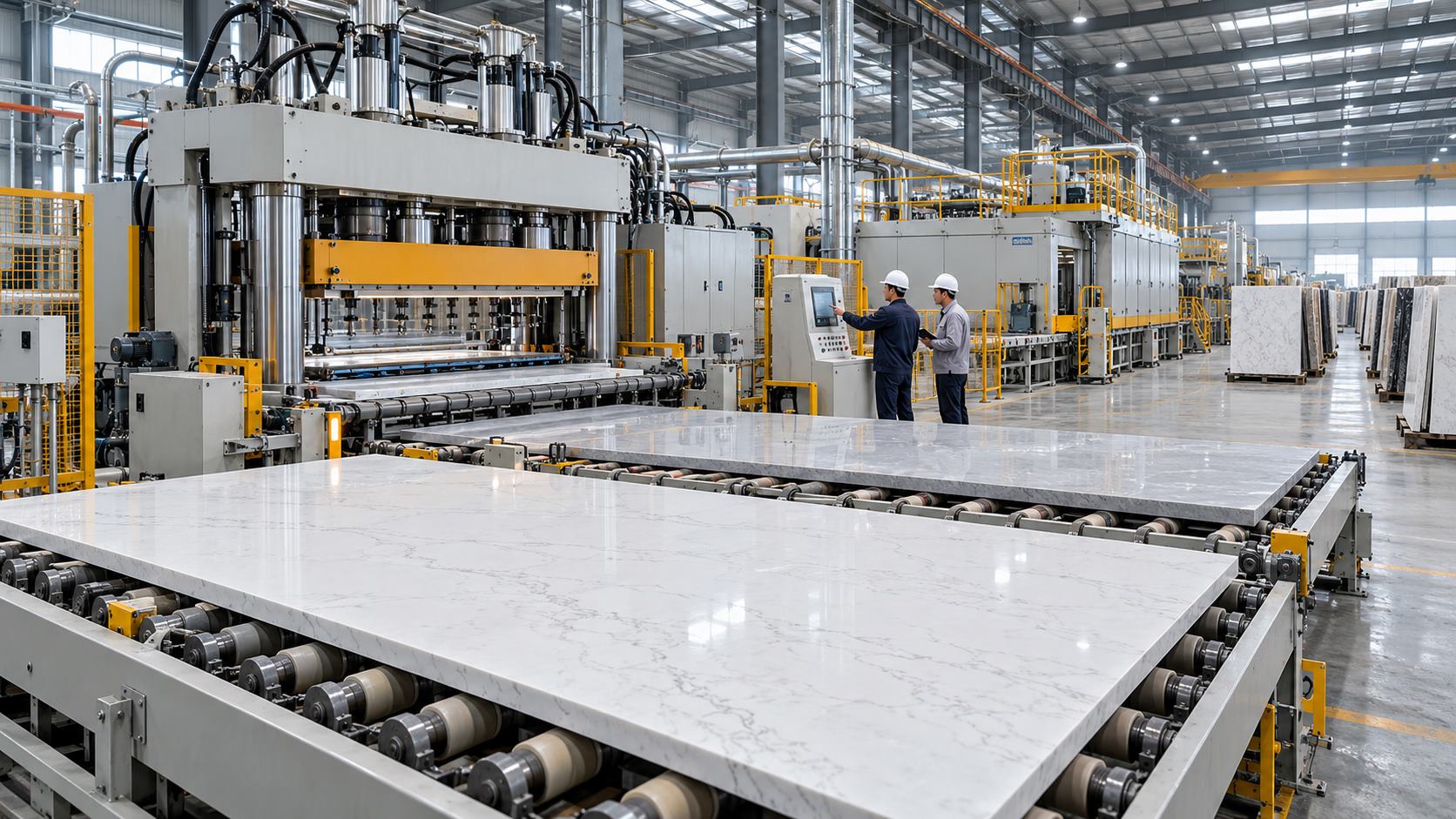
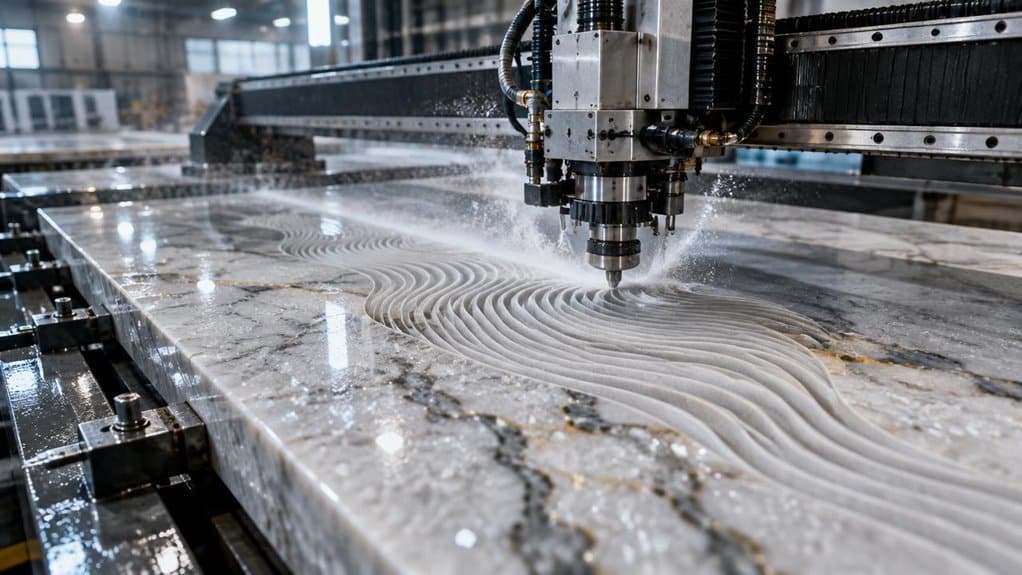
The inorganic stone manufacturing process combines mineral aggregates, inorganic binders, powders, pigments, and additives through controlled batching, mixing, forming, curing, and finishing operations to produce engineered stone slabs.
Unlike conventional resin-bound engineered quartz, cement-based inorganic stone relies primarily on inorganic binding reactions, including cement hydration. This difference affects material preparation, forming conditions, curing requirements, and the equipment needed for industrial production.
A complete inorganic stone production line integrates automated weighing, powder and liquid preparation, material homogenization, slab pressing, mold handling, controlled curing, and surface finishing. Each stage must operate consistently to achieve the required slab dimensions, mechanical properties, and production capacity.
This article explains how inorganic stone slabs are manufactured, the main equipment used at each stage, the parameters that influence product quality, and the considerations involved in establishing an industrial inorganic stone manufacturing plant.
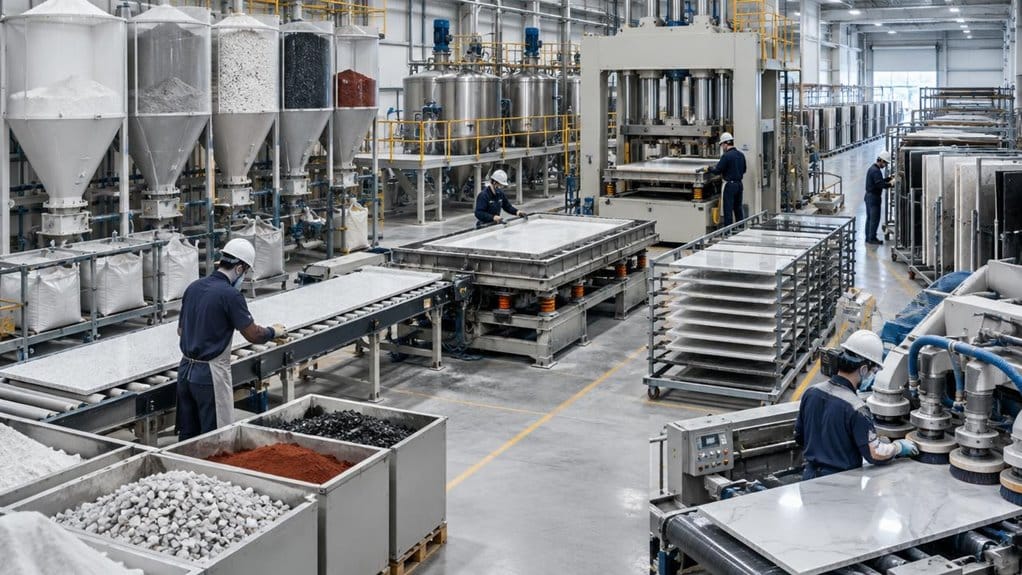
Inorganic stone is a manufactured composite material consisting primarily of mineral aggregates, powders, and an inorganic binding system.
Cement-based inorganic stone uses cementitious binders or other specified inorganic components to form a hardened matrix around the mineral particles. Its finished properties depend on material formulation, particle grading, forming conditions, curing, and subsequent surface processing.
The term inorganic stone covers different material systems and does not represent one universal formulation.
In industrial slab manufacturing, cement-based inorganic stone is produced through several connected operations:
These stages work together to transform the prepared mineral mixture into slabs with the required dimensions, surface appearance, and physical properties.
Inorganic stone should be distinguished from natural stone, conventional engineered quartz, and sintered stone.
Natural stone is quarried from geological deposits before being cut and finished.
Conventional engineered quartz uses mineral aggregates combined with polymer resin binders that harden through polymerization.
Sintered stone uses high-temperature processing to consolidate mineral materials.
Cement-based inorganic stone develops its structure through inorganic binding reactions, with curing conditions determined by the binder formulation.
Although these products may have similar appearances and applications, their manufacturing technologies and equipment requirements can differ considerably.
Raw-material selection is one of the main factors affecting inorganic stone slab quality.
The composition of the mineral mixture determines how the material behaves during mixing, distribution, pressing, curing, and finishing.
Industrial inorganic stone production may use several separately prepared material groups, including mineral aggregates, powder materials, pigments, liquid components, and functional additives.
| Raw material | Main manufacturing function |
|---|---|
| Mineral aggregates | Form the principal mineral structure and influence particle packing, strength, and decorative appearance |
| Powder materials | Influence mixture consistency, particle distribution, and the hardened matrix |
| Inorganic binder components | Develop the binding structure through hydration or other formulation-specific reactions |
| Pigments | Produce the required colors and decorative effects |
| Alkaline water | A controlled liquid component used according to the specified formulation |
| Emulsion | A formulation-specific liquid component prepared through a separate dosing and mixing system |
| Cooling water | A separately controlled water input used according to the process formulation |
| Solid additives | Provide additional material functions specified by the formulation |
| Other additives | Adjust processing characteristics or finished-product properties |
The chemical composition and dosage of each component depend on the approved formulation.
For example, liquid components may influence mixture workability and binder reactions, while variations in mineral particle sizes affect packing and material distribution.
An inorganic binder system does not automatically mean that every ingredient is inorganic or that the finished product is completely free from polymers or crystalline silica. These characteristics depend on the actual formulation.
Variations in raw-material quality can affect the entire production process.
Inconsistent aggregate grading may change particle packing and material distribution. Changes in powder properties or moisture can influence mixture workability and compaction.
Binder and additive variations may also affect setting behavior, curing requirements, and mechanical performance.
For stable production, manufacturers should establish appropriate incoming-material specifications, including:
Accurate raw-material preparation reduces avoidable variations before the materials enter the mixing system.
Industrial inorganic stone manufacturing involves a connected sequence of material preparation, forming, curing, and finishing operations.
In a modern automated production line, powder materials and liquid components are prepared through separate systems before entering the main mixing stage. The prepared mixture then undergoes distribution, pressing, controlled curing, and surface processing.
The following sections explain the principal manufacturing operations.
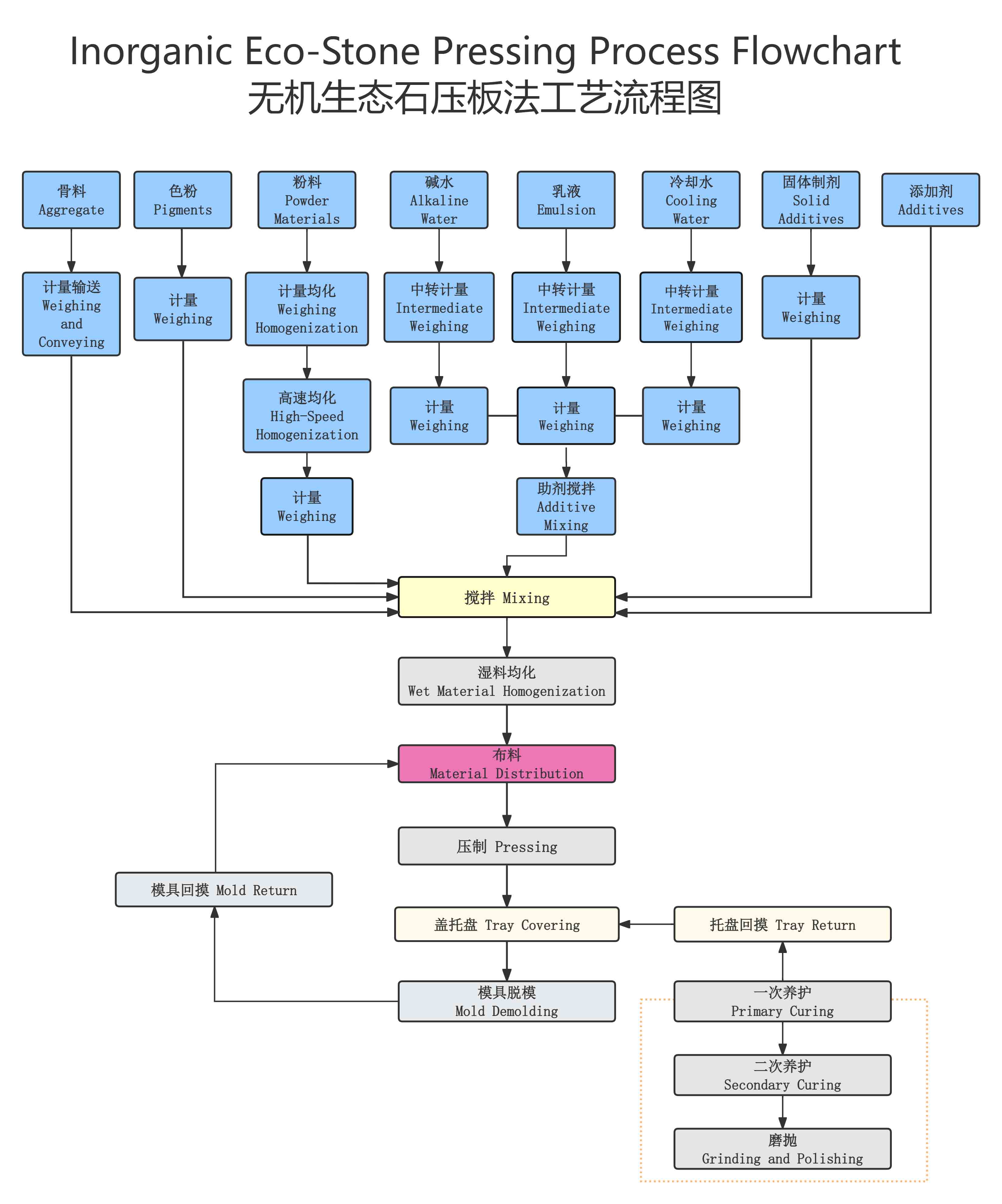
Production begins with the controlled measurement and preparation of the ingredients required by the inorganic stone formulation.
Mineral aggregates, pigments, powder materials, and additives are measured according to their specified quantities.
Different materials may require separate storage, feeding, and weighing equipment because their physical characteristics and handling requirements vary.
For example, aggregates can be transferred through suitable conveying systems, while fine powders require equipment designed for accurate feeding and dust containment.
Liquid ingredients are measured separately before being introduced into the mixing process.
Automated batching systems help maintain accurate material proportions and reduce variations between production batches.
Important control points include:
Accurate dosing establishes the correct material proportions, but subsequent homogenization remains necessary to achieve a consistent mixture.
Inorganic stone production can require several material preparation operations before the principal ingredients are combined.
Powder preparation may include preliminary weighing, homogenization, high-speed homogenization, and subsequent controlled dosing.
These operations are used to achieve the required consistency of the powder stream before it enters the main mixer.
Liquid ingredients are prepared through separate weighing and additive-mixing systems.
Alkaline water, emulsion, cooling water, and other specified liquid components may be handled through dedicated intermediate and final weighing operations.
Where required, the emulsion preparation system also incorporates additive mixing before transfer to the main mixing stage.
Separating these operations allows material preparation to be controlled according to the individual characteristics of each ingredient.
Key operating considerations include:
The operating sequence must follow the approved formulation. Different inorganic binder systems may require different preparation methods, liquid components, and process conditions.
After material preparation, the measured ingredients enter the main mixing system.
The objective is to combine mineral aggregates, powders, binder components, pigments, liquids, and additives into a mixture suitable for slab forming.
The mixing process must provide consistent material distribution while maintaining the required workability.
Inorganic stone production may incorporate two connected operations.
Main mixing combines the prepared ingredient streams and distributes them throughout the mixture.
Wet material homogenization further processes the combined material before it enters the slab distribution system.
This additional homogenization stage helps prepare a consistent material condition for controlled forming.
The quality of the mixture depends on several factors:
| Mixing parameter | Manufacturing significance |
|---|---|
| Material addition sequence | Influences how powder, aggregates, binders, and liquids combine |
| Mixing time | Affects material dispersion and batch consistency |
| Mixing intensity | Influences particle movement and mixture characteristics |
| Batch loading | Affects effective material circulation inside the mixer |
| Liquid dosage | Influences workability and binder reaction conditions |
| Material temperature | May affect setting behavior and processing characteristics |
| Discharge consistency | Influences subsequent material distribution |
Insufficient mixing can leave localized differences in material composition, including poorly incorporated powder or unevenly distributed additives.
Excessive mixing or unsuitable operating conditions may also affect workability, temperature, or setting behavior.
Manufacturers should establish the appropriate mixing parameters through formulation testing and controlled production trials.
After wet material homogenization, the prepared mixture is transferred to the material distribution system.
The distributor places the mixture into the forming area according to the required slab dimensions, thickness, and product design.
The material must be distributed consistently to support uniform forming conditions.
Uneven placement can result in differences in local material quantity, compaction behavior, and slab geometry.
Important considerations include:
For single-color slabs, the distribution objective is generally consistent material placement.
For decorative inorganic stone products, different colors or prepared material fractions may be arranged according to the intended appearance, depending on the selected production technology.
Reusable molds are incorporated into the production cycle, with mold-return equipment coordinating their movement back toward the distribution stage.
Mold circulation must be matched to the required production rhythm so that forming equipment can operate without unnecessary waiting.
The distributed mixture then enters the pressing stage, where it is consolidated into the required slab form.
Pressing applies controlled mechanical force to the material within the forming system.
The objective is to achieve the specified slab geometry and an appropriately consolidated internal structure.
Depending on the equipment configuration and formulation, additional forming methods may be incorporated.
Pressing conditions must be selected according to:
Insufficient consolidation may contribute to internal voids or uneven material structure.
However, excessive or unsuitable forming conditions can also cause material displacement, segregation, or dimensional inconsistency.
The appropriate forming parameters should be validated using the intended material formulation.
Pressing equipment used for cement-based inorganic stone should not automatically be operated using the same parameters as conventional resin-bound quartz pressing systems.
Although the equipment may perform similar forming functions, the material behavior and subsequent curing requirements are different.

After pressing, the formed slab must be transferred through the appropriate support and handling operations.
Industrial inorganic stone production may incorporate tray covering, mold release, mold return, and tray circulation systems.
These operations coordinate the movement of formed slabs and reusable forming components.
Tray covering introduces the designated support or covering component required by the handling process.
Demolding separates reusable mold components from the formed slab or supporting assembly when the material has reached the appropriate release condition.
Mold and tray return systems move reusable components back into the production cycle.
The timing of these operations depends on the material formulation, handling strength, equipment configuration, and curing arrangement.
Important equipment considerations include:
In a continuous production environment, mold and tray circulation can influence the effective forming capacity.
A press may have sufficient processing capability, but production can still be interrupted if reusable molds or support components are unavailable at the required time.
Curing is one of the most important stages in cement-based inorganic stone manufacturing.
After forming, the binder system must develop the required hardened structure before the slabs can proceed through subsequent processing.
For cementitious formulations, hardening depends on hydration reactions that require appropriate moisture and temperature conditions.
The production process incorporates primary curing and secondary curing as two controlled stages.
Primary curing provides the first designated curing period under the conditions required by the formulation.
Secondary curing provides an additional controlled hardening stage before the slabs proceed to subsequent processing.
The specific functions, duration, temperature, humidity, and transfer conditions of each stage depend on the material system and production requirements.
Curing parameters should therefore be based on validated formulation data rather than copied from another production line.
| Curing parameter | Function | Risk from unsuitable conditions |
|---|---|---|
| Temperature | Influences hydration and hardening rate | Inconsistent strength development or thermal stress |
| Moisture and humidity | Support hydration and limit premature drying | Shrinkage, cracking, incomplete hydration |
| Curing duration | Allows the required material properties to develop | Insufficient strength or processing readiness |
| Slab support | Maintains appropriate handling and support conditions | Deformation or handling damage |
| Process consistency | Supports repeatable hardening between batches | Variation in material properties |
Curing systems must also be sized around the intended production capacity.
For example, increasing pressing output will not necessarily increase finished slab output if the curing stages cannot process the additional material.
The capacities of primary curing, secondary curing, slab transfer, and downstream finishing must be coordinated.
Controlled cooling and stabilization may also be incorporated where required by the selected process.
These downstream operations are separate from any cooling-water input used during raw-material preparation.
Once the slabs have achieved the necessary curing and handling properties, they can enter the finishing section.
Finishing operations may include thickness calibration, grinding, polishing, trimming, and additional surface processing.
Calibration uses controlled abrasive material removal to achieve the specified slab thickness and improve surface regularity.
Grinding progressively refines the surface and prepares it for the required finish.
Polishing uses suitable abrasive stages to produce the intended surface smoothness and appearance.
The finishing configuration depends on the required product specifications.
Important considerations include:
Cement-based inorganic stone formulations may respond differently to grinding and polishing than polymer-resin engineered quartz.
Abrasive selection and operating parameters should therefore be validated for the actual material.
Depending on the project, additional texture drawing, cutting, or surface processing equipment may also be integrated into the production line.
After finishing, inorganic stone slabs undergo quality inspection to verify compliance with the intended product specifications.
Routine inspection generally focuses on dimensions, surface condition, visual consistency, and handling damage.
| Inspection item | Main evaluation |
|---|---|
| Slab dimensions | Length, width, thickness, squareness |
| Surface geometry | Flatness and dimensional consistency |
| Appearance | Color, texture, aggregate distribution |
| Surface finish | Smoothness, gloss, visible grinding marks |
| Defects | Cracks, chips, voids, surface irregularities |
| Traceability | Material batches, production records, curing information |
The required mechanical and physical properties should also be verified through an appropriate quality-control testing program.
Depending on the product and application, this may include flexural strength, density, water absorption, abrasion resistance, or other specified properties.
Destructive mechanical testing is normally performed according to an approved sampling and testing plan rather than on every finished slab.
Approved slabs are then transferred to suitable storage, handling, protection, or packaging equipment.
Stable inorganic stone production requires coordinated control of raw-material properties, mixing, forming, curing, and finishing.
These parameters interact throughout the manufacturing process.
| Parameter | Manufacturing impact | What manufacturers should control |
|---|---|---|
| Aggregate grading | Influences particle packing, workability, and distribution | Particle-size distribution, cleanliness, moisture |
| Binder formulation | Determines setting and hardening characteristics | Binder compatibility, formulation consistency |
| Powder homogenization | Influences consistency of the prepared powder stream | Homogenization performance, batch variation |
| Liquid dosage | Affects workability and binder reactions | Accurate dosing and approved formulation |
| Mixing uniformity | Influences binder and aggregate distribution | Mixing sequence, loading, operating parameters |
| Material distribution | Affects local material quantity and forming consistency | Mold filling, placement and transfer |
| Pressing conditions | Influence consolidation and slab geometry | Forming settings, alignment and material behavior |
| Mold handling | Influences transfer reliability and production continuity | Release conditions, circulation and support |
| Curing temperature | Affects hydration and hardening rate | Validated temperature conditions |
| Curing moisture and duration | Influence strength development and dimensional stability | Moisture retention and curing schedule |
| Calibration and polishing | Determine final thickness and surface finish | Abrasive condition, equipment adjustment and inspection |
For cement-based inorganic stone, the binder formulation and liquid components influence workability and hardening behavior.
The required dosing conditions depend on the specific ingredients and their functions.
A change in powder characteristics, liquid dosage, or aggregate moisture can alter the consistency of the prepared mixture.
These variations may affect distribution and compaction, even when the pressing equipment operates with unchanged settings.
Manufacturers should therefore monitor relevant material properties and dosing records together.
Process adjustments should be validated through controlled trials rather than increasing liquid content simply to improve material flow.
Material distribution, forming pressure, curing conditions, and slab support collectively influence final dimensional consistency.
Uneven distribution may contribute to differences in local consolidation.
Unsuitable curing conditions can affect hydration and moisture gradients, increasing the risk of shrinkage or deformation.
Increasing forming pressure or extending curing duration does not necessarily correct problems caused by unsuitable raw materials or mixing.
The most reliable approach is to establish validated operating parameters for the complete manufacturing process rather than treating individual production stages independently.

An industrial inorganic stone production line integrates material preparation, forming, curing, handling, and finishing equipment.
Each system must be configured around the product formulation, slab dimensions, production capacity, and automation requirements.
| Equipment system | Main function | Selection considerations |
|---|---|---|
| Raw material storage and feeding | Stores and supplies mineral aggregates, powders, and additives | Material characteristics, capacity, containment |
| Automatic weighing and batching | Measures raw materials according to production formulas | Dosing accuracy, recipe management |
| Powder homogenization | Prepares powder materials before main mixing | Material properties, homogenization capacity |
| Liquid preparation and weighing | Measures and prepares specified liquid components | Chemical compatibility, dosing, mixing |
| Main mixing system | Combines prepared raw-material streams | Mixing performance, batch capacity |
| Wet material homogenization | Further processes the mixed material before forming | Consistency, throughput and transfer |
| Material distribution | Places prepared mixture into molds | Slab dimensions, placement uniformity |
| Pressing system | Consolidates and forms the slab | Forming method, material behavior, slab size |
| Mold and tray handling | Supports slab transfer and reusable component circulation | Handling capacity, release conditions, automation |
| Primary and secondary curing | Maintains the required hardening conditions | Temperature, humidity, duration and capacity |
| Calibration and polishing | Produces required thickness and surface finish | Material characteristics, finishing requirements |
| Environmental and utility systems | Supports material handling and process-water management | Dust collection, water treatment, electrical supply |
At SINONE, we develop modular inorganic stone production systems with PLC-based centralized control.
Our equipment configurations are designed to coordinate material weighing, mixing, forming, curing, and downstream operations according to the manufacturer's production requirements.
Depending on the selected configuration, automation can support:
The automation level and equipment arrangement are determined by the actual manufacturing requirements.
An effective system must balance the capacities of material preparation, forming, curing, and finishing rather than maximizing the output of one machine independently.
Cement-based inorganic stone and conventional resin-bound engineered quartz both use mineral aggregates and industrial slab-forming equipment.
However, the binder systems and hardening mechanisms are different.
| Manufacturing aspect | Cement-based inorganic stone | Conventional engineered quartz |
|---|---|---|
| Primary binder | Cementitious or specified inorganic binder | Typically polymer resin |
| Hardening mechanism | Cement hydration or other binder-specific reactions | Resin polymerization |
| Material preparation | Aggregates, powders, inorganic binder components, liquid ingredients and additives | Quartz aggregates, powders, resin, pigments and additives |
| Mixing | Binder-specific preparation and workability control | Resin wetting, aggregate distribution and pigment dispersion |
| Forming | Formulation-specific pressing and consolidation | Commonly vacuum vibration pressing |
| Curing | Moisture and temperature conditions appropriate to the binder | Resin-specific thermal curing |
| Equipment configuration | Based on inorganic formulation, mold handling and curing requirements | Based on resin formulation and quartz slab production requirements |
The conventional quartz slab manufacturing process uses different material preparation and curing methods.
Therefore, an existing resin-bound quartz production line should not automatically be considered suitable for inorganic stone manufacturing.
Any conversion or equipment reuse requires an engineering evaluation of material compatibility, forming requirements, curing systems, and downstream handling.

Inorganic stone defects may originate during material preparation, mixing, forming, curing, or finishing.
The station where a defect becomes visible is not necessarily the process stage where it originated.
A systematic investigation should identify the earliest observable problem and compare production conditions between acceptable and defective slabs.
| Problem | Possible causes | Initial investigation |
|---|---|---|
| Uneven material distribution | Segregation, inconsistent mixing, irregular feeding | Material preparation, distribution and mold filling |
| Visible voids | Incomplete consolidation, entrapped air, unsuitable workability | Mixing conditions, distribution, pressing |
| Surface cracks | Shrinkage, unsuitable curing, handling stress | Binder formulation, moisture and curing |
| Slab warping | Uneven support, moisture variation, forming inconsistency | Mold support, curing conditions, dimensions |
| Inconsistent hardening | Temperature variation, moisture loss, formulation differences | Material batches and curing records |
| Color differences | Pigment dosing, raw-material variation, inadequate mixing | Weighing, preparation and mixing records |
| Surface finishing defects | Abrasive wear, unsuitable settings, incoming slab irregularities | Grinding and polishing equipment |
Corrective action should be based on verified causes rather than assumptions.
For example, visible voids do not automatically prove that pressing pressure is insufficient. Material workability, distribution, and forming conditions may all contribute.
Likewise, extending curing time may not resolve cracks caused by improper mixture composition or handling.
Manufacturers should use controlled trials, compare batch records, and verify improvements before standardizing revised settings.
Before investing in an inorganic stone manufacturing plant, factory owners should define the intended product and its production requirements.
The equipment selection process begins with the binder formulation, material properties, required slab specifications, and target capacity.
| Requirement | Information to confirm |
|---|---|
| Binder system | Intended inorganic binder formulation and curing requirements |
| Raw materials | Aggregate types, powder specifications, pigments, additives and availability |
| Liquid preparation | Required liquid components, dosing and preparation methods |
| Slab dimensions | Maximum length, width and finished thickness |
| Product designs | Single-color, decorative or textured products |
| Forming | Material workability, mold requirements and compaction method |
| Curing | Primary and secondary curing requirements, temperature, moisture and duration |
| Production capacity | Required finished slabs or square meters per shift |
| Factory layout | Available space, equipment flow, mold and tray return routes |
| Utilities | Electricity, water, ventilation and environmental infrastructure |
| Automation | Weighing, conveying, forming, controls and monitoring |
| Quality control | Dimensional tolerances, product testing and inspection criteria |
| Implementation | Equipment delivery, installation, commissioning and training |
The forming system and curing equipment must be sized together.
A press may be capable of producing slabs faster than the curing stages can accommodate them.
If curing capacity is insufficient, formed slabs may accumulate between operations, limiting the effective output of the entire factory.
For a system with primary and secondary curing, both stages must be considered when calculating production throughput.
Manufacturers should evaluate curing duration, available curing positions, material handling, mold circulation, and production shifts.
The appropriate line capacity should be based on saleable finished output, not simply the rated cycle speed of the press.
The production-line layout must provide sufficient space for raw-material preparation, mixing, forming, curing, slab handling, finishing, and maintenance.
Mold and tray return routes also need to be incorporated into the factory arrangement.
Existing quartz stone manufacturers planning to enter inorganic stone production should assess whether installed equipment can support the new material system.
Differences in powder preparation, liquid dosing, forming behavior and curing may require modifications or new machinery.
The quartz slab factory layout planning guide explains the broader principles of organizing industrial slab production equipment, although the specific layout must be configured for inorganic stone manufacturing.
Industrial inorganic stone manufacturing involves mineral powders, liquid additives, powered equipment, pressing systems, curing facilities, and abrasive finishing.
The required safety and environmental controls depend on the raw materials, production process, equipment arrangement, and local regulations.

Material storage, feeding, weighing, mixing, and cleaning operations can generate airborne mineral dust.
Where raw materials contain crystalline silica, appropriate engineering controls are required to manage respirable silica exposure.
Depending on the process, these may include enclosed feeding equipment, local dust extraction, controlled conveying, safe cleaning procedures and exposure monitoring.
Using an inorganic binder does not automatically eliminate silica-related occupational hazards.
Liquid preparation systems should be designed around the properties of the formulation ingredients.
Storage and handling procedures must account for applicable chemical safety requirements, including any alkalinity, compatibility, or spill-management considerations.
Grinding and polishing operations may also produce wastewater and mineral slurry.
Factories should provide suitable wastewater collection, treatment, recycling or disposal arrangements based on the actual process and applicable environmental requirements.
Pressing equipment, conveyors, molds, trays and lifting systems require appropriate guarding, interlocks, safe operating procedures and maintenance isolation.
The production-line layout should provide suitable access for equipment inspection, cleaning, and maintenance.
Operators should receive training appropriate to the machinery and processes installed.
The main difference is the binder system and hardening process.
Cement-based inorganic stone develops strength through hydration and other inorganic binding reactions.
Conventional engineered quartz generally uses polymer resin binders that harden through polymerization.
These differences affect material preparation, forming, curing, and equipment requirements.
The curing arrangement depends on the binder system and manufacturing process.
Cement-based inorganic stone generally requires controlled moisture and temperature conditions to support hydration and hardening.
Industrial production systems may use dedicated primary and secondary curing equipment.
The required curing system should be configured according to the formulation, slab properties, production rate, and validated curing conditions.
Primary and secondary curing provide two controlled stages within the hardening process.
The individual operating conditions and objectives depend on the material formulation and equipment configuration.
Temperature, moisture, curing duration, and slab transfer requirements must be established through process validation.
The two stages should not automatically be assigned identical settings or fixed curing times.
Some machinery may be reusable, but compatibility must be verified.
Inorganic stone production can require different liquid preparation, mixing, forming, curing and handling systems from conventional resin-bound quartz production.
An engineering assessment should determine which equipment can be retained, modified, or replaced.
No. These characteristics depend on the actual formulation.
Inorganic stone may contain quartz or other minerals with crystalline silica.
A primarily inorganic binder system may also include formulation-specific emulsions or other additives.
Material-composition claims should therefore be supported by verified formulation information and appropriate technical documentation.
Production capacity depends on the complete manufacturing system.
Important factors include weighing and mixing cycles, material distribution, pressing, mold availability, primary and secondary curing, finishing capacity, and operating hours.
The effective production rate must also account for downtime, changeovers, handling delays and finished-product yield.
Factory capacity should be evaluated using the complete process configuration rather than the speed of one machine.
At SINONE, we provide integrated production equipment for cement-based and inorganic composite stone slab manufacturing.
Our modular production-line solutions can incorporate automated batching, powder and liquid preparation, mixing, material distribution, pressing, mold and tray handling, controlled curing, and downstream finishing equipment.
We configure these systems according to the manufacturer's formulation requirements, slab dimensions, product specifications, target production capacity and factory conditions.
Planning a New Inorganic Stone Manufacturing Plant?
Share your intended raw materials, binder system, slab dimensions, thickness range, production capacity, curing requirements, and available factory layout with our engineering team.
We can help evaluate the material preparation, forming, curing, handling and finishing equipment required for your project.
Contact SINONE to discuss your inorganic stone production requirements and request a technical proposal.