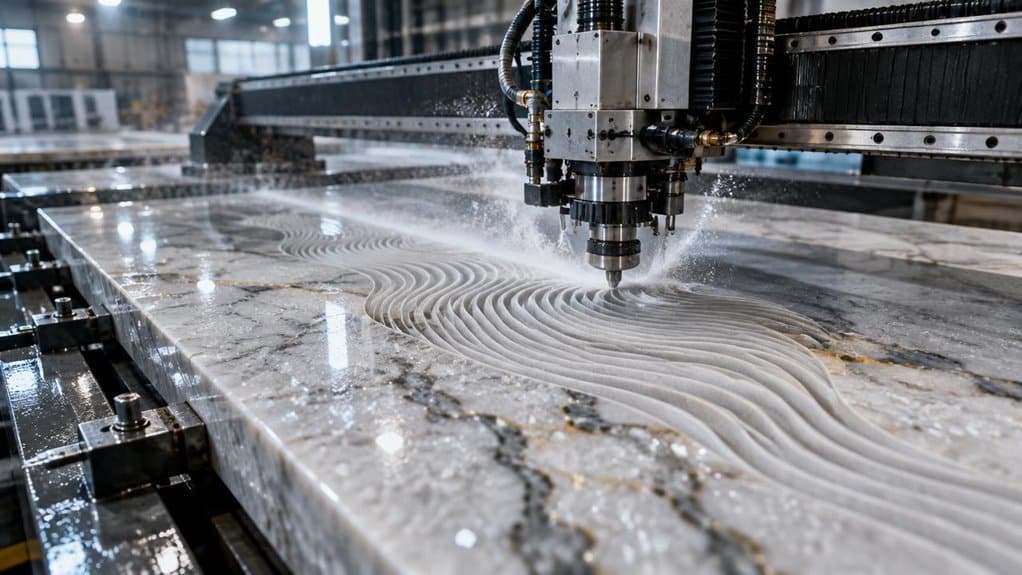
The CNC texture drawing process is a specialized surface-processing method used to create programmable three-dimensional textures and decorative effects on finished or semi-finished quartz and inorganic stone slabs. By combining CNC-controlled slotting, mixing, and spraying systems, the equipment produces customized surface patterns with controlled depth, movement paths, and positioning.
This technology allows manufacturers to develop natural-stone-inspired textures, brushed finishes, and customized decorative surfaces. Understanding how the CNC texture drawing process works helps manufacturers evaluate equipment configurations, processing requirements, and integration with downstream finishing operations.

A CNC texture drawing machine performs specialized surface processing on quartz and inorganic stone slabs to create decorative patterns with controlled three-dimensional characteristics.
The machine combines three principal processing functions:
These operations are coordinated through a CNC control system, allowing manufacturers to program different texture designs and control relevant processing parameters.
The resulting surfaces can reproduce characteristics inspired by natural stone, including directional textures, marble-look decorative effects, brushed appearances, and customized three-dimensional patterns.
Conventional CNC stone engraving machines are generally designed for cutting, carving, lettering, or machining stone surfaces.
A CNC texture drawing machine for engineered stone has a more specialized configuration.
It integrates slotting cutter heads, mixing cutter heads, and multiple spray heads within one automated processing system.
This combination allows manufacturers to create decorative surface effects through coordinated cutting, mixing, and spraying operations rather than relying on a single engraving function.
The distinction is important when selecting equipment for industrial quartz slab manufacturing, where the objective is to achieve repeatable decorative textures across large-format slabs.
A CNC texture drawing machine processes finished or semi-finished quartz slabs through a programmed sequence of positioning, cutting, mixing, and spraying operations.
The CNC system coordinates the relevant processing components according to the selected texture design.
The main operations are explained below.
The process begins when a finished or semi-finished quartz or inorganic stone slab enters the machine through the conveying system.
The slab is positioned according to the programmed processing requirements.
Accurate positioning is important because the texture design must correspond to the intended slab area.
The positioning system establishes the working position, while the conveying arrangement supports stable material transfer through the processing area.
Before processing, manufacturers should ensure that the slab dimensions are compatible with the selected machine configuration and that the slab is appropriately supported.
The desired decorative texture is translated into programmed processing instructions.
The CNC control system coordinates the movement of the machine components according to the selected design.
Important programmed parameters include:
These parameters determine the geometry and arrangement of the resulting surface texture.
The ability to program different designs allows manufacturers to develop standard and customized surface patterns without relying entirely on manual processing.
Accurate programming and consistent positioning are particularly important when repeating the same decorative design across multiple slabs.
After positioning and programming, the CNC system controls the slotting cutter heads to perform the required surface-processing operations.
The cutter heads follow the programmed paths to establish the specified texture geometry.
Processing depth, movement direction, and operating speed influence the resulting surface characteristics.
Different cutter-head configurations provide flexibility for different production requirements.
The machine is available with configurations incorporating either one or two slotting cutter heads, depending on the selected model.
Maintaining accurate positioning and consistent processing conditions helps achieve repeatable texture patterns across production batches.
The mixing cutter heads form another part of the integrated processing system.
They operate in coordination with the other machine components according to the selected texture design.
The CNC control system coordinates the relevant movements and processing parameters to achieve the intended decorative surface effect.
The specific operating conditions depend on the machine configuration and required texture.
This integrated arrangement allows cutting, mixing, and spraying functions to be incorporated into one automated surface-processing system.
The spraying system applies the specified materials as part of the decorative surface-processing sequence.
The six spray heads are coordinated with the CNC-controlled processing operation to support the required decorative effect.
The positioning and operation of the spray heads must correspond to the selected texture design.
Consistent spraying conditions are important for achieving the intended surface appearance across the processed slab.
The relationship between cutting, mixing, and spraying allows manufacturers to develop more differentiated decorative surfaces than conventional single-function processing equipment.
After the programmed texture-processing operations are completed, the slab is discharged from the machine.
It can then be transferred to subsequent finishing or surface-treatment equipment according to the intended product specification.
Additional processes may include suitable surface finishing, cleaning, thermal transfer printing, or other downstream treatments.
Where multiple decorative processes are combined, their sequence must be evaluated according to material compatibility and the required finished appearance.
The machine's automated conveying and positioning arrangements help coordinate the texture-processing stage with the surrounding production equipment.
A CNC texture drawing machine integrates mechanical processing, positioning, conveying, spraying, and automatic control systems.
Each component performs a specific function within the overall processing sequence.
| Component | Main function |
|---|---|
| CNC texture processing system | Controls the programmed texture-processing operations |
| Slotting cutter heads | Perform programmed cutting and slotting operations |
| Mixing cutter heads | Support the integrated mixing and texture-processing functions |
| Spray heads | Apply specified materials during decorative processing |
| Slab positioning system | Positions the slab for accurate processing |
| Tool positioning and depth control system | Controls processing position and depth |
| Slab conveying system | Transfers slabs through the processing area |
| Automatic control system | Coordinates machine operations and programmed parameters |
| Dust and debris collection system | Collects processing dust and debris |
| Safety protection units | Support safe machine operation |
Machine guarding, operator access, maintenance procedures, and emergency protection should be considered when configuring industrial processing equipment. The principles outlined in ISO 12100:2010 – Safety of Machinery: Risk Assessment and Risk Reduction provide a useful framework for identifying machinery hazards and evaluating appropriate risk-reduction measures.
The CNC control system is central to the machine's operation.
It coordinates programmed movements and relevant processing parameters, allowing different texture designs to be executed through controlled machine operation.
Servo-driven positioning supports accurate movement of the processing assemblies.
The relationship between programmed paths, positioning, and processing depth is important for achieving consistent surface effects.
Different production requirements may require different cutter-head arrangements.
The machine is available with configurations incorporating one or two slotting cutter heads and one or two mixing cutter heads.
This provides flexibility when selecting equipment for different slab sizes and processing requirements.
The appropriate configuration depends on the intended texture designs, working area, and production objectives.
The spraying system is integrated with the CNC-controlled processing operation to support the intended decorative surface treatment.
The dust and debris collection system helps manage waste generated during mechanical processing.
These supporting systems are important for maintaining a suitable working environment and supporting continuous industrial operation.

The quality of a CNC-drawn texture depends on the complete processing system rather than the CNC program alone.
Programmed movement, cutter-head configuration, slab positioning, processing depth, and spraying coordination all contribute to the finished result.
Several factors require particular attention.
| Parameter | Effect on processing | Manufacturing consideration |
|---|---|---|
| Programmed movement path | Determines the texture arrangement | Accurate design programming and positioning |
| Processing depth | Influences the physical texture characteristics | Controlled depth according to the required design |
| Operating speed | Affects processing conditions and consistency | Appropriate settings for the selected material and pattern |
| Slab positioning | Determines the relationship between the design and slab surface | Stable positioning and alignment |
| Cutter-head condition | Influences processing consistency | Inspection and maintenance of processing components |
| Spray-head operation | Affects decorative material application | Consistent operation and appropriate maintenance |
| Conveying stability | Influences slab positioning during processing | Stable material transfer and handling |
| Machine condition | Affects repeatability during continuous operation | Routine inspection and maintenance |
The programmed design must correspond correctly to the slab's working area.
Incorrect positioning or inconsistent movement can cause deviations in the intended pattern.
Accurate positioning is especially important when producing customized designs or processing slabs with different dimensions.
Processing depth influences the physical characteristics of the finished texture.
The selected depth must match the intended decorative effect and the slab's processing requirements.
Cutter-head condition and machine alignment also influence processing consistency.
Regular inspection helps identify wear or changes in equipment condition that may affect the finished surface.
The spraying system must operate in coordination with the selected texture design.
Inconsistent operation can affect the distribution of decorative materials and the appearance of the finished slab.
The spray heads should therefore be inspected and maintained according to the equipment's operating requirements.
Stable slab positioning helps maintain the relationship between the programmed design and the actual processing area.
Conveying equipment must also transfer slabs consistently without introducing unwanted movement or handling problems.
These factors become particularly important when processing large-format slabs and repeating customized designs across production batches.
The CNC texture drawing machine is a downstream surface-processing unit that works with finished or semi-finished quartz and inorganic stone slabs.
Unlike material batching, mixing, or slab pressing equipment, it processes an already-formed slab to introduce the required decorative surface characteristics.
A typical processing arrangement includes:
| Production stage | Equipment | Main function |
|---|---|---|
| Slab preparation | Existing slab production equipment | Produces finished or semi-finished slabs |
| Slab transfer | Conveying and positioning equipment | Delivers and positions slabs |
| Texture processing | CNC Texture Drawing Machine | Creates programmed surface textures and decorative effects |
| Subsequent processing | Suitable finishing or surface-treatment equipment | Completes the required surface treatment |
The machine can be integrated with slab conveying, positioning, cleaning, and supporting handling equipment to create a coordinated processing workflow.
For manufacturers developing more complex decorative slab products, CNC texture drawing can also be combined with thermal transfer printing and other downstream finishing operations.
These technologies perform different functions.
CNC texture drawing mechanically processes the slab surface to create controlled three-dimensional textures, while thermal transfer printing transfers decorative imagery using suitable transfer media and controlled processing conditions.
Combining the two may expand the range of visual and physical surface effects available to manufacturers.
However, the processing sequence must be evaluated according to the slab material, surface condition, and compatibility of the selected treatments.
Our Thermal Transfer Printing Production Line provides a separate processing solution for manufacturers seeking additional decorative surface capabilities.

Different slab dimensions and production requirements require different equipment configurations.
Our CNC Texture Drawing Production Line offers four configurations with two working-area options.
| Model | Working area (mm) | Slotting cutter heads | Mixing cutter heads | Spray heads |
|---|---|---|---|---|
| SYDL2×2-1650 | 3500 × 1750 | 1 | 1 | 6 |
| SYDL2×2-2050 | 3800 × 2150 | 1 | 1 | 6 |
| SYDL4×4-1650 | 3500 × 1750 | 2 | 2 | 6 |
| SYDL4×4-2050 | 3800 × 2150 | 2 | 2 | 6 |
The available working areas reach 3800 × 2150 mm, supporting the processing of large-format engineered stone slabs.
The different cutter-head configurations provide options for manufacturers with different processing requirements.
The selected model should match the maximum slab dimensions, intended decorative patterns, and factory production conditions.
For complete equipment dimensions, installed power, machine weight, and configuration details, see our CNC Texture Drawing Production Line.
A conventional CNC stone engraving machine primarily performs cutting, carving, or machining operations on stone surfaces.
A CNC texture drawing machine integrates slotting cutter heads, mixing cutter heads, and spray heads to create programmable three-dimensional decorative surface effects.
Its processing configuration is specifically designed for industrial quartz and inorganic stone slab decoration.
The machine can produce natural-stone-inspired surface textures, Calacatta-style decorative slabs, brushed finishes, linear patterns, and customized three-dimensional surface effects.
The available designs depend on the programmed processing paths, cutter-head configuration, and production requirements.
The available configurations provide working areas of 3500 × 1750 mm and 3800 × 2150 mm.
The appropriate model depends on the slab dimensions and required processing arrangement.
Yes. The machine can be integrated with suitable slab conveying, positioning, cleaning, and handling equipment.
Manufacturers should evaluate available factory space, slab dimensions, conveyor compatibility, utilities, and automation requirements before installation.
Yes. The two technologies can be combined where the processing sequence and material compatibility allow.
CNC texture drawing creates physical surface textures, while thermal transfer printing applies decorative imagery through a separate surface-treatment process.
The appropriate sequence depends on the intended finished product and should be validated through production trials.
Our CNC Texture Drawing Production Line is designed for manufacturers seeking to develop differentiated quartz and inorganic stone slab products through automated surface processing.
The integrated system combines CNC-controlled cutting, mixing, and spraying functions to create programmable three-dimensional textures and decorative surface effects.
With four equipment configurations and working areas up to 3800 × 2150 mm, the system can be configured according to different slab dimensions and production requirements.
Planning to Introduce CNC Texture Drawing Into Your Stone Production Line?
Share your slab dimensions, intended surface designs, required working area, and production requirements with our engineering team.
We can help evaluate the appropriate machine configuration and integration requirements for your factory.
Contact SINONE to discuss your CNC Texture Drawing Production Line requirements and request an equipment quotation.