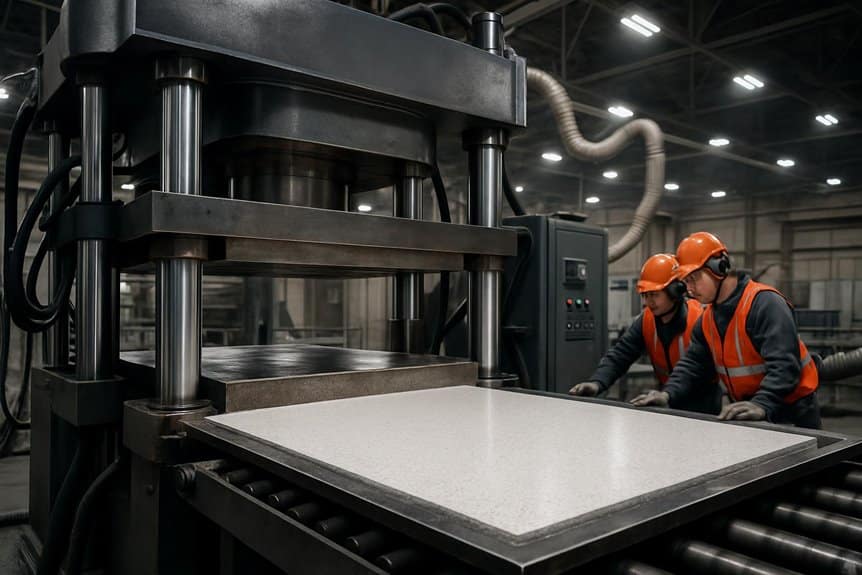
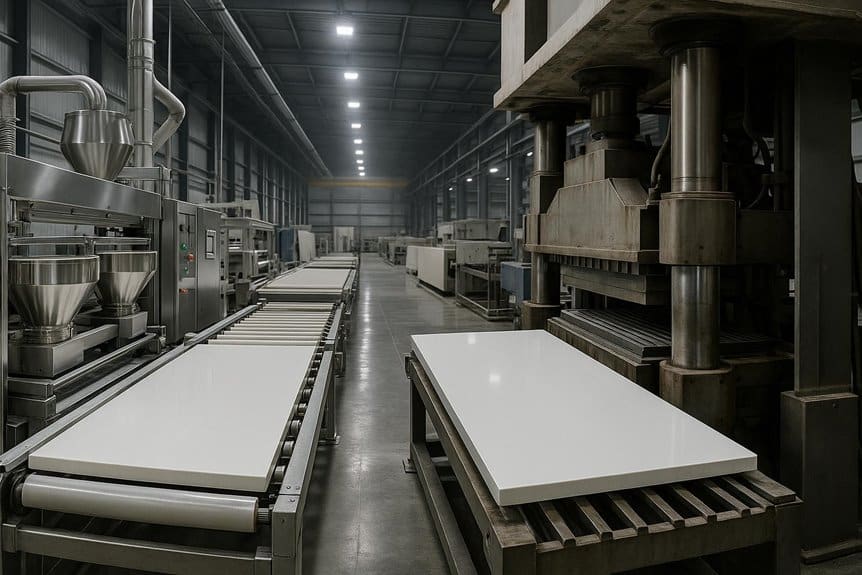
Quartz slab press machine price can vary widely because the press is not a standard-cost item. Pressing area, tonnage, mold size, vacuum-vibration design, hydraulic system, automation level, and control accuracy all affect the base quotation. Freight, installation, foundation work, power supply, and commissioning can further change the total investment. A realistic cost comparison starts with production targets, slab size, and expected output, but one factor often causes the largest price gap.
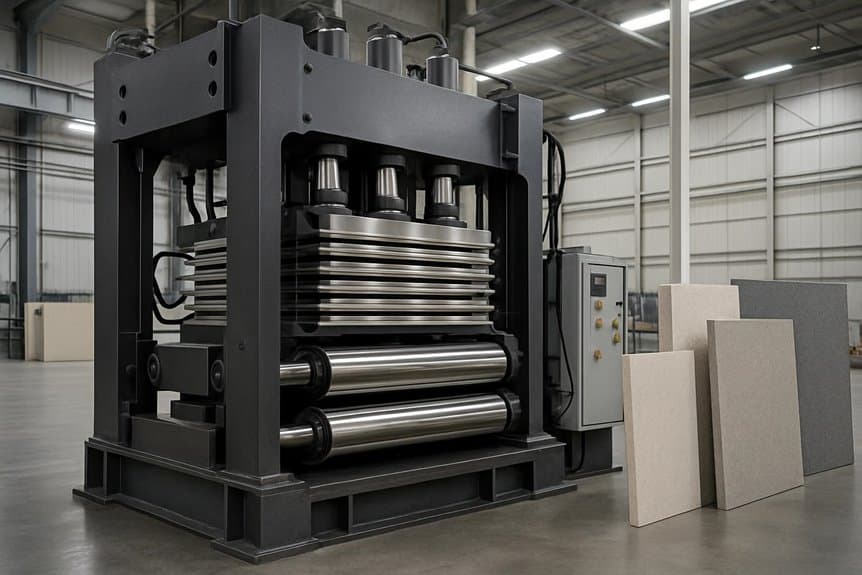
How much does a quartz slab press machine cost? The direct answer is that no single universal figure There is no single standard quartz slab press machine price because the final cost depends heavily on the machine configuration, slab size, pressing system, automation level, and what is included in the supplier’s quotation.
Online listings can vary significantly. Some low-priced offers may refer only to a basic press or partial configuration, while higher quotations may include a larger-format press, vacuum and vibration systems, PLC controls, supporting equipment, installation, commissioning, or even part of a complete quartz slab production line. This is why comparing headline prices alone can be misleading.
For buyers, the more useful question is:
What equipment and services are included in the quoted quartz slab press machine price?
A practical way to understand the difference is shown below:
| Quotation Type | What It May Include |
|---|---|
| Basic machine price | Main press only, with limited accessories |
| Pressing system price | Press, vacuum system, vibration system, controls, and related components |
| Integrated equipment package | Press plus loading, conveying, forming, or other supporting equipment |
| Production line package | Pressing system together with upstream and downstream quartz slab production equipment |
The price of a quartz slab press machine can therefore vary widely even when two suppliers appear to offer similar equipment. A press designed for larger slabs, higher automation, more advanced control, or a more complete system will generally require a higher investment than a basic configuration.
For this reason, buyers should avoid comparing quotations until the machine scope and technical specifications are aligned. The most accurate price can only be determined after confirming factors such as target slab size, thickness range, production capacity, automation requirements, and delivery scope.
For Sinone projects, the press configuration is typically matched to the customer’s actual slab specifications and production requirements rather than treated as a fixed-price standard machine.
Quartz slab press machine price is mainly determined by slab size and pressing area, vacuum-vibration configuration, output capacity, automation level, and component specifications.
Larger formats, higher tonnage, advanced control systems, and customized structures typically increase equipment cost but may reduce labor, downtime, and energy consumption.
Buyers should compare price against measurable production metrics such as slabs per hour, power usage, automation ratio, and maintenance requirements.
When slab output shifts from standard sizes to large-format or jumbo slabs, the required pressing area increases, directly raising the quartz slab press machine price through larger frame dimensions, higher tonnage capacity, stronger vibration systems, and expanded mold platforms.
Larger slab size also requires longer beams, wider tables, heavier hydraulic structures, and more precise alignment control to maintain uniform density across the surface.
For buyers comparing quartz slab press price levels, the usable pressing area is a primary cost variable because steel consumption, machining time, transport weight, and installation space all scale upward.
A quartz stone pressing machine price for jumbo production is thus higher than a standard model. A quartz press machine manufacturer typically prices equipment by output format, structural load, and mold compatibility, enabling controlled budgeting and capacity planning.
The pressing and vacuum-vibration configuration can significantly affect quartz slab press machine price because it determines the complexity of the press structure, vacuum system, vibration system, controls, and supporting components. Buyers should therefore compare the complete pressing configuration, not simply machine dimensions or advertised pressing force.
| Configuration Factor | How It Can Affect Price |
|---|---|
| Pressing system and force capacity | Larger or more complex force-transmission systems generally require a stronger frame and heavier-duty components |
| Vacuum system capacity | Larger chambers, higher-capacity pumps, improved sealing, and vacuum monitoring can increase equipment cost |
| Vibration system | Motor arrangement, vibration control, synchronization, and adjustability affect system complexity |
| Structural rigidity | Larger-format and higher-load presses require stronger machine structures to maintain stability during operation |
| Control system | PLC control, sensors, parameter adjustment, alarms, and production monitoring add to automation cost |
A simpler press typically uses a more basic combination of vacuum, vibration, and pressing controls, while higher-specification equipment may provide more precise parameter adjustment, stronger structural design, improved vacuum stability, and greater process automation.
These differences can increase the initial investment, but they may also improve pressing consistency, slab density, process repeatability, and production stability. When comparing a quartz press quotation, buyers should therefore confirm exactly which pressing, vacuum, vibration, and control systems are included rather than comparing price alone.
Capacity demand is a direct price multiplier because the required daily slab output determines press size, cycle speed, loading method, hydraulic recovery rate, vacuum evacuation time, and downstream synchronization.
A line targeting limited residential batches may justify a smaller press frame, moderate tonnage, and longer cycle allowance. A commercial-scale line with high slab counts requires higher clamping force, larger working tables, faster mold turnover, reinforced vibration structures, and greater vacuum capacity, all raising capital cost.
Buyers should calculate target slabs per shift, slab thickness mix, curing queue limits, and acceptable utilization rate before specifying equipment. Underestimating capacity creates bottlenecks; oversizing locks capital into unused output.
Price control comes from matching rated throughput to verified demand, not purchasing maximum capacity by default. Cycle time data should be contractually benchmarked.
Automation depth is a major price driver because it determines how much of the pressing cycle is managed manually, semi-automatically, or through integrated control architecture. A basic control system costs less upfront but requires more operator intervention for pressure setting, timing, vibration coordination, and fault monitoring.
PLC control raises the purchase price, yet improves repeatability, parameter storage, alarm handling, and production consistency across shifts. More integrated automation adds centralized interfaces, recipe management, data logging, synchronized process control, and remote diagnostics, increasing capital cost while reducing labor dependence and downtime risk.
For buyers seeking tighter control, the price premium is often evaluated against labor savings, yield stability, maintenance response time, and measurable efficiency gains, such as reported automation-driven labor reductions of up to 40% in comparable production environments.
Component selection can significantly affect quartz slab press machine price because the quality, capacity, and specification of each electrical, mechanical, pneumatic, and control component influence both the initial equipment cost and long-term operating reliability.
Buyers should compare not only component brands, but also load capacity, control accuracy, maintenance requirements, spare-parts availability, and compatibility with local service support.
For this reason, two quartz presses with similar overall dimensions may still have very different prices if their component specifications and customization scope are not equivalent.
The real value of a quartz press machine quotation depends on its scope, not just the headline price. Two suppliers may quote a similar amount while including very different equipment, controls, services, and commissioning support.
Before comparing offers, buyers should confirm exactly what is included in the quotation, especially the core pressing system, automation, and project-support items.
| Quotation Item | Typical Cost Impact | What Buyers Should Confirm |
|---|---|---|
| Main press + vacuum/vibration system | High | Machine model, slab size, capacity, pressing configuration |
| PLC/control cabinet | Medium | Component brand, automation level, interfaces, parameter control |
| Supporting equipment | Medium | Conveyors, loading/unloading, molds, transfer equipment |
| Spare parts | Low–Medium | Included parts list, recommended startup inventory, replacement availability |
| Installation & commissioning | Medium | Scope of work, engineer days, site responsibilities, acceptance criteria |
| Operator training | Low–Medium | Training content, duration, number of operators covered |
A complete quotation makes it easier to compare suppliers on a like-for-like basis and helps prevent additional costs appearing later. Buyers should therefore look beyond the initial machine price and evaluate the full package in terms of automation, installation scope, production readiness, service support, and long-term operating reliability.
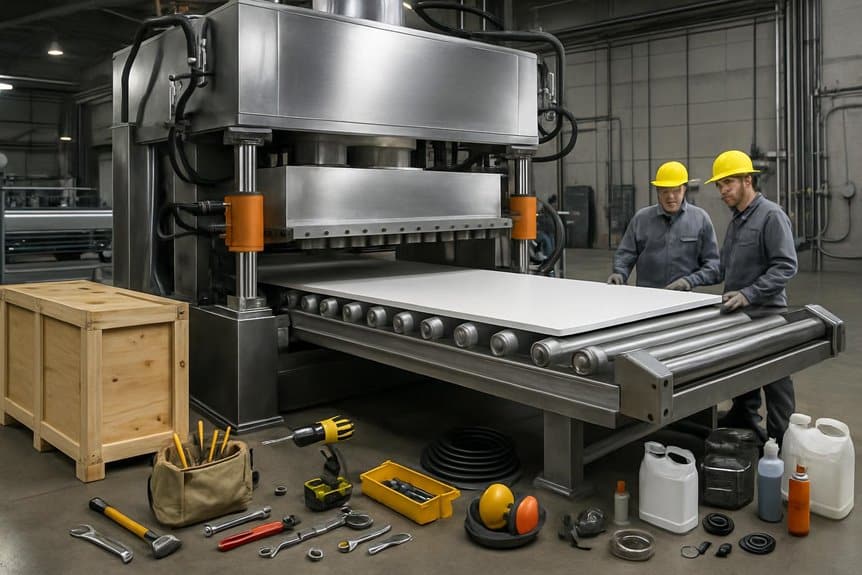
A quartz slab press machine budget should separate machine price, delivered cost, and installed cost, because the purchase price usually excludes several material expenses required to place the equipment into production.
Buyers should assign controlled allowances to logistics, site readiness, and startup tasks before approving capital expenditure.
These items convert a quoted machine price into a realistic cash requirement.
How should buyers compare quartz press machine prices without being misled by the lowest quotation? They should normalize each offer against the same technical and commercial scope.
Key checkpoints include maximum slab size, press configuration, vacuum and vibration system design, automation level, major component brands, and included auxiliary equipment.
Compare slab capacity, press design, vacuum-vibration system, automation, component brands, and auxiliary equipment before judging price.
Installation, commissioning, warranty length, spare parts availability, and after-sales response terms should also be assigned measurable value.
A quotation with a lower machine price may exclude equipment or service items that another supplier includes. It may also use smaller capacity, fewer automated functions, or lower-grade components.
A disciplined comparison table helps buyers convert each proposal into total functional cost, not just purchase price. The supplier offering stronger output stability and service coverage may deliver better controlled long-term cost.
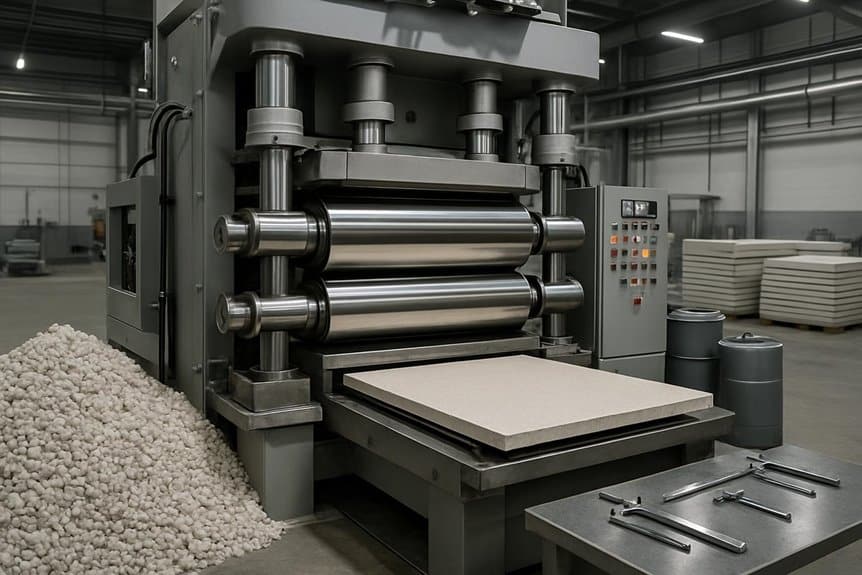
An accurate quartz press price depends on the machine configuration required for your actual production conditions. Slab format, output target, automation level, and installation scope can all change the press specification and final quotation.
Before requesting a quote, buyers should provide the following information:
With these details, the supplier can prepare a more accurate machine configuration and clearly define what is included in the quotation, such as auxiliary equipment, spare parts, installation, commissioning, and service support.
SINONE can evaluate your slab size, capacity, automation, and project requirements to provide a configuration-specific quartz press quotation.
The price of a quartz slab press machine varies significantly depending on slab size, pressing configuration, vacuum and vibration systems, automation level, component specification, and the scope included in the quotation. Buyers should compare equivalent configurations rather than relying only on advertised machine prices.
Quartz press prices vary because different machines may support different slab dimensions, production capacities, automation levels, and pressing technologies. Some quotations include only the main press, while others may also include vacuum systems, controls, supporting equipment, installation, commissioning, or training.
Generally, yes. A jumbo quartz press usually requires a larger pressing area, stronger machine structure, a larger vacuum chamber, wider vibration coverage, and compatible slab-handling equipment. These additional engineering requirements normally increase the equipment cost compared with a standard-size press.
A clear quotation should state what is included in the price, such as the main press, vacuum system, vibration system, PLC controls, supporting equipment, spare parts, installation, commissioning, training, warranty, and technical support. Freight, customs charges, and local installation costs should also be clearly identified as included or excluded.
30% electricity reduction is reported by clients. After purchase, buyers receive installation guidance, commissioning, operator training, maintenance support, spare-parts coordination, and rapid technical response, helping control downtime, lifecycle costs, and press machine performance stability.