The quartz slab manufacturing process turns graded quartz aggregates, quartz powder, resin, pigments, and additives into durable engineered stone slabs. The process begins with accurate weighing, batching, and mixing to create a uniform material compound. This mixture is then distributed into molds, compacted through vacuum vibration pressing, and cured under controlled heat to develop slab strength, density, and stability.
After curing, the slabs are cooled, calibrated, polished, cut, inspected, and protected for storage or further fabrication. Each stage plays an important role in controlling surface quality, thickness accuracy, color consistency, defect reduction, and long-term durability. The following sections explain how each step works inside a complete quartz slab production process.
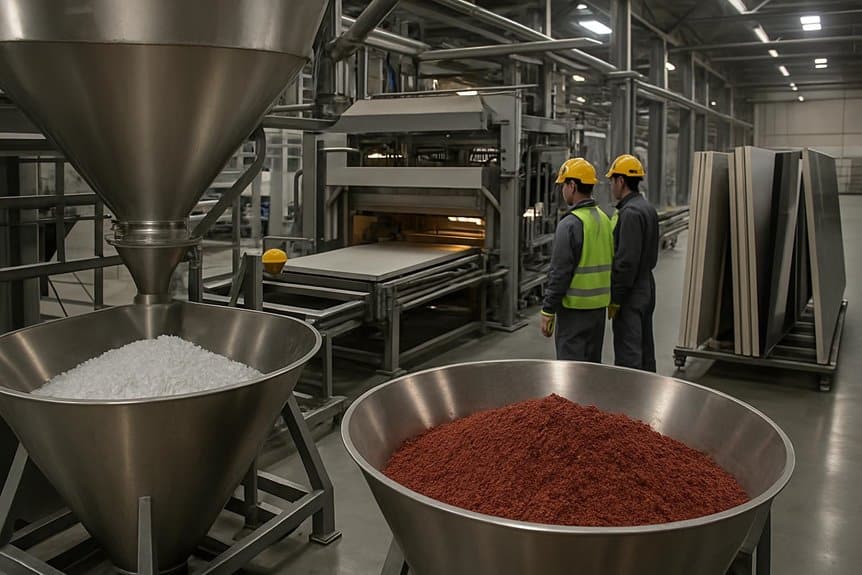
Quartz slab manufacturing is a controlled engineered-stone process that transforms natural quartz into durable, uniform slabs for countertops and other surfaces.
In the quartz slab manufacturing process, calibrated quartz sand, quartz powder, resin, pigments, and additives are combined through a regulated mixing system to produce a consistent compound. The material is then distributed into molds, compacted by pressing, cured under controlled conditions, polished to specification, cut to size, and verified before release.
As an engineered quartz manufacturing process, each stage is designed to control density, color uniformity, surface finish, and dimensional accuracy.
In the quartz countertop manufacturing process, quality inspection confirms slab integrity, visual consistency, and compliance with production standards, giving manufacturers predictable output and fabricators reliable material for downstream cutting, edging, and installation work.
Raw material consistency determines how predictably quartz slabs perform through mixing, pressing, curing, and finishing.
Quartz sand and powder, resin binders, pigments, curing agents, coupling agents, and additives must meet controlled specifications for particle size, purity, color, and reactivity.
Variations in these inputs can affect slab density, bonding strength, surface appearance, and final quality.
Consistency is the control point that determines whether a quartz slab production line can deliver stable color, density, strength, and surface quality. In the quartz stone manufacturing process, stable raw materials keep resin absorption, pigment response, and particle packing within controlled limits.
For production line buyers, this stability directly protects yield and repeatability across the quartz slab production process.
Material consistency consequently becomes a purchasing, inspection, and process-control priority.
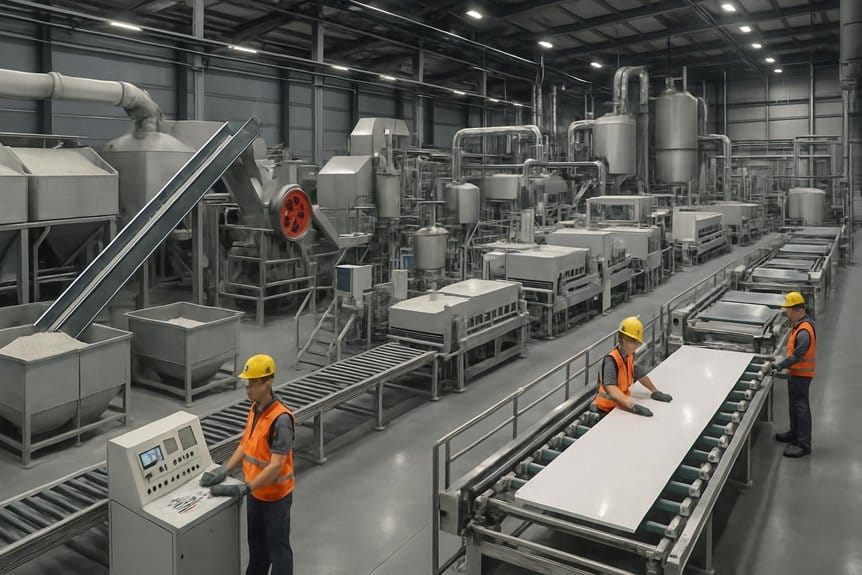
The quartz slab manufacturing process begins with accurate material preparation. Before the slab is formed, quartz aggregates, quartz powder, polyester resin, pigments, curing agents, and other additives must be measured according to a controlled formula. In a modern quartz stone production line, this is usually handled by automated weighing and batching systems to reduce human error and maintain consistency across production batches.
Accurate batching is important because even small variations in raw material ratios can affect slab density, color stability, curing performance, and surface quality. Once the materials are weighed, they are sent to the mixing system, where quartz particles are evenly coated with resin and pigments are dispersed throughout the mixture.
| Control Point | Process Focus | Quality Impact |
|---|---|---|
| Weighing | Accurate material dosage | Consistent formula from batch to batch |
| Batching | Stable material ratios | Better density and curing control |
| Mixing | Even resin coating and pigment dispersion | Uniform color, texture, and slab structure |
During this stage, operators may monitor resin viscosity, raw material moisture, pigment strength, mixing time, and material temperature before the mixture moves to slab forming. Proper mixing is not simply about combining ingredients. It directly affects veining clarity, color consistency, compaction behavior, and the quality of the later pressing stage.
When weighing, batching, and mixing are well controlled, the production line can achieve a more stable slab appearance, fewer internal defects, and a more predictable finished product.
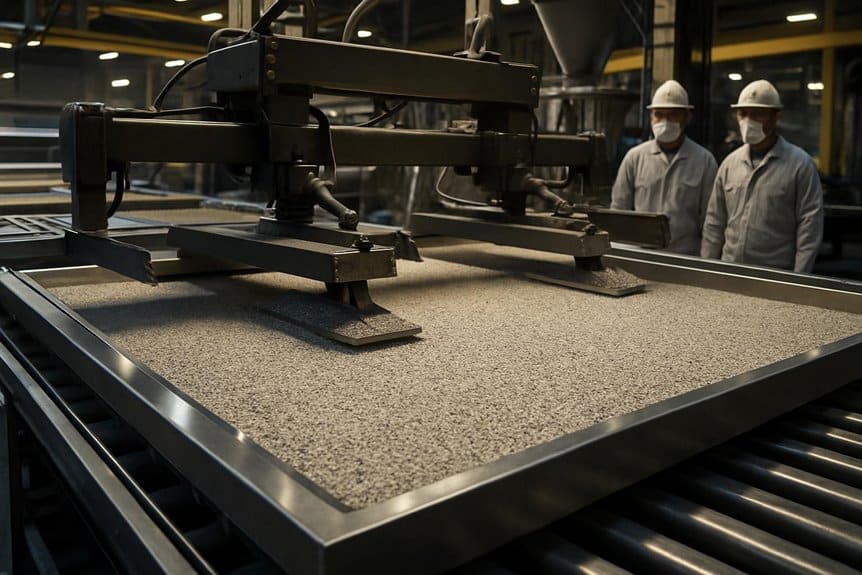
After mixing, the quartz compound is transferred into the mold or forming area. At this stage, the material must be distributed evenly across the full slab surface before pressing begins. Proper material distribution helps control slab thickness, density, surface consistency, and pattern accuracy.
The mixed material is spread at a controlled feed rate so quartz aggregates, powder, resin, pigments, and additives form a uniform layer. If the material is unevenly distributed, some areas may become too dense while others may contain gaps, weak spots, or inconsistent resin coverage.
In a quartz slab production line, the forming stage usually involves:
This step is especially important for slabs with marble-look veins, multi-color patterns, or large-format designs. Accurate material distribution ensures the slab is properly prepared for vacuum vibration pressing, where the material will be compacted into a dense and stable engineered stone structure.
Vacuum vibration pressing is one of the most important stages in the quartz slab manufacturing process. At this point, the mixed quartz-resin material is compacted into a dense slab under controlled vacuum, vibration, and pressure.
The purpose of this stage is to remove trapped air, improve material consolidation, and ensure the quartz particles and resin are evenly bonded across the slab. When pressing is properly controlled, the slab becomes denser, flatter, and more stable before entering the curing stage.
Poor pressing can lead to hidden defects that may only become visible later during polishing, cutting, or final inspection. These defects may include bubbles, pinholes, weak internal areas, uneven density, or surface irregularities.
Pressing quality directly influences the physical performance and commercial value of the finished quartz slab. A stable pressing process helps manufacturers achieve:
For quartz slab manufacturers, pressing is not only a forming step. It is a key quality-control point that affects production stability, material strength, and final product consistency.
To achieve reliable results, the pressure level, vibration frequency, vacuum performance, and pressing time must match the mix design, slab thickness, and target product specification. When these parameters are well controlled, the production line can produce quartz slabs with more consistent quality and fewer downstream defects.
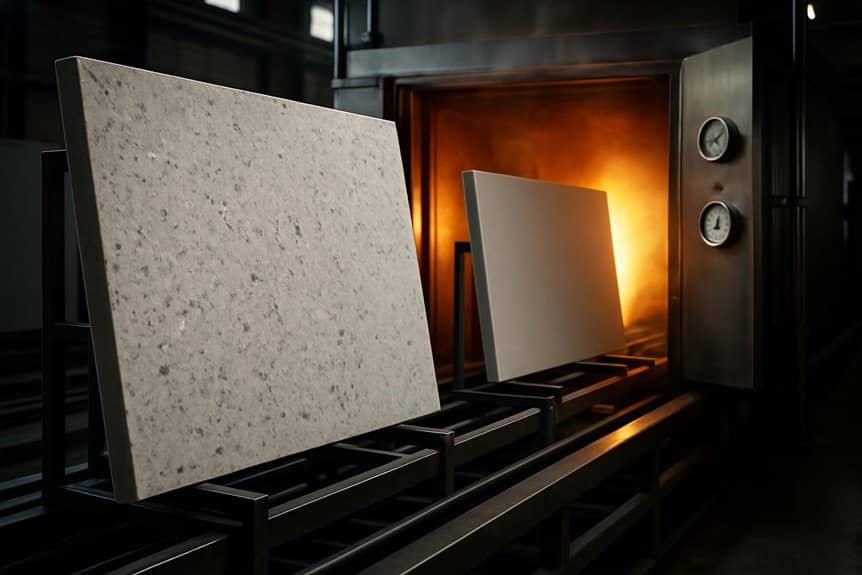
After pressing, each quartz slab enters a controlled curing stage. During this stage, heat and time are carefully managed to harden the resin binder and develop stable mechanical strength.
The compacted slab is transferred into a curing oven, where the curing temperature is kept within defined process limits. Stable heat distribution allows the quartz-resin matrix to set evenly, helping improve bond integrity, slab strength, and dimensional stability.
Curing time depends on factors such as slab thickness, resin formulation, and production requirements. If the curing cycle is too short, uneven, or poorly controlled, the slab may develop inconsistent strength, unstable bonding, or quality problems during later processing.
After curing, the slab moves into a controlled cooling stage. Proper cooling helps the slab stabilize before calibration, polishing, and cutting. It also helps reduce internal stress, support flatness, and improve downstream handling reliability.
For quartz slab manufacturers, curing and cooling are not passive steps. They are important process-control stages that affect finished slab strength, flatness, consistency, and long-term performance. When curing temperature, curing time, and cooling conditions are properly managed, the production line can achieve more repeatable quartz slab quality.
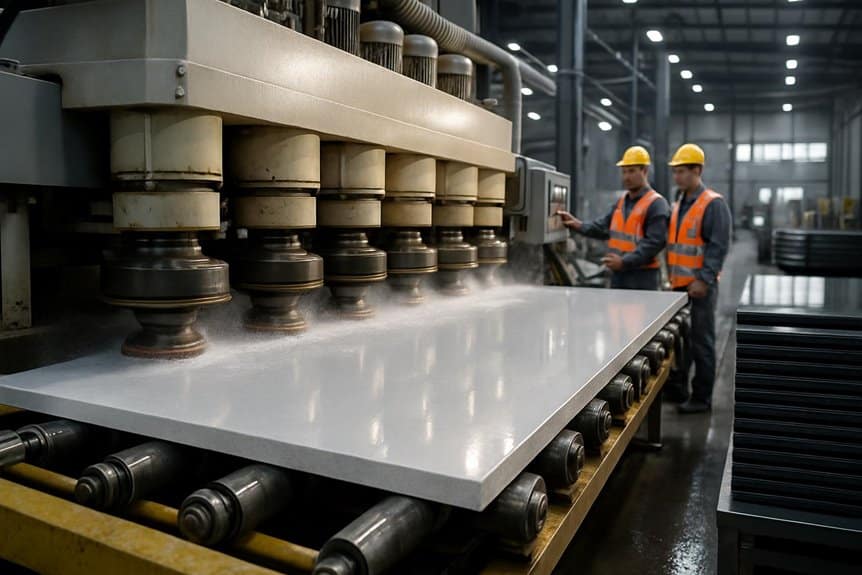
After curing, the quartz slab enters the calibration and polishing stage. This step brings the slab to its required thickness, flatness, and surface finish before cutting, inspection, and final handling.
Calibration is used to control slab thickness across the full surface. It removes uneven areas and helps ensure the slab meets the required dimensional tolerance. This is important because thickness variation can affect later cutting, fabrication, installation, and product consistency.
After calibration, the slab surface is refined through grinding and polishing. Surface grinding removes high points, resin film, and minor curing irregularities. The polishing line then uses progressively finer abrasives to create the required surface smoothness and visual finish.
Depending on the product requirement, the surface can be finished as matte, honed, semi-gloss, or high gloss. Stable polishing helps achieve consistent reflectivity, smooth touch, and uniform appearance across the slab.
A well-controlled finishing process helps manufacturers achieve:
Polishing is therefore both functional and aesthetic. It not only improves the appearance of the quartz slab; it also helps confirm dimensional quality and prepares the slab for final cutting, inspection, protection film application, and storage.nces.
Trimmed to specification, the finished quartz slab moves from surface finishing into dimensional cutting, final verification, and controlled handling. A calibrated cutting machine sizes the slab to the required length and width, removing irregular edges and aligning it with production tolerances.
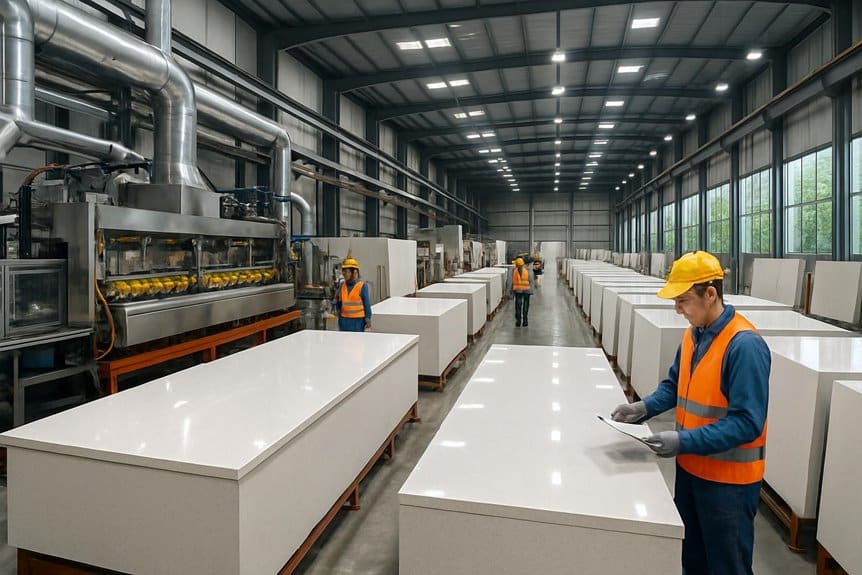
Quality control remains active during this stage, not isolated at the end. Operators conduct visual inspection under controlled lighting to identify color variation, edge damage, cracks, pinholes, resin marks, or surface contamination.
Thickness and surface checks confirm flatness, gauge consistency, polish uniformity, and finish conformity. Structured defect detection determines whether the slab can proceed, requires rework, or be rejected.
Approved slabs receive film protection to reduce abrasion during movement. Final inspection confirms commercial requirements before storage and handling systems position slabs safely for shipment or fabrication.
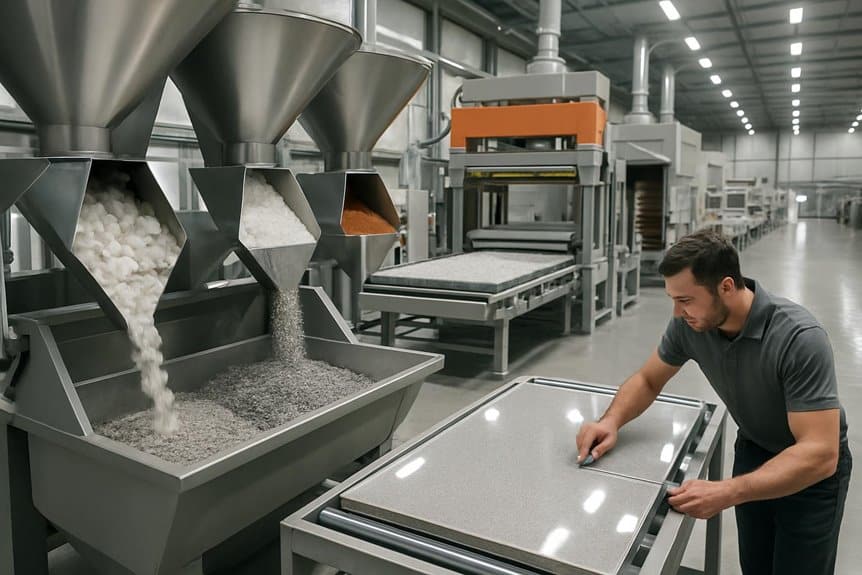
Finished quartz slab quality depends on the stability of the entire manufacturing sequence, not on a single press, polisher, or inspection station. In how quartz slabs are made, each controlled variable influences the next step, making the quartz stone production process a chain of measurable tolerances.
When control points remain stable, finished slabs show fewer variations, lower rejection rates, and more predictable performance.
Understanding the quartz slab manufacturing process gives buyers a clearer basis for planning a complete production line, because each quality control point corresponds to specific equipment requirements.
Material preparation determines whether quartz sand, quartz powder, resin, and pigments require separate storage, screening, weighing, and a controlled batching system. Mixing accuracy then affects distribution, mold filling, and slab consistency.
Production targets also influence configuration. A quartz stone production line may include raw material systems, mixers, distribution systems, vacuum vibration pressing equipment, curing systems, calibration and polishing lines, cutting systems, and environmental treatment systems.
Each section should match slab size, output capacity, recipe flexibility, surface finish, and defect-control requirements. With process knowledge, buyers can compare equipment layouts by function, sequence, stability, and quality control rather than by isolated machine specifications.
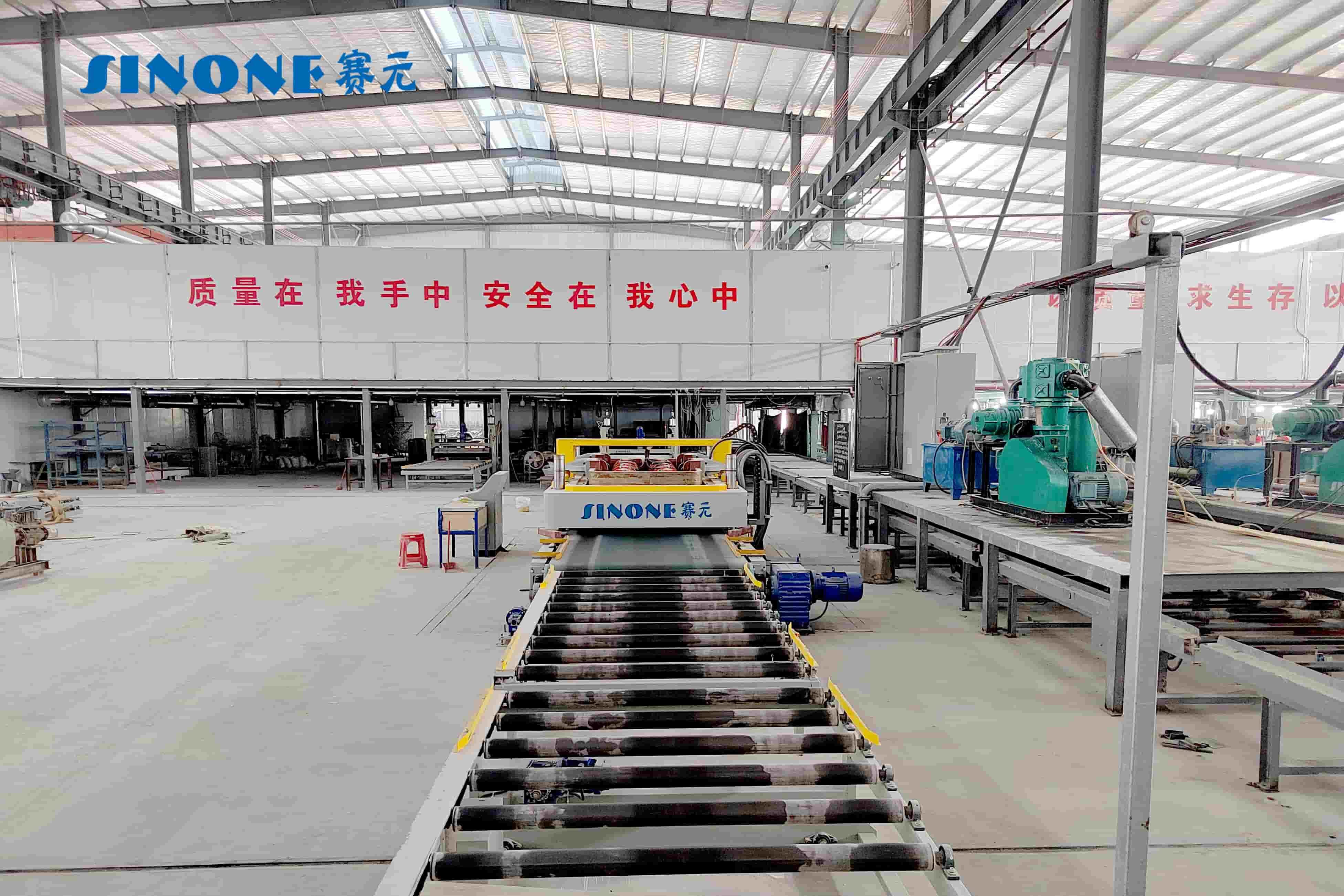
A reliable quartz slab production process depends on stable process control, not only on individual machines. From batching, mixing, pressing, and curing to calibrating, polishing, cutting, and inspection, each stage must work smoothly with the next. When the process is not well planned, factories may face problems such as color variation, bubbles, uneven density, surface defects, high waste rate, and unstable slab quality.
SINONE is a quartz stone production line manufacturer focused on complete production systems for artificial quartz slab manufacturing. We support customers with process planning, equipment configuration, installation, commissioning, training, and after-sales service, based on their target slab size, production capacity, factory conditions, and automation requirements.
For buyers planning a new quartz slab factory or upgrading an existing line, the key is to choose a process solution that can support consistent quality, efficient production, and long-term operation.
Planning to build or improve a quartz slab production line? Contact SINONE to discuss your production process, capacity requirements, and suitable equipment configuration.
A quartz slab typically lasts 20–30 years, often longer when properly specified, installed, and maintained. Its service life depends on resin quality, fabrication accuracy, structural support, heat control, cleaning practices, and avoidance of impact damage.
Yes—though 90–95% quartz content provides strength, outdoor use requires UV-rated resin systems. Standard slabs may fade, yellow, or warp. He should specify exterior-grade quartz, verify manufacturer warranties, and control installation exposure conditions.
Yes. Quartz slabs are generally safe for food preparation, since their resin-bound, nonporous surface resists bacterial growth, staining, and moisture absorption better than many porous natural stones. For added assurance, buyers can check whether the material is tested to NSF/ANSI 51, the food-contact materials standard, and should stick to mild soap for daily cleaning rather than harsh chemicals that can degrade the resin over time.
Soft swipes should start daily cleaning: one wipes quartz slabs with warm water, mild soap, and a nonabrasive cloth. Spills should be removed promptly; harsh chemicals, scouring pads, and heat exposure should be strictly avoided.
Quartz slabs typically cost $60 to $100+ per square foot installed, depending on grade, color, thickness, edge profile, and fabrication complexity. Buyers should verify specifications, warranties, installer qualifications, and total project scope before approval.

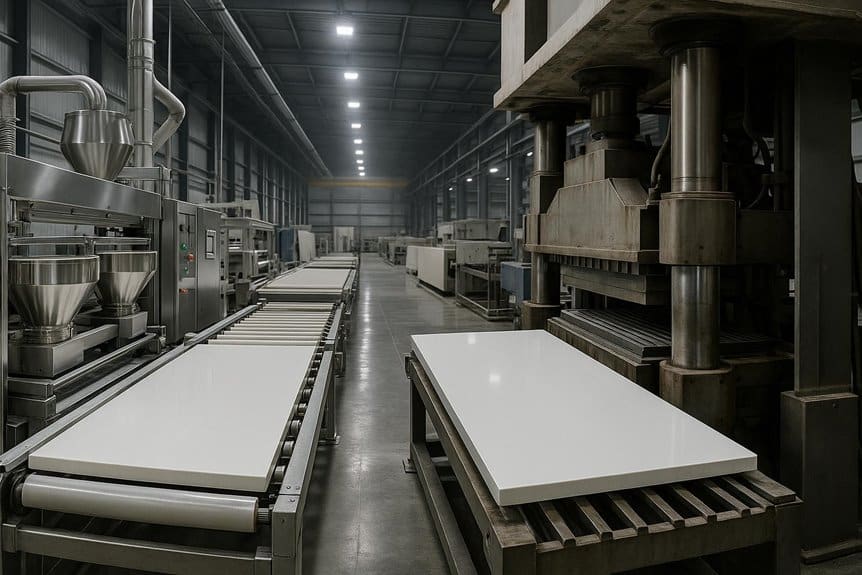
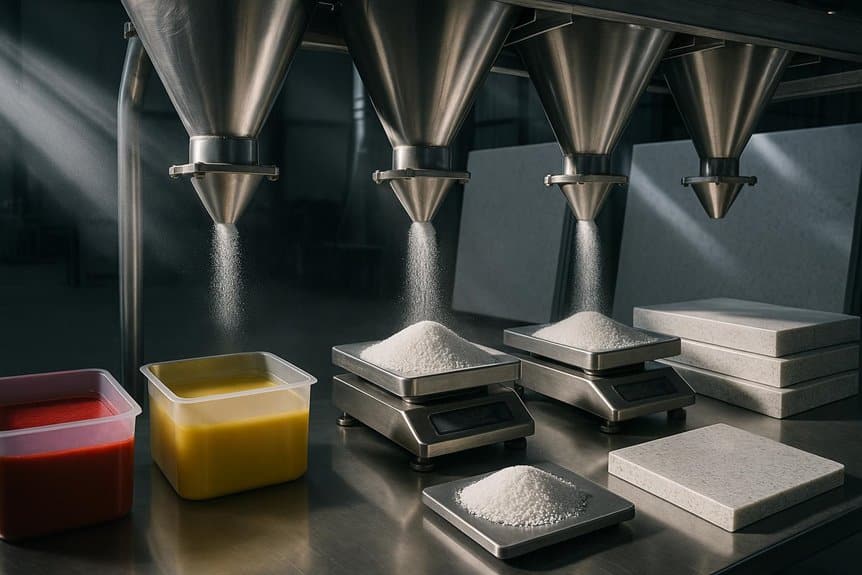

[…] from raw material preparation through pressing, curing, polishing, and final inspection, see our quartz slab manufacturing process […]
[…] color variation is often blamed on pigment instability, batch-to-batch inconsistency in quartz slab manufacturing is usually a broader production-control problem involving raw materials, batching accuracy, mixer […]
[…] agents, and other selected additives according to controlled recipe parameters. Within the broader quartz slab manufacturing process, its role sits between raw material storage and […]